Programme in Health Services & Systems Research, Duke-NUS Medical School, Singapore, Singapore.
Lien Centre for Palliative Care, Duke-NUS Medical School, Singapore, Singapore.
PLoS One. 2021 Oct 22;16(10):e0258866. doi: 10.1371/journal.pone.0258866. eCollection 2021.
The long-term stress, anxiety and job burnout experienced by healthcare workers (HCWs) are important to consider as the novel coronavirus disease (COVID-19) pandemic stresses healthcare systems globally. The primary objective was to examine the changes in the proportion of HCWs reporting stress, anxiety, and job burnout over six months during the peak of the pandemic in Singapore. The secondary objective was to examine the extent that objective job characteristics, HCW-perceived job factors, and HCW personal resources were associated with stress, anxiety, and job burnout.
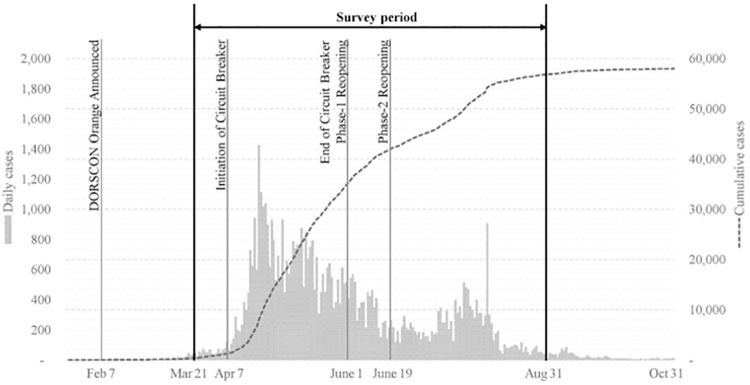
A sample of HCWs (doctors, nurses, allied health professionals, administrative and operations staff; N = 2744) was recruited via invitation to participate in an online survey from four tertiary hospitals. Data were gathered between March-August 2020, which included a 2-month lockdown period. HCWs completed monthly web-based self-reported assessments of stress (Perceived Stress Scale-4), anxiety (Generalized Anxiety Disorder-7), and job burnout (Physician Work Life Scale).
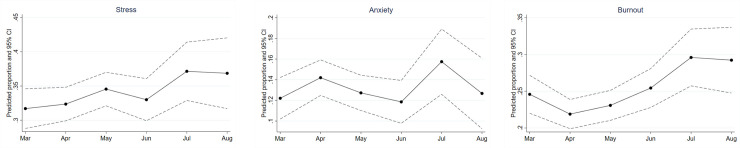
The majority of the sample consisted of female HCWs (81%) and nurses (60%). Using random-intercept logistic regression models, elevated perceived stress, anxiety and job burnout were reported by 33%, 13%, and 24% of the overall sample at baseline respectively. The proportion of HCWs reporting stress and job burnout increased by approximately 1·0% and 1·2% respectively per month. Anxiety did not significantly increase. Working long hours was associated with higher odds, while teamwork and feeling appreciated at work were associated with lower odds, of stress, anxiety, and job burnout.
Perceived stress and job burnout showed a mild increase over six months, even after exiting the lockdown. Teamwork and feeling appreciated at work were protective and are targets for developing organizational interventions to mitigate expected poor outcomes among frontline HCWs.
新型冠状病毒病(COVID-19)大流行给全球医疗系统带来压力,长期以来医护人员(HCWs)所经历的压力、焦虑和工作倦怠是需要考虑的重要因素。主要目的是在新加坡 COVID-19 大流行高峰期的六个月内,检查报告压力、焦虑和工作倦怠的 HCWs 比例的变化。次要目的是检查客观工作特征、HCW 感知工作因素和 HCW 个人资源与压力、焦虑和工作倦怠的关联程度。
通过邀请四家三级医院的 HCWs(医生、护士、辅助卫生专业人员、行政和运营人员;N=2744)参与在线调查,招募了一个 HCWs 样本。数据收集于 2020 年 3 月至 8 月之间,其中包括两个月的封锁期。HCWs 每月通过基于网络的自我报告评估来完成压力(感知压力量表-4)、焦虑(广泛性焦虑症-7)和工作倦怠(医师工作生活量表)的评估。
样本中的大多数 HCWs 为女性(81%)和护士(60%)。使用随机截距逻辑回归模型,基线时总体样本中分别有 33%、13%和 24%的 HCWs 报告存在较高的感知压力、焦虑和工作倦怠。每月报告压力和工作倦怠的 HCWs 比例分别增加约 1.0%和 1.2%。焦虑没有显著增加。工作时间长与更高的几率相关,而团队合作和工作中被欣赏与更低的几率相关,与压力、焦虑和工作倦怠相关。
即使在解除封锁后,六个月内感知压力和工作倦怠仍呈轻度增加。团队合作和工作中被欣赏具有保护作用,是制定组织干预措施的目标,以减轻一线 HCWs 预期的不良后果。