Yeste Natalia, Gómez Néstor, Vázquez-Gómez Marta, García-Contreras Consolación, Pumarola Martí, González-Bulnes Antonio, Bassols Anna
Departament de Bioquímica i Biologia Molecular, Facultat de Veterinària, Universitat Autònoma de Barcelona, Cerdanyola del Vallès, 08193 Barcelona, Spain.
Faculty of Veterinary Sciences, UCM, Ciudad Universitaria s/n, 28040 Madrid, Spain.
Antioxidants (Basel). 2021 Sep 22;10(10):1505. doi: 10.3390/antiox10101505.
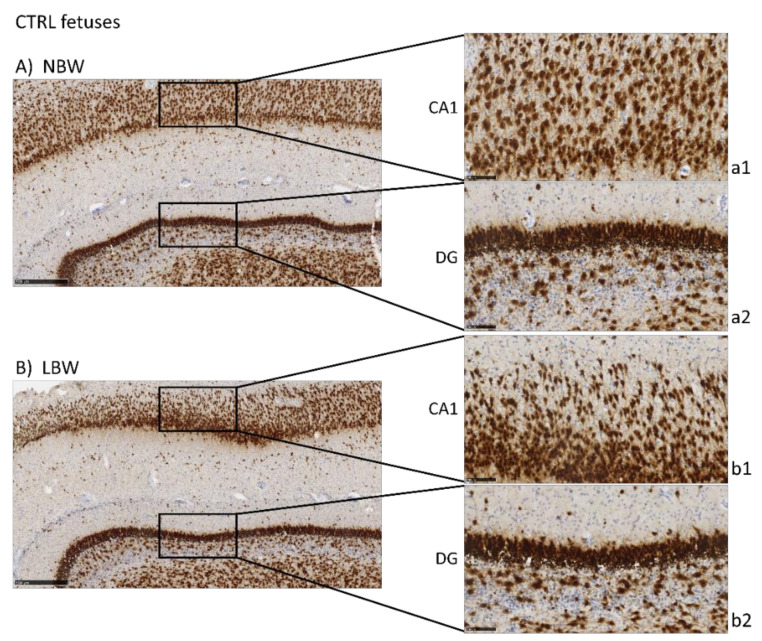
Intrauterine growth restriction (IUGR) refers to poor growth of a fetus during pregnancy due to deficient maternal nutrition or oxygen supply. Supplementation of a mother's diet with antioxidants, such as hydroxytyrosol (HTX), has been proposed to ameliorate the adverse phenotypes of IUGR. In the present study, sows were treated daily with or without 1.5 mg of HTX per kilogram of feed from day 35 of pregnancy (at 30% of the total gestational period), and fetuses were sampled at day 100 of gestation. Fetuses were classified as normal body weight (NBW) or low body weight (LBW) as a consequence of IUGR, constituting four groups: NBW-Control, NBW-HTX, LBW-Control, and LBW-HTX. The brain was removed, and the hippocampus, amygdala, and prefrontal cortex were rapidly dissected. Neuronal markers were studied by immunohistochemistry, and a decrease in the number of mature neurons in the hippocampal subfield 1 (CA1) and the (DG) regions was observed in LBW fetuses together with a higher number of immature neurons and other alterations in neuronal morphology. Furthermore, IUGR conditions altered the neurotransmitter (NT) profile, since an increase in the serotonin (5-HT) pathway was observed in LBW fetuses. Supplementation with HTX was able to reverse the morphological and neurochemical changes, leading both characteristics to values similar to those of NBW fetuses.
宫内生长受限(IUGR)是指由于母体营养或氧气供应不足,胎儿在孕期生长不佳。有人提出在母亲饮食中补充抗氧化剂,如羟基酪醇(HTX),以改善IUGR的不良表型。在本研究中,从妊娠第35天(占妊娠期的30%)开始,母猪每天接受每千克饲料含1.5毫克HTX或不含HTX的处理,并在妊娠第100天采集胎儿样本。根据IUGR的结果,将胎儿分为正常体重(NBW)或低体重(LBW),共构成四组:NBW-对照组、NBW-HTX组、LBW-对照组和LBW-HTX组。取出大脑,迅速解剖海马体、杏仁核和前额叶皮层。通过免疫组织化学研究神经元标记物,发现LBW胎儿海马体1区(CA1)和齿状回(DG)区域成熟神经元数量减少,同时未成熟神经元数量增加,且神经元形态出现其他改变。此外,IUGR情况改变了神经递质(NT)谱,因为在LBW胎儿中观察到血清素(5-HT)途径增加。补充HTX能够逆转形态和神经化学变化,使这两个特征的值与NBW胎儿相似。