Saccaro Luigi F, Schilliger Zoé, Perroud Nader, Piguet Camille
Clinical Neuroscience Department, Geneva University Hospital, 1205 Geneva, Switzerland.
Center for Psychiatric Neuroscience, Department of Psychiatry, Centre Hospitalier Universitaire Vaudois and University of Lausanne (CHUV-UNIL), 1008 Prilly-Lausanne, Switzerland.
Biomedicines. 2021 Sep 24;9(10):1313. doi: 10.3390/biomedicines9101313.
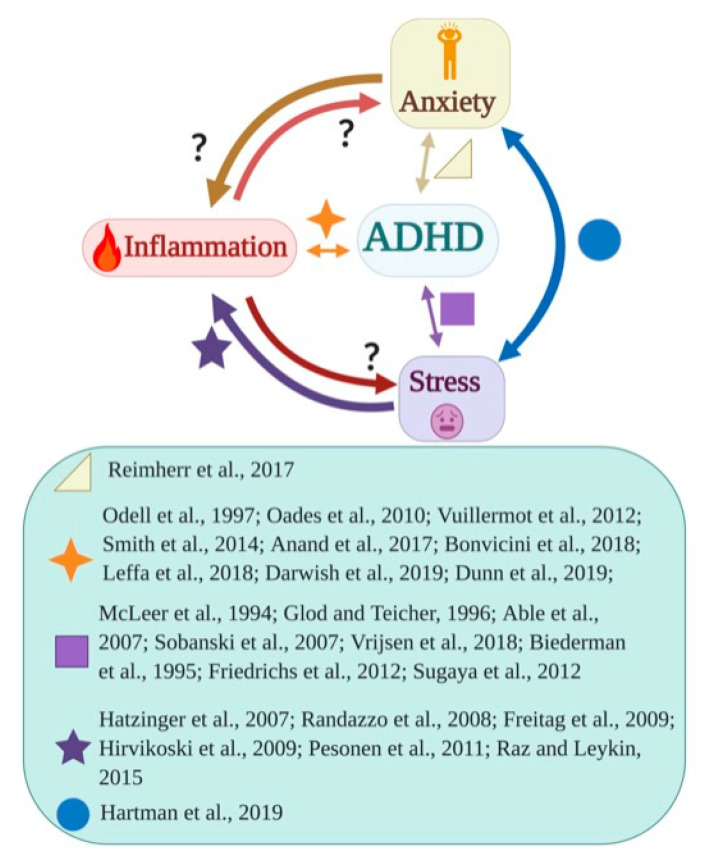
Attention-deficit/hyperactivity disorder (ADHD) is a prevalent and serious neurodevelopmental disorder characterized by symptoms of inattention and/or hyperactivity/impulsivity. Chronic and childhood stress is involved in ADHD development, and ADHD is highly comorbid with anxiety. Similarly, inflammatory diseases and a pro-inflammatory state have been associated with ADHD. However, while several works have studied the relationship between peripheral inflammation and stress in affective disorders such as depression or bipolar disorder, fewer have explored this association in ADHD. In this narrative review we synthetize evidence showing an interplay between stress, anxiety, and immune dysregulation in ADHD, and we discuss the implications of a potential disrupted neuroendocrine stress response in ADHD. Moreover, we highlight confounding factors and limitations of existing studies on this topic and critically debate multidirectional hypotheses that either suggest inflammation, stress, or anxiety as a cause in ADHD pathophysiology or inflammation as a consequence of this disease. Untangling these relationships will have diagnostic, therapeutic and prognostic implications for ADHD patients.
注意力缺陷多动障碍(ADHD)是一种常见且严重的神经发育障碍,其特征为注意力不集中和/或多动/冲动症状。慢性应激和童年期应激与ADHD的发展有关,且ADHD与焦虑症高度共病。同样,炎症性疾病和促炎状态也与ADHD有关。然而,虽然有几项研究探讨了外周炎症与抑郁症或双相情感障碍等情感障碍中应激之间的关系,但在ADHD中探讨这种关联的研究较少。在这篇叙述性综述中,我们综合了证据,表明应激、焦虑和免疫失调在ADHD中相互作用,并讨论了ADHD中潜在的神经内分泌应激反应紊乱的影响。此外,我们强调了现有关于该主题研究的混杂因素和局限性,并对多向性假设进行了批判性辩论,这些假设要么认为炎症、应激或焦虑是ADHD病理生理学的原因,要么认为炎症是该疾病的结果。理清这些关系将对ADHD患者产生诊断、治疗和预后方面的影响。