Schnebelen-Berthier Coralie, Acar Niyazi, Simon Emilie, Thabuis Clémentine, Bourdillon Anne, Mathiaud Adeline, Dauchet Luc, Delcourt Cécile, Benlian Pascale, Crochet Martine, Defoort Sabine, Tailleux Anne, Staels Bart, Bretillon Lionel, Lecerf Jean-Michel
Service Nutrition & Activité Physique, Institut Pasteur de Lille, F-59019 Lille, France.
Centre des Sciences du Goût et de l'Alimentation, Agrosup Dijon, CNRS, INRA, Université Bourgogne Franche-Comté, F-21000 Dijon, France.
Nutrients. 2021 Sep 24;13(10):3347. doi: 10.3390/nu13103347.
Carotenoids and docosahexaenoic acid (DHA) were identified as essential components for eye health and are both naturally present in eggs.
We aimed to evaluate the effect of the daily consumption of two eggs enriched with lutein/zeaxanthin and DHA on macular pigment optical density (MPOD) and on circulating xanthophyll and fatty acid concentrations in healthy participants.
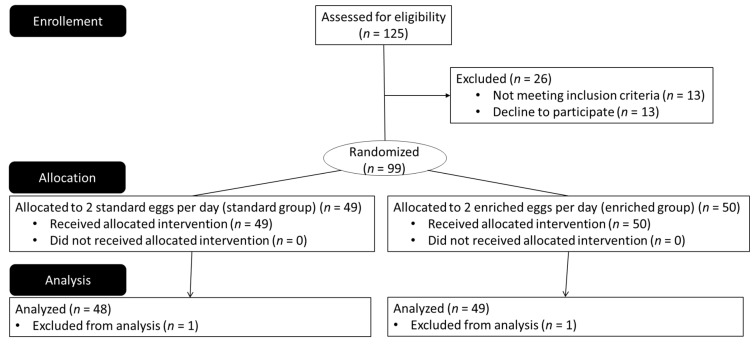
Ninety-nine healthy volunteers consumed either two standard eggs or two enriched eggs per day for 4 months. MPOD was measured at baseline (V0) and at follow-up (V4) using a modified confocal scanning laser ophthalmoscope (primary outcome). Blood samples were collected to determine total plasma and lipoprotein fatty acids and lutein/zeaxanthin compositions at V0 and V4 (secondary outcomes).
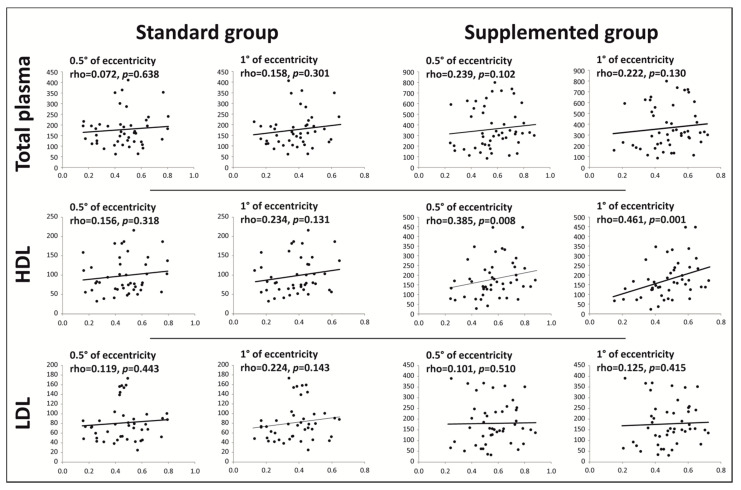
A slight but significant increase in MPOD was observed for all study participants consuming two eggs per day for 4 months at all eccentricities (0.5°, 1°, 2°, and 4°). Plasma and lipoprotein lutein, zeaxanthin, and DHA concentrations significantly increased in both groups but were greater in the enriched group (for the enriched group (V0 vs. V4): lutein, 167 vs. 369 ng/mL; zeaxanthin, 17.7 vs. 29.2 ng/mL; DHA, 1.89 vs. 2.56% of total fatty acids). Interestingly, lutein from high-density lipoprotein (HDL) was strongly correlated with MPOD at 0.5 and 1° eccentricities (rho = 0.385, = 0.008, and rho = 0.461, = 0.001, respectively).
MPOD was slightly increased in both groups. Lutein, zeaxanthin, and DHA plasma concentrations were strongly enhanced in the enriched group compared with the standard group. A significant correlation was found between MPOD level and lutein concentration in HDL.
类胡萝卜素和二十二碳六烯酸(DHA)被认为是对眼睛健康至关重要的成分,且二者均天然存在于鸡蛋中。
我们旨在评估每日食用两个富含叶黄素/玉米黄质和DHA的鸡蛋对健康参与者黄斑色素光密度(MPOD)以及循环中叶黄素和脂肪酸浓度的影响。
99名健康志愿者每天食用两个标准鸡蛋或两个强化鸡蛋,持续4个月。使用改良的共焦扫描激光检眼镜在基线(V0)和随访时(V4)测量MPOD(主要结局)。在V0和V4采集血样以测定总血浆和脂蛋白脂肪酸以及叶黄素/玉米黄质组成(次要结局)。
所有每天食用两个鸡蛋、持续4个月的研究参与者在所有偏心率(0.5°、1°、2°和4°)下的MPOD均有轻微但显著的增加。两组的血浆和脂蛋白叶黄素、玉米黄质和DHA浓度均显著增加,但强化组增加幅度更大(强化组(V0与V4):叶黄素,167对369 ng/mL;玉米黄质,17.7对29.2 ng/mL;DHA,占总脂肪酸的1.89%对2.56%)。有趣的是,高密度脂蛋白(HDL)中的叶黄素在偏心率为0.5°和1°时与MPOD密切相关(相关系数分别为rho = 0.385,P = 0.008,以及rho = 0.461,P = 0.001)。
两组的MPOD均有轻微增加。与标准组相比,强化组的叶黄素、玉米黄质和DHA血浆浓度显著升高。发现MPOD水平与HDL中叶黄素浓度之间存在显著相关性。