Otorhinolaryngology Hospital, The First Affiliated Hospital, Sun Yat-sen University, Guangzhou, China.
Front Immunol. 2021 Oct 8;12:710372. doi: 10.3389/fimmu.2021.710372. eCollection 2021.
Allergic rhinitis (AR) is characterized by IgE-mediated mucosa response after exposure to allergens. Extracellular vesicles (EVs) are nano-size vesicles containing biological cargos for intercellular communications. However, the role of plasma EVs in pathogenesis of AR remains largely unknown.
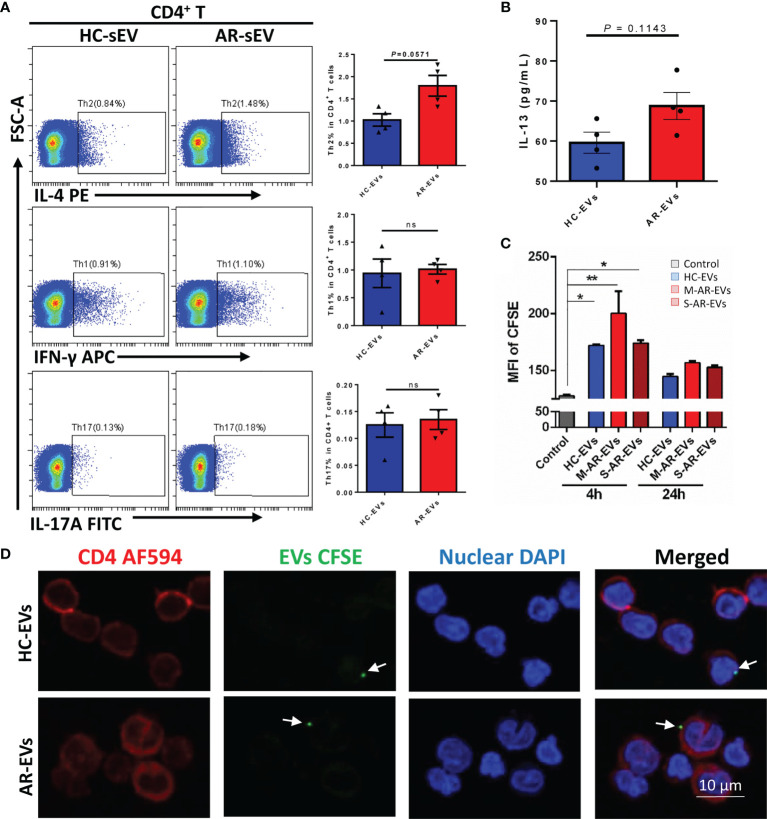
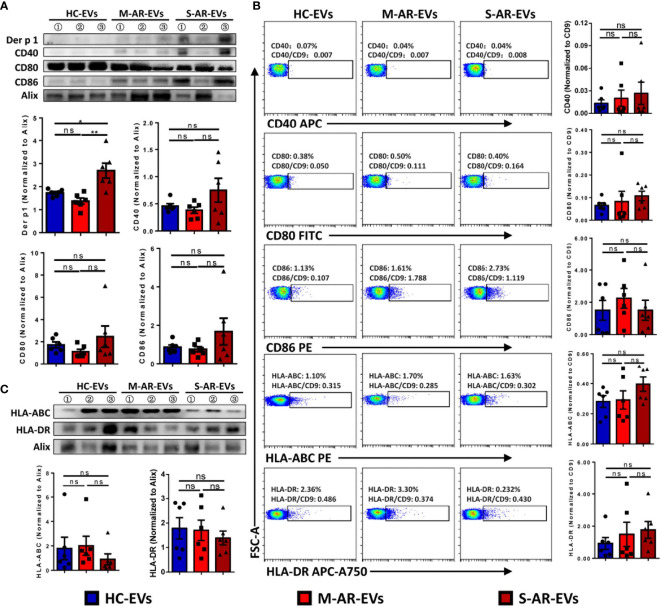
Plasma EVs from patients with AR were isolated, quantified, and characterized. The expression of Der p 1 and antigen-presenting molecules on EVs was determined by Western blot, flow cytometry, or ELISA. PKH26- and CFSE (carboxyfluorescein succinimidyl ester)-stained AR-EVs were used to determine the uptake of EVs by CD4T cells and their effects on CD4T cell proliferation, respectively.
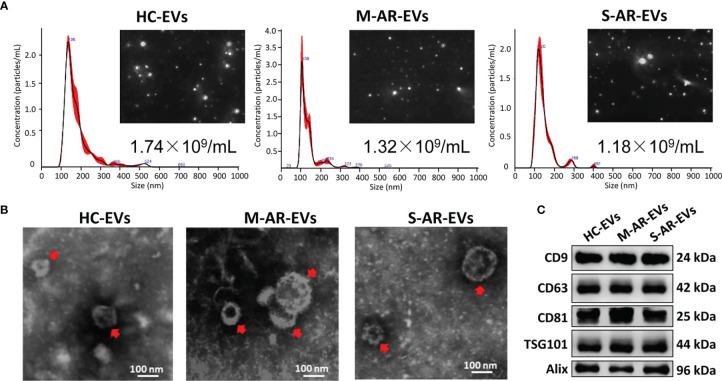
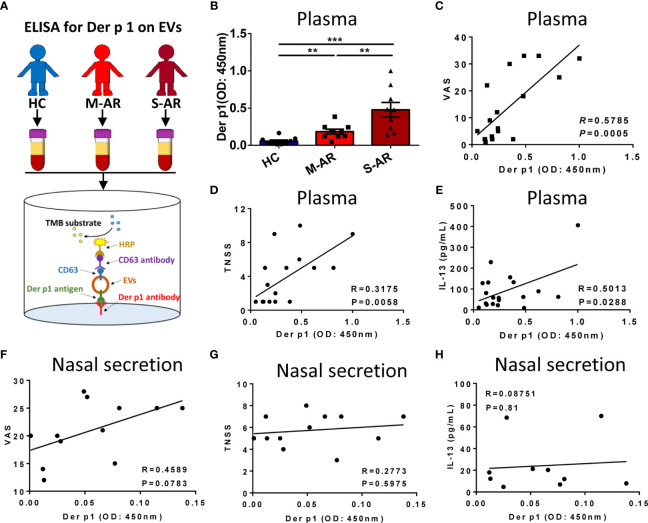
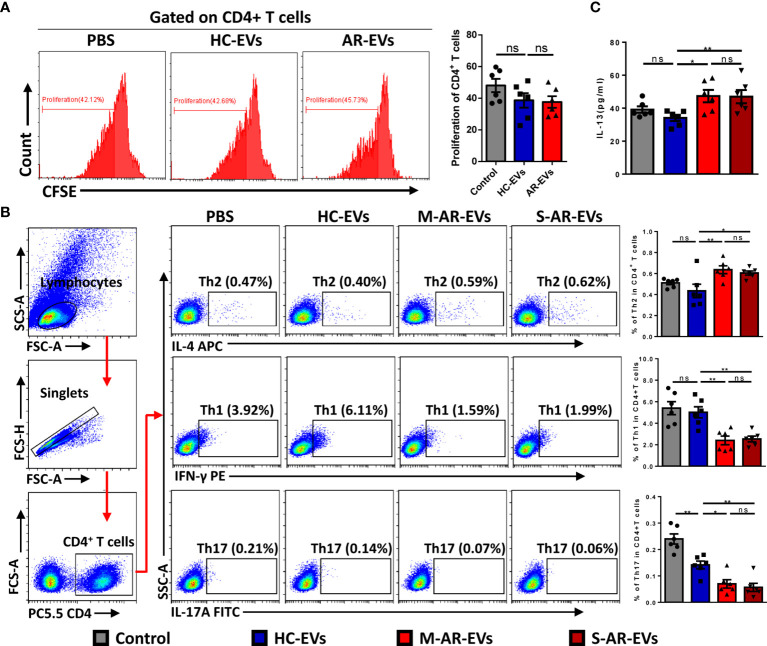
Plasma EVs in healthy control (HC) and AR patients were similar in the concentration of particles, expression for specific EV markers, and both had structural lipid bilayer. However, the levels of Der p 1 on plasma EVs from both mild and moderate-severe AR patients were significantly higher than that on HC. The levels of antigen-presenting molecules on plasma EVs were similar from three subjects. Moreover, levels of Der p 1 on EVs in plasma, but not nasal secretion, were significantly associated with the symptom score of AR patients and level of plasma IL-13. Additionally, plasma EVs from patients with AR promoted the development of Th2 cells, while no effect was found on CD4 T-cell proliferation.
Plasma EVs derived from patients with AR exhibited antigen-presenting characteristics and promoted differentiation of Th2 cells, thus providing novel understanding of the pathogenesis of AR.
过敏性鼻炎(AR)的特征是在暴露于过敏原后,IgE 介导的黏膜反应。细胞外囊泡(EVs)是含有生物货物的纳米级囊泡,用于细胞间通讯。然而,血浆 EVs 在 AR 发病机制中的作用在很大程度上仍然未知。
从 AR 患者中分离、定量和表征血浆 EVs。通过 Western blot、流式细胞术或 ELISA 确定 EVs 上 Der p 1 和抗原呈递分子的表达。使用 PKH26 和 CFSE(羧基荧光素琥珀酰亚胺酯)标记的 AR-EVs 分别确定 EVs 被 CD4T 细胞摄取及其对 CD4T 细胞增殖的影响。
健康对照(HC)和 AR 患者的血浆 EVs 在颗粒浓度、特定 EV 标志物的表达以及两者都具有结构脂质双层方面相似。然而,轻度和中重度 AR 患者血浆 EVs 上 Der p 1 的水平明显高于 HC。来自三个受试者的血浆 EVs 上抗原呈递分子的水平相似。此外,AR 患者血浆 EVs 上的 Der p 1 水平与 AR 患者的症状评分和血浆 IL-13 水平显著相关,但鼻分泌物中 EVs 上的 Der p 1 水平则无显著相关性。此外,来自 AR 患者的血浆 EVs 促进了 Th2 细胞的发育,而对 CD4 T 细胞增殖则没有影响。
AR 患者来源的血浆 EVs 表现出抗原呈递特征,并促进 Th2 细胞的分化,从而为 AR 的发病机制提供了新的认识。