Messina Julia A, Maziarz Eileen K, Galgiani John, Truong Jonathan T, Htoo Aung K, Heidari Arash, Johnson Royce H, Narang Aneesh T, Donovan Fariba M, Ewell Marion, Catanzaro Antonino, Thompson George R, Ampel Neil M, Perfect John R, Naggie Susanna, Walter Emmanuel B
Duke University School of Medicine, Durham, NC, USA.
Valley Fever Center for Excellence, University of Arizona, Tucson, AZ, USA.
Contemp Clin Trials Commun. 2021 Oct 14;24:100851. doi: 10.1016/j.conctc.2021.100851. eCollection 2021 Dec.
Coccidioidomycosis is a fungal infection endemic in the southwestern United States (US). Primary pulmonary coccidioidomycosis (PPC) is a leading cause of community-acquired pneumonia (CAP) in this region, although its diagnosis is often delayed, leading to lag in antifungal treatment and subsequent morbidity. The impact of early empiric antifungal therapy as part of treatment for CAP in endemic areas on clinical outcomes is unknown.
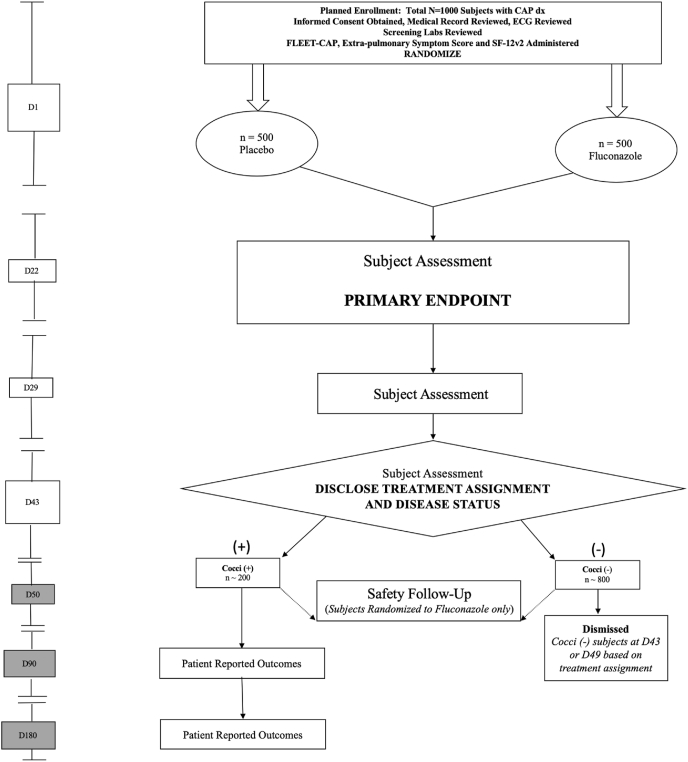
Phase IV randomized, double-blind, placebo-controlled trial in individuals aged 18 years or older with CAP who met all eligibility criteria in endemic regions in the US. Eligible participants with CAP were randomized to receive either fluconazole (400 mg daily) or matching placebo for 42 days and were subsequently monitored for clinical resolution of their illness.
The primary objective was to assess the clinical response of early empiric antifungal therapy with fluconazole through Day 22 in subjects with PPC who were adherent to the study intervention. Secondary objectives included: assessments of the impact of early empiric antifungal therapy with fluconazole through Day 22 and 43 in subjects with PPC regardless of adherence, comparisons of the clinical response and its individual components over time by treatment group in subjects with PPC, assessments of days lost from work or school, hospitalization, and all-cause mortality.
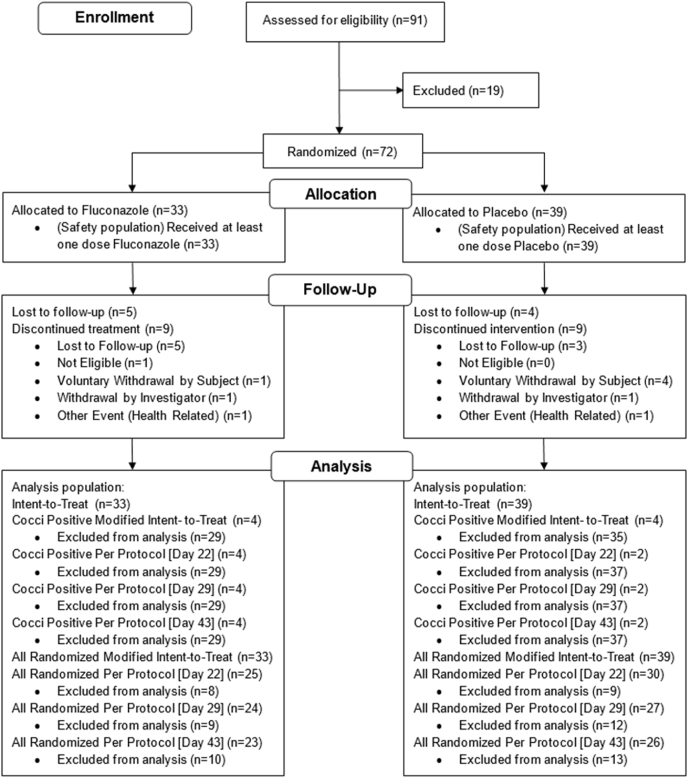
This trial was halted early due to slow enrollment (72 participants in one year, 33 received fluconazole and 39 received placebo). Of those enrolled, eight (11%) met the study definition of PPC. The study design and challenges are discussed.
球孢子菌病是一种在美国西南部流行的真菌感染。原发性肺球孢子菌病(PPC)是该地区社区获得性肺炎(CAP)的主要病因,尽管其诊断常常延迟,导致抗真菌治疗滞后及随后的发病情况。在流行地区,作为CAP治疗一部分的早期经验性抗真菌治疗对临床结局的影响尚不清楚。
在美国流行地区对年龄18岁及以上符合所有入选标准的CAP患者进行IV期随机、双盲、安慰剂对照试验。符合条件的CAP参与者被随机分配接受氟康唑(每日400毫克)或匹配的安慰剂,为期42天,随后对其疾病的临床缓解情况进行监测。
主要目的是评估在坚持研究干预的PPC患者中,至第22天使用氟康唑进行早期经验性抗真菌治疗的临床反应。次要目的包括:评估在PPC患者中至第22天和第43天使用氟康唑进行早期经验性抗真菌治疗的影响(无论是否坚持),比较PPC患者中治疗组随时间推移的临床反应及其各个组成部分,评估工作或学校缺勤天数、住院情况及全因死亡率。
由于入组缓慢(一年中有72名参与者,33人接受氟康唑,39人接受安慰剂),该试验提前终止。在入组者中,8人(11%)符合PPC的研究定义。对研究设计及挑战进行了讨论。