Yu Kexin, Wild Katherine, Potempa Kathleen, Hampstead Benjamin M, Lichtenberg Peter A, Struble Laura M, Pruitt Patrick, Alfaro Elena L, Lindsley Jacob, MacDonald Mattie, Kaye Jeffrey A, Silbert Lisa C, Dodge Hiroko H
Suzanne Dworak-Peck School of Social Work, University of Southern California, Los Angeles, CA, United States.
Edward R. Roybal Institute on Aging, University of Southern California, Los Angeles, CA, United States.
Front Digit Health. 2021 Aug 25;3:714813. doi: 10.3389/fdgth.2021.714813. eCollection 2021.
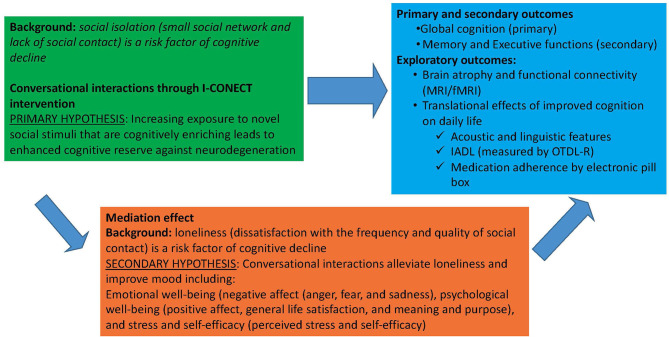
Increasing social interactions through communication technologies could offer a cost-effective prevention approach that slows cognitive decline and delays the onset of Alzheimer's disease. This paper describes the protocol of an active project named "Internet-based conversational engagement clinical trial (I-CONECT)" (ClinicalTrials.gov: NCT02871921). The COVID-19 pandemic related protocol modifications are also addressed in the current paper. I-CONECT is a multi-site, assessor-blind, randomized controlled behavioral intervention trial (RCT). We aim to randomize 320 socially isolated adults 75+ years old [160 Caucasian and 160 African American participants, 50:50 split between those with normal cognition and mild cognitive impairment (MCI)] recruited from the community to either the video chat intervention group or the control group (1:1 allocation). Those in the video chat group receive a computer and Internet service for the duration of the study, which they use to video chat with study staff for 30 min/day 4×/week for 6 months (high dose), and then 2×/week for an additional 6 months (maintenance dose). Both video chat and control groups have a brief (about 10 min) telephone check-in with study staff once per week. The primary outcome is the change in global cognitive function measured by Montreal Cognitive Assessment (MoCA) from baseline to 6 months. Secondary outcomes include changes in cognition in memory and executive function domains, emotional well-being measured by NIH Toolbox emotional battery, and daily functional abilities assessed with the Revised Observed Tasks of Daily Living (OTDL-R). Eligible participants have MRIs at baseline and 6 months. Participants contribute saliva for genetic testing (optional consent), and all video chats, weekly check-in calls and neuropsychological assessment sessions are recorded for speech and language analysis. The pandemic halted research activities and resulted in protocol modifications, including replacing in-person assessment with remote assessment, remote deployment of study equipment, and revised targeted sample size. This trial provides user-friendly hardware for the conversational-based intervention that can be easily provided at participants' homes. The trial aspires to use age and culture-specific conversational materials and a related platform developed in this trial for enhancing cognitive reserve and improving cognitive function.
通过通信技术增加社交互动可能提供一种经济有效的预防方法,减缓认知衰退并延迟阿尔茨海默病的发病。本文描述了一个名为“基于互联网的对话参与临床试验(I-CONECT)”(ClinicalTrials.gov:NCT02871921)的正在进行项目的方案。本文还讨论了与2019冠状病毒病大流行相关的方案修改。I-CONECT是一项多中心、评估者盲法、随机对照行为干预试验(RCT)。我们的目标是将从社区招募的320名75岁及以上的社会孤立成年人(160名白人和160名非裔美国参与者,认知正常和轻度认知障碍(MCI)者各占50%)随机分为视频聊天干预组或对照组(1:1分配)。视频聊天组的参与者在研究期间会获得一台电脑和互联网服务,他们每天使用该设备与研究人员进行30分钟的视频聊天,每周4次,持续6个月(高剂量),然后在接下来的6个月里每周2次(维持剂量)。视频聊天组和对照组每周都会与研究人员进行一次简短(约10分钟)的电话沟通。主要结局是从基线到6个月时通过蒙特利尔认知评估(MoCA)测量的整体认知功能的变化。次要结局包括记忆和执行功能领域的认知变化、通过美国国立卫生研究院工具箱情绪量表测量的情绪健康状况,以及通过修订的日常生活观察任务(OTDL-R)评估的日常功能能力。符合条件的参与者在基线和6个月时进行磁共振成像(MRI)检查。参与者提供唾液用于基因检测(自愿同意),所有视频聊天、每周的沟通电话和神经心理学评估会议都进行录音以进行言语和语言分析。大流行中断了研究活动并导致方案修改,包括用远程评估取代现场评估、远程部署研究设备以及修订目标样本量。该试验为基于对话的干预提供了用户友好型硬件,可轻松在参与者家中提供。该试验希望使用针对年龄和文化的对话材料以及在本试验中开发的相关平台来增强认知储备并改善认知功能。