Guangdong Cardiovascular Institute, WHO Collaborating Center for Research and Training in Cardiovascular Diseases, Guangdong Provincial People's Hospital, Guangdong Academy of Medical Sciences, Guangzhou, Guangdong, China.
Department of Environmental Health Sciences, University at Albany, State University of New York, New York, NY, USA.
BMC Public Health. 2021 Oct 29;21(1):1961. doi: 10.1186/s12889-021-12006-x.
Chronic obstructive pulmonary disease (COPD) is the third-leading cause of death worldwide with continuous rise. Limited studies indicate that COPD was associated with major storms and related power outages (PO). However, significant gaps remain in understanding what PO's role is on the pathway of major storms-COPD. This study aimed to examine how PO mediates the major storms-COPD associations.
In this time-series study, we extracted all hospital admissions with COPD as the principal diagnosis in New York, 2001-2013. Using distributed lag nonlinear models, the hospitalization rate during major storms and PO was compared to non-major storms and non-PO periods to determine the risk ratios (RRs) for COPD at each of 0-6 lag days respectively after controlling for time-varying confounders and concentration of fine particulate matter (PM). We then used Granger mediation analysis for time series to assess the mediation effect of PO on the major storms-COPD associations.
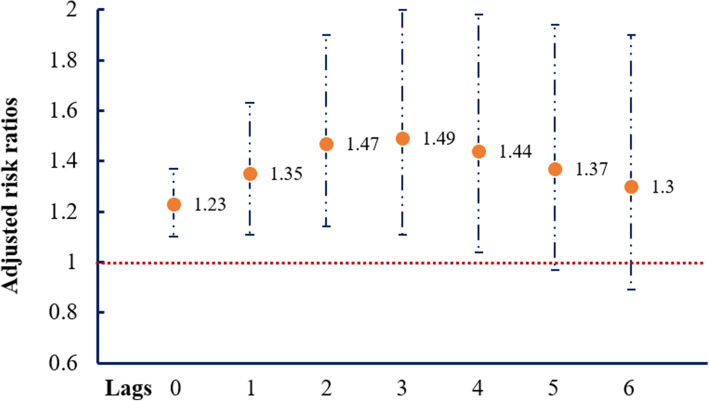
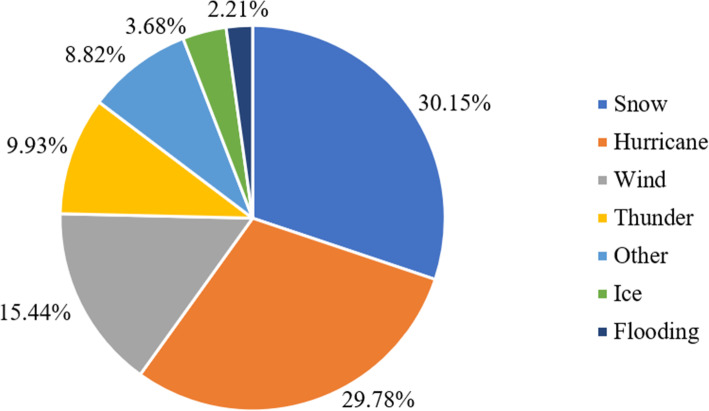
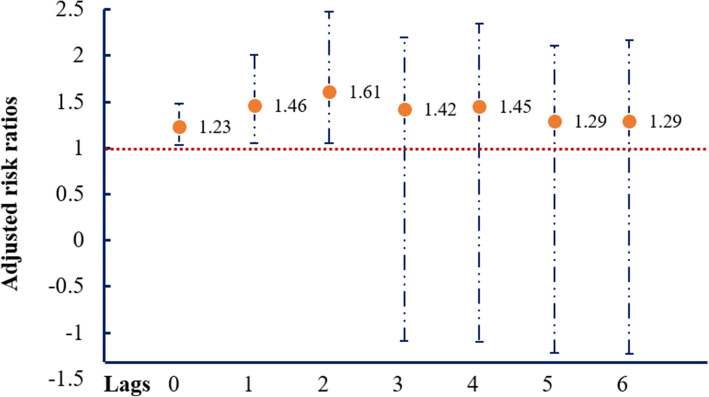
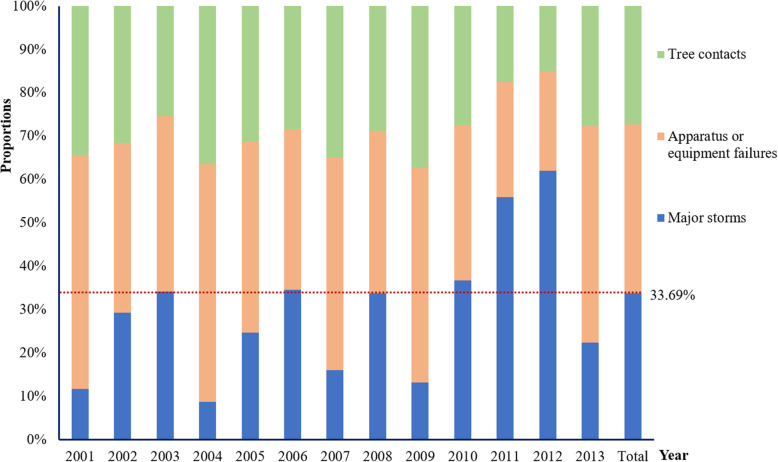
The RRs of COPD hospitalization following major storms, which mainly included flooding, thunder, hurricane, snow, ice, and wind, were 1.23 to 1.49 across lag 0-6 days. The risk was strongest at lag3 and lasted significantly for 4 days. Compared with non-outage periods, the PO period was associated with 1.23 to 1.61 higher risk of COPD admissions across lag 0-6 days. The risk lasted significantly for 2 days and was strongest at lag2. Snow, hurricane and wind were the top three contributors of PO among the major storms. PO mediated as much as 49.6 to 65.0% of the major storms-COPD associations.
Both major storms and PO were associated with increased hospital admission of COPD. PO mediated almost half of the major storms-COPD hospitalization associations. Preparation of surrogate electric system before major storms is essential to reduce major storms-COPD hospitalization.
慢性阻塞性肺疾病(COPD)是全球第三大致死原因,且呈持续上升趋势。有限的研究表明,COPD 与重大风暴和相关的停电(PO)有关。然而,在了解 PO 在重大风暴-COPD 途径中的作用方面仍存在重大差距。本研究旨在探讨 PO 如何介导重大风暴与 COPD 的关联。
在这项时间序列研究中,我们从 2001 年至 2013 年在纽约提取了所有以 COPD 为主要诊断的住院病例。使用分布式滞后非线性模型,比较了重大风暴和 PO 期间以及非重大风暴和非 PO 期间的住院率,以确定 COPD 在每个滞后 0-6 天的风险比(RR),同时控制了时变混杂因素和细颗粒物(PM)浓度。然后,我们使用时间序列格兰杰因果分析来评估 PO 对重大风暴-COPD 关联的中介效应。
主要包括洪水、雷暴、飓风、雪、冰和风的重大风暴后 COPD 住院的 RR 在滞后 0-6 天内为 1.23 至 1.49。风险在滞后 3 天最大,并持续显著 4 天。与非停电期相比,PO 期 COPD 入院的风险在滞后 0-6 天内高出 1.23 至 1.61。风险持续显著 2 天,滞后 2 天最大。雪、飓风和风是重大风暴中导致 PO 的前三大因素。PO 介导了重大风暴-COPD 关联的 49.6%至 65.0%。
重大风暴和 PO 都与 COPD 住院人数的增加有关。PO 介导了重大风暴-COPD 住院关联的近一半。在重大风暴前准备备用电力系统对于减少重大风暴-COPD 住院至关重要。