Robert Véronique, Vandenberghe Christian
HEC Montréal, 3000 chemin Côte Ste-Catherine, Montréal, Québec H3T2A7 Canada.
J Bus Psychol. 2021;36(4):533-551. doi: 10.1007/s10869-020-09700-9. Epub 2020 Jun 26.
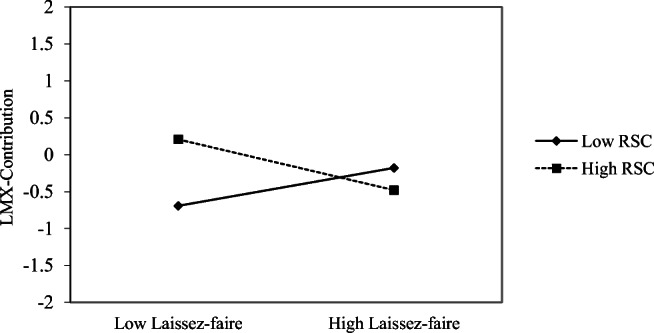
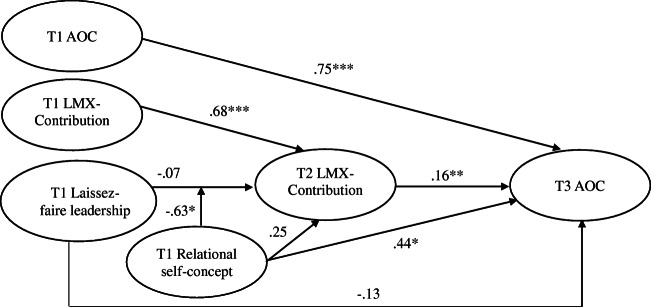
Although the detrimental effects of laissez-faire leadership are well documented, research on the underlying mechanisms and the boundary conditions associated with these effects remains scarce. Using the identity orientation framework and social exchange theory, we propose that employees with stronger relational self-concepts are more likely to be affected by laissez-faire leadership. As these employees define themselves through dyadic relationships, they may react more negatively to laissez-faire leadership by diminishing their contributions to mutual goals and reducing their affective organizational commitment. These predictions were tested within a three-wave longitudinal study through structural equations modeling analyses with full information maximum likelihood estimation on a sample of employees from multiple organizations ( = 449). As predicted, the relational self-concept was associated with a stronger negative effect of laissez-faire leadership on the contribution dimension of leader-member exchange and a stronger negative indirect effect on affective organizational commitment. The implications of these findings for our understanding of the mechanisms related to laissez-faire leadership are discussed.
尽管放任式领导的不利影响已有充分记载,但关于这些影响背后的机制以及与之相关的边界条件的研究仍然匮乏。运用身份导向框架和社会交换理论,我们提出,具有更强关系自我概念的员工更容易受到放任式领导的影响。由于这些员工通过二元关系来定义自己,他们可能会通过减少对共同目标的贡献以及降低其情感组织承诺,对放任式领导做出更消极的反应。在一项三阶段纵向研究中,通过对来自多个组织的员工样本(N = 449)进行全信息最大似然估计的结构方程模型分析,对这些预测进行了检验。正如预期的那样,关系自我概念与放任式领导对领导 - 成员交换的贡献维度的更强负面影响以及对情感组织承诺的更强负面间接影响相关。讨论了这些发现对我们理解与放任式领导相关机制的启示。