Osorio-Palacios Mireya, Montiel-Trejo Laura, Oliver-Domínguez Iván, Hernández-Falcón Jesús, Mendoza-Ángeles Karina
Laboratorio de Redes Neuronales, Departamento de Fisiología, Facultad de Medicina, Universidad Nacional Autónoma de México (UNAM), México City, Mexico.
Front Neurosci. 2021 Oct 14;15:694924. doi: 10.3389/fnins.2021.694924. eCollection 2021.
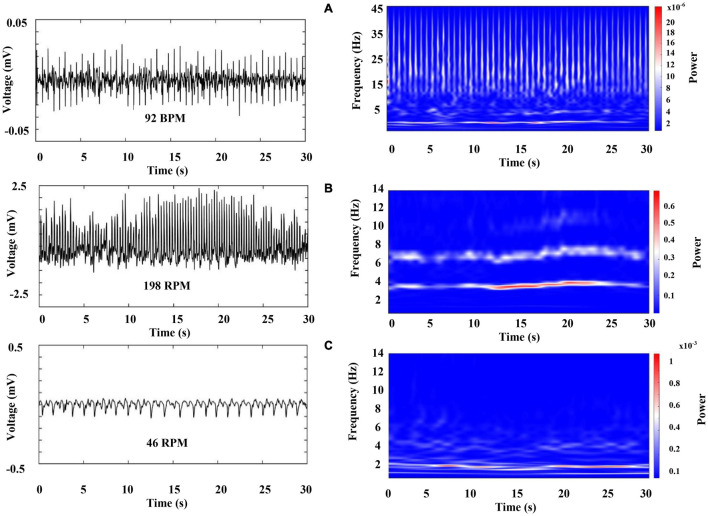
In vertebrates like mammals and birds, two types of sleep have been identified: rapid eye movement and non-rapid eye movement sleep. Each one is associated with specific electroencephalogram patterns and is accompanied by variations in cardiac and respiratory frequencies. Sleep has been demonstrated only in a handful of invertebrates, and evidence for different sleep stages remains elusive. Previous results show that crayfish sleeps while lying on one side on the surface of the water, but it is not known if this animal has sleep phases. Heart rate and respiratory frequency are modified by diverse changes in the crayfish environment during wakefulness, and previously, we showed that variations in these variables are present during sleep despite that there are no autonomic anatomical structures described in this animal. Here, we conducted experiments to search for sleep phases in crayfish and the relationships between sleep and cardiorespiratory activity. We used the wavelet transform, grouping analysis with -means clustering, and principal component analysis, to analyze brain and cardiorespiratory electrical activity. Our results show that (a) crayfish can sleep lying on one side or when it is motionless and (b) the depth of sleep (measured as the power of electroencephalographic activity) changes over time and is accompanied by oscillations in cardiorespiratory signal amplitude and power. Finally, we propose that in crayfish there are at least three phases of sleep.
在哺乳动物和鸟类等脊椎动物中,已识别出两种睡眠类型:快速眼动睡眠和非快速眼动睡眠。每种睡眠类型都与特定的脑电图模式相关联,并伴随着心脏和呼吸频率的变化。仅在少数无脊椎动物中证实了睡眠现象,而关于不同睡眠阶段的证据仍然难以捉摸。先前的研究结果表明,小龙虾在水面上侧卧时会睡觉,但尚不清楚这种动物是否有睡眠阶段。在清醒状态下,小龙虾环境的各种变化会改变其心率和呼吸频率,并且我们之前已经表明,尽管该动物没有被描述的自主解剖结构,但在睡眠期间这些变量也会发生变化。在这里,我们进行了实验,以寻找小龙虾的睡眠阶段以及睡眠与心肺活动之间的关系。我们使用小波变换、基于均值聚类的分组分析和主成分分析,来分析大脑和心肺电活动。我们的结果表明:(a)小龙虾可以侧卧或静止不动时睡觉;(b)睡眠深度(以脑电图活动的功率来衡量)随时间变化,并伴随着心肺信号幅度和功率的振荡。最后,我们提出小龙虾至少有三个睡眠阶段。