• 文献检索
  • 文档翻译
  • 深度研究
  • 学术资讯
  • Suppr Zotero 插件Zotero 插件
  • 邀请有礼
  • 套餐&价格
  • 历史记录
应用&插件
Suppr Zotero 插件Zotero 插件浏览器插件Mac 客户端Windows 客户端微信小程序
定价
高级版会员购买积分包购买API积分包
服务
文献检索文档翻译深度研究API 文档MCP 服务
关于我们
关于 Suppr公司介绍联系我们用户协议隐私条款
关注我们

Suppr 超能文献

核心技术专利:CN118964589B侵权必究
粤ICP备2023148730 号-1Suppr @ 2026

文献检索

告别复杂PubMed语法,用中文像聊天一样搜索,搜遍4000万医学文献。AI智能推荐,让科研检索更轻松。

立即免费搜索

文件翻译

保留排版,准确专业,支持PDF/Word/PPT等文件格式,支持 12+语言互译。

免费翻译文档

深度研究

AI帮你快速写综述,25分钟生成高质量综述,智能提取关键信息,辅助科研写作。

立即免费体验

一种基于编码器-解码器的CT图像中COVID-19肺部感染分割方法。

An Encoder-Decoder-Based Method for Segmentation of COVID-19 Lung Infection in CT Images.

作者信息

Elharrouss Omar, Subramanian Nandhini, Al-Maadeed Somaya

机构信息

Department of Computer Science and Engineering, Qatar University, Doha, Qatar.

出版信息

SN Comput Sci. 2022;3(1):13. doi: 10.1007/s42979-021-00874-4. Epub 2021 Oct 25.

DOI:10.1007/s42979-021-00874-4
PMID:34723206
原文链接:https://pmc.ncbi.nlm.nih.gov/articles/PMC8543772/
Abstract

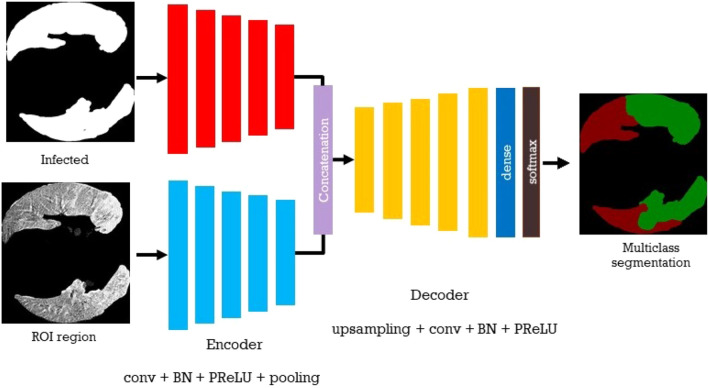
The novelty of the COVID-19 Disease and the speed of spread, created colossal chaotic, impulse all the worldwide researchers to exploit all resources and capabilities to understand and analyze characteristics of the coronavirus in terms of spread ways and virus incubation time. For that, the existing medical features such as CT-scan and X-ray images are used. For example, CT-scan images can be used for the detection of lung infection. However, the quality of these images and infection characteristics limit the effectiveness of these features. Using artificial intelligence (AI) tools and computer vision algorithms, the accuracy of detection can be more accurate and can help to overcome these issues. In this paper, we propose a multi-task deep-learning-based method for lung infection segmentation on CT-scan images. Our proposed method starts by segmenting the lung regions that may be infected. Then, segmenting the infections in these regions. In addition, to perform a multi-class segmentation the proposed model is trained using the two-stream inputs. The multi-task learning used in this paper allows us to overcome the shortage of labeled data. In addition, the multi-input stream allows the model to learn from many features that can improve the results. To evaluate the proposed method, many metrics have been used including Sorensen-Dice similarity, Sensitivity, Specificity, Precision, and MAE metrics. As a result of experiments, the proposed method can segment lung infections with high performance even with the shortage of data and labeled images. In addition, comparing with the state-of-the-art method our method achieves good performance results. For example, the proposed method reached 78..6% for Dice, 71.1% for Sensitivity metric, 99.3% for Specificity 85.6% for Precision, and 0.062 for Mean Average Error metric, which demonstrates the effectiveness of the proposed method for lung infection segmentation.

摘要

新型冠状病毒肺炎(COVID-19)疾病的新颖性及其传播速度造成了巨大的混乱,促使全球所有研究人员利用一切资源和能力,从传播方式和病毒潜伏期等方面了解和分析冠状病毒的特征。为此,人们使用了诸如CT扫描和X射线图像等现有的医学特征。例如,CT扫描图像可用于检测肺部感染。然而,这些图像的质量和感染特征限制了这些特征的有效性。使用人工智能(AI)工具和计算机视觉算法,检测的准确性可以更高,并且有助于克服这些问题。在本文中,我们提出了一种基于多任务深度学习的方法,用于对CT扫描图像上的肺部感染进行分割。我们提出的方法首先分割可能被感染的肺部区域。然后,分割这些区域中的感染部位。此外,为了进行多类分割,所提出的模型使用双流输入进行训练。本文中使用的多任务学习使我们能够克服标记数据不足的问题。此外,多输入流允许模型从许多可以改善结果的特征中学习。为了评估所提出的方法,使用了许多指标,包括索伦森-戴斯相似性、灵敏度、特异性、精度和平均绝对误差指标。实验结果表明,即使在数据和标记图像不足的情况下,所提出的方法也能以高性能分割肺部感染。此外,与现有方法相比,我们的方法取得了良好的性能结果。例如,所提出的方法在戴斯指标上达到了78.6%,在灵敏度指标上达到了71.1%,在特异性指标上达到了99.3%,在精度指标上达到了85.6%,在平均绝对误差指标上达到了0.062,这证明了所提出的方法在肺部感染分割方面的有效性。

https://cdn.ncbi.nlm.nih.gov/pmc/blobs/8751/8543772/af450ff1c937/42979_2021_874_Fig8_HTML.jpg
https://cdn.ncbi.nlm.nih.gov/pmc/blobs/8751/8543772/035512096256/42979_2021_874_Fig1_HTML.jpg
https://cdn.ncbi.nlm.nih.gov/pmc/blobs/8751/8543772/71bf0aac3505/42979_2021_874_Fig2_HTML.jpg
https://cdn.ncbi.nlm.nih.gov/pmc/blobs/8751/8543772/de6673cf42c7/42979_2021_874_Fig3_HTML.jpg
https://cdn.ncbi.nlm.nih.gov/pmc/blobs/8751/8543772/3bb76ed7c2bb/42979_2021_874_Fig4_HTML.jpg
https://cdn.ncbi.nlm.nih.gov/pmc/blobs/8751/8543772/dcfc3177312d/42979_2021_874_Fig5_HTML.jpg
https://cdn.ncbi.nlm.nih.gov/pmc/blobs/8751/8543772/82a33e2ff971/42979_2021_874_Fig6_HTML.jpg
https://cdn.ncbi.nlm.nih.gov/pmc/blobs/8751/8543772/36d4fe709912/42979_2021_874_Fig7_HTML.jpg
https://cdn.ncbi.nlm.nih.gov/pmc/blobs/8751/8543772/af450ff1c937/42979_2021_874_Fig8_HTML.jpg
https://cdn.ncbi.nlm.nih.gov/pmc/blobs/8751/8543772/035512096256/42979_2021_874_Fig1_HTML.jpg
https://cdn.ncbi.nlm.nih.gov/pmc/blobs/8751/8543772/71bf0aac3505/42979_2021_874_Fig2_HTML.jpg
https://cdn.ncbi.nlm.nih.gov/pmc/blobs/8751/8543772/de6673cf42c7/42979_2021_874_Fig3_HTML.jpg
https://cdn.ncbi.nlm.nih.gov/pmc/blobs/8751/8543772/3bb76ed7c2bb/42979_2021_874_Fig4_HTML.jpg
https://cdn.ncbi.nlm.nih.gov/pmc/blobs/8751/8543772/dcfc3177312d/42979_2021_874_Fig5_HTML.jpg
https://cdn.ncbi.nlm.nih.gov/pmc/blobs/8751/8543772/82a33e2ff971/42979_2021_874_Fig6_HTML.jpg
https://cdn.ncbi.nlm.nih.gov/pmc/blobs/8751/8543772/36d4fe709912/42979_2021_874_Fig7_HTML.jpg
https://cdn.ncbi.nlm.nih.gov/pmc/blobs/8751/8543772/af450ff1c937/42979_2021_874_Fig8_HTML.jpg

相似文献

1
An Encoder-Decoder-Based Method for Segmentation of COVID-19 Lung Infection in CT Images.一种基于编码器-解码器的CT图像中COVID-19肺部感染分割方法。
SN Comput Sci. 2022;3(1):13. doi: 10.1007/s42979-021-00874-4. Epub 2021 Oct 25.
2
Does non-COVID-19 lung lesion help? investigating transferability in COVID-19 CT image segmentation.非 COVID-19 肺部病变有帮助吗?在 COVID-19 CT 图像分割中探究可转移性。
Comput Methods Programs Biomed. 2021 Apr;202:106004. doi: 10.1016/j.cmpb.2021.106004. Epub 2021 Feb 23.
3
A novel adaptive cubic quasi-Newton optimizer for deep learning based medical image analysis tasks, validated on detection of COVID-19 and segmentation for COVID-19 lung infection, liver tumor, and optic disc/cup.一种用于深度学习的新型自适应三次拟牛顿优化器,在 COVID-19 检测和 COVID-19 肺部感染、肝脏肿瘤以及视盘/杯分割等医学图像分析任务中得到验证。
Med Phys. 2023 Mar;50(3):1528-1538. doi: 10.1002/mp.15969. Epub 2022 Oct 6.
4
COVID-19 infection segmentation using hybrid deep learning and image processing techniques.使用混合深度学习和图像处理技术进行 COVID-19 感染分割。
Sci Rep. 2023 Dec 20;13(1):22737. doi: 10.1038/s41598-023-49337-1.
5
SELDNet: Sequenced encoder and lightweight decoder network for COVID-19 infection region segmentation.SELDNet:用于新冠病毒感染区域分割的序列编码器和轻量级解码器网络。
Displays. 2023 Apr;77:102395. doi: 10.1016/j.displa.2023.102395. Epub 2023 Feb 14.
6
GIFNet: an effective global infection feature network for automatic COVID-19 lung lesions segmentation.GIFNet:一种用于自动分割COVID-19肺部病变的有效全局感染特征网络。
Med Biol Eng Comput. 2024 Feb 3. doi: 10.1007/s11517-024-03024-z.
7
ABCNet: A new efficient 3D dense-structure network for segmentation and analysis of body tissue composition on body-torso-wide CT images.ABCNet:一种用于在全身躯干CT图像上分割和分析身体组织成分的新型高效3D密集结构网络。
Med Phys. 2020 Jul;47(7):2986-2999. doi: 10.1002/mp.14141. Epub 2020 Apr 21.
8
Automated deep learning-based segmentation of COVID-19 lesions from chest computed tomography images.基于深度学习的胸部计算机断层扫描图像中新冠病毒肺炎病变的自动分割
Pol J Radiol. 2022 Aug 26;87:e478-e486. doi: 10.5114/pjr.2022.119027. eCollection 2022.
9
An effective deep network for automatic segmentation of complex lung tumors in CT images.一种用于 CT 图像中复杂肺肿瘤自动分割的有效深度网络。
Med Phys. 2021 Sep;48(9):5004-5016. doi: 10.1002/mp.15074. Epub 2021 Jul 27.
10
Dual attention fusion UNet for COVID-19 lesion segmentation from CT images.基于双注意力融合 U-Net 的 CT 图像新冠肺炎病灶分割。
J Xray Sci Technol. 2023;31(4):713-729. doi: 10.3233/XST-230001.

引用本文的文献

1
Encoder-decoder convolutional neural network for simple CT segmentation of COVID-19 infected lungs.用于COVID-19感染肺部简单CT分割的编码器-解码器卷积神经网络。
PeerJ Comput Sci. 2024 Jul 23;10:e2178. doi: 10.7717/peerj-cs.2178. eCollection 2024.
2
PDRF-Net: a progressive dense residual fusion network for COVID-19 lung CT image segmentation.PDRF-Net:一种用于COVID-19肺部CT图像分割的渐进式密集残差融合网络。
Evol Syst (Berl). 2023 Feb 17:1-17. doi: 10.1007/s12530-023-09489-x.
3
Remora Namib Beetle Optimization Enabled Deep Learning for Severity of COVID-19 Lung Infection Identification and Classification Using CT Images.

本文引用的文献

1
Leveraging Data Science to Combat COVID-19: A Comprehensive Review.利用数据科学抗击新冠疫情:全面综述
IEEE Trans Artif Intell. 2020 Sep 2;1(1):85-103. doi: 10.1109/TAI.2020.3020521. eCollection 2020 Aug.
2
BEMD-3DCNN-based method for COVID-19 detection.基于 BEMD-3DCNN 的 COVID-19 检测方法。
Comput Biol Med. 2022 Mar;142:105188. doi: 10.1016/j.compbiomed.2021.105188. Epub 2021 Dec 30.
3
COVID-19 Control by Computer Vision Approaches: A Survey.基于计算机视觉方法的COVID-19防控:一项综述。
利用 CT 图像对 COVID-19 肺部感染严重程度进行识别和分类的 Remora Namib 甲虫优化深度学习
Sensors (Basel). 2023 Jun 3;23(11):5316. doi: 10.3390/s23115316.
4
Deep-Learning-Based Automatic Segmentation of Parotid Gland on Computed Tomography Images.基于深度学习的计算机断层扫描图像上腮腺的自动分割
Diagnostics (Basel). 2023 Feb 4;13(4):581. doi: 10.3390/diagnostics13040581.
5
A Survey on Deep-Learning-Based Diabetic Retinopathy Classification.基于深度学习的糖尿病视网膜病变分类研究
Diagnostics (Basel). 2023 Jan 18;13(3):345. doi: 10.3390/diagnostics13030345.
6
Combating Covid-19 using machine learning and deep learning: Applications, challenges, and future perspectives.利用机器学习和深度学习抗击新冠疫情:应用、挑战及未来展望
Array (N Y). 2023 Mar;17:100271. doi: 10.1016/j.array.2022.100271. Epub 2022 Dec 10.
7
Active deep learning from a noisy teacher for semi-supervised 3D image segmentation: Application to COVID-19 pneumonia infection in CT.基于带噪教师的主动深度学习的半监督 3D 图像分割:在 CT 中 COVID-19 肺炎感染中的应用。
Comput Med Imaging Graph. 2022 Dec;102:102127. doi: 10.1016/j.compmedimag.2022.102127. Epub 2022 Oct 7.
8
EffViT-COVID: A dual-path network for COVID-19 percentage estimation.EffViT-COVID:一种用于估计新型冠状病毒肺炎感染率的双路径网络。
Expert Syst Appl. 2023 Mar 1;213:118939. doi: 10.1016/j.eswa.2022.118939. Epub 2022 Oct 3.
9
FAM: focal attention module for lesion segmentation of COVID-19 CT images.FAM:用于COVID-19 CT图像病变分割的焦点注意力模块。
J Real Time Image Process. 2022;19(6):1091-1104. doi: 10.1007/s11554-022-01249-5. Epub 2022 Sep 4.
10
A fast lightweight network for the discrimination of COVID-19 and pulmonary diseases.一种用于鉴别新型冠状病毒肺炎和肺部疾病的快速轻量级网络。
Biomed Signal Process Control. 2022 Sep;78:103925. doi: 10.1016/j.bspc.2022.103925. Epub 2022 Jun 21.
IEEE Access. 2020 Sep 29;8:179437-179456. doi: 10.1109/ACCESS.2020.3027685. eCollection 2020.
4
Classification of COVID-19 in chest X-ray images using DeTraC deep convolutional neural network.使用DeTraC深度卷积神经网络对胸部X光图像中的新冠肺炎进行分类。
Appl Intell (Dordr). 2021;51(2):854-864. doi: 10.1007/s10489-020-01829-7. Epub 2020 Sep 5.
5
Transfer learning-based approach for detecting COVID-19 ailment in lung CT scan.基于迁移学习的肺部 CT 扫描中 COVID-19 疾病检测方法。
Comput Biol Med. 2021 Aug;135:104575. doi: 10.1016/j.compbiomed.2021.104575. Epub 2021 Jun 12.
6
Large-scale screening to distinguish between COVID-19 and community-acquired pneumonia using infection size-aware classification.利用感染大小感知分类进行大规模筛选,以区分 COVID-19 和社区获得性肺炎。
Phys Med Biol. 2021 Mar 17;66(6):065031. doi: 10.1088/1361-6560/abe838.
7
JCS: An Explainable COVID-19 Diagnosis System by Joint Classification and Segmentation.JCS:基于联合分类与分割的 COVID-19 可解释诊断系统。
IEEE Trans Image Process. 2021;30:3113-3126. doi: 10.1109/TIP.2021.3058783. Epub 2021 Feb 24.
8
Multi-task deep learning based CT imaging analysis for COVID-19 pneumonia: Classification and segmentation.基于多任务深度学习的 COVID-19 肺炎 CT 成像分析:分类与分割。
Comput Biol Med. 2020 Nov;126:104037. doi: 10.1016/j.compbiomed.2020.104037. Epub 2020 Oct 8.
9
A light CNN for detecting COVID-19 from CT scans of the chest.一种用于从胸部CT扫描中检测新冠肺炎的轻量级卷积神经网络。
Pattern Recognit Lett. 2020 Dec;140:95-100. doi: 10.1016/j.patrec.2020.10.001. Epub 2020 Oct 3.
10
Deep-COVID: Predicting COVID-19 from chest X-ray images using deep transfer learning.深度 COVID:使用深度迁移学习从胸部 X 光图像预测 COVID-19。
Med Image Anal. 2020 Oct;65:101794. doi: 10.1016/j.media.2020.101794. Epub 2020 Jul 21.