Cardiovascular Center, OLV Hospital, Moorselbaan 164, Aalst, 9300, Belgium.
Department of Advanced Biomedical Sciences, University of Naples Frederico II, Naples, Italy.
ESC Heart Fail. 2021 Dec;8(6):4780-4790. doi: 10.1002/ehf2.13659. Epub 2021 Nov 1.
We investigated the prognostic relevance of serpin peptidase inhibitor, clade A member 3 (SERPINA3) in patients admitted with a de novo or worsened heart failure (HF).
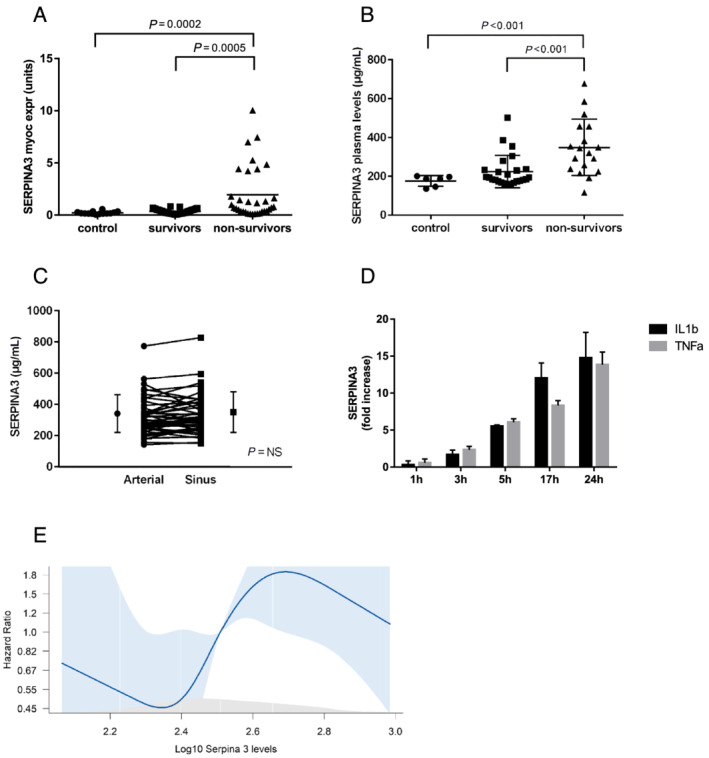
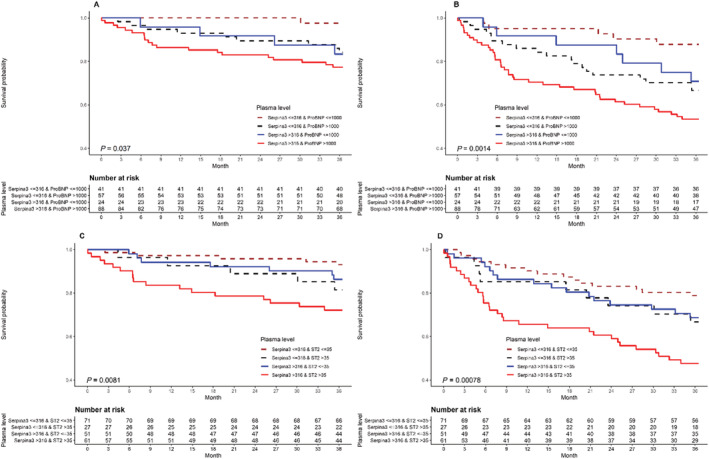
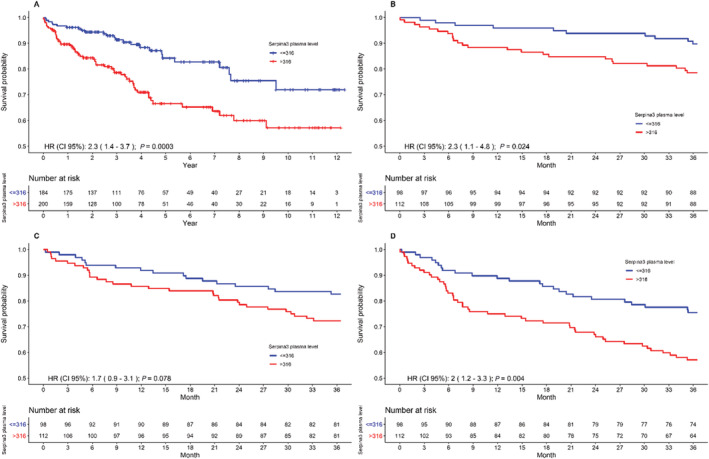
In the first stage, 83 HF-related left ventricular (LV) transcripts were examined in patients with congestive cardiomyopathy (CCMP, n = 44) who died within 5 years and compared with age-matched and haemodynamically matched CCMP survivors (n = 39) and controls with normal LV function (n = 17). Among 14 differentially expressed transcripts, myocardial gene and circulating SERPINA3 levels were up-regulated in non-survivors vs. survivors (2.40 ± 3.66 vs. 0.36 ± 0.22 units, P < 0.01 and 334.7 ± 138.7 vs. 228.2 ± 83.1 μg/mL, P < 0.01, respectively). While no significant transmyocardial gradient was detected, cytokine stimulation of human endothelial cells induced SERPINA3 secretion. In an independent validation cohort with a de novo or worsened HF (n = 387), circulating SERPINA3 levels > 316 μg/mL were associated with increased all-cause mortality {hazard ratio [HR] [95% confidence interval (CI)]: 2.4 [1.5-3.9], P = 0.0002} and its composite with unplanned cardiovascular readmission [HR (95% CI): 2.0 (1.2-3.3), P = 0.004]. Patients with elevated SERPINA3 levels and elevated either N-terminal pro brain natriuretic peptide or ST2 showed worse freedom from both endpoints. In a multivariate analysis, including established clinical risk factors, SERPINA3 remained independent predictor of all-cause mortality together with age, gender, ST2, glomerular filtration, and pulmonary capillary wedge pressure.
In patients with a de novo or worsened HF, increased SERPINA3 levels > 316 μg/mL are associated with increased mortality or unplanned cardiac readmission. Elevated SERPINA3 levels on top of established clinical predictors appear to identify a subgroup of HF patients at higher mortality risk. Prospective studies should further validate its value in prognostic stratification of HF.
我们研究了丝氨酸蛋白酶抑制剂,A 族成员 3(SERPINA3)在新发或恶化心力衰竭(HF)患者中的预后相关性。
在第一阶段,我们在充血性心肌病(CCMP)患者中检查了 83 个与左心室(LV)相关的 HF 转录本,这些患者在 5 年内死亡,并与年龄匹配和血流动力学匹配的 CCMP 幸存者(n=39)和 LV 功能正常的对照组(n=17)进行比较。在 14 个差异表达的转录本中,与幸存者相比,非幸存者的心肌基因和循环 SERPINA3 水平升高(2.40±3.66 与 0.36±0.22 单位,P<0.01 和 334.7±138.7 与 228.2±83.1μg/mL,P<0.01)。虽然没有检测到明显的跨心肌梯度,但人内皮细胞的细胞因子刺激诱导 SERPINA3 分泌。在一个具有新发或恶化 HF 的独立验证队列中(n=387),循环 SERPINA3 水平>316μg/mL 与全因死亡率增加相关[危险比(HR)[95%置信区间(CI)]:2.4[1.5-3.9],P=0.0002]及其复合无计划心血管再入院[HR(95%CI):2.0(1.2-3.3),P=0.004]。SERPINA3 水平升高且 N 端脑利钠肽或 ST2 升高的患者在两个终点的无事件生存方面均较差。在包括既定临床危险因素的多变量分析中,SERPINA3 仍然是全因死亡率的独立预测因素,与年龄、性别、ST2、肾小球滤过率和肺毛细血管楔压相关。
在新发或恶化 HF 的患者中,SERPINA3 水平升高>316μg/mL 与死亡率或无计划的心脏再入院增加相关。在既定的临床预测因子基础上升高 SERPINA3 水平似乎可以识别 HF 患者中死亡率较高的亚组。前瞻性研究应进一步验证其在 HF 预后分层中的价值。