Sadeh Sadra, Clopath Claudia
Bioengineering Department, Imperial College London, London SW7 2AZ, UK.
Sci Adv. 2021 Nov 5;7(45):eabg8411. doi: 10.1126/sciadv.abg8411. Epub 2021 Nov 3.
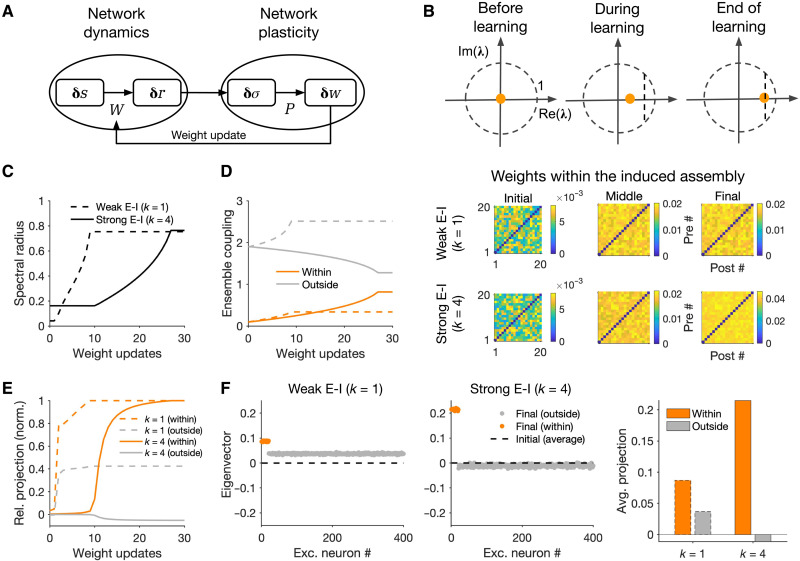
Repetitive activation of subpopulations of neurons leads to the formation of neuronal assemblies, which can guide learning and behavior. Recent technological advances have made the artificial induction of these assemblies feasible, yet how various parameters of induction can be optimized is not clear. Here, we studied this question in large-scale cortical network models with excitatory-inhibitory balance. We found that the background network in which assemblies are embedded can strongly modulate their dynamics and formation. Networks with dominant excitatory interactions enabled a fast formation of assemblies, but this was accompanied by recruitment of other non-perturbed neurons, leading to some degree of nonspecific induction. On the other hand, networks with strong excitatory-inhibitory interactions ensured that the formation of assemblies remained constrained to the perturbed neurons, but slowed down the induction. Our results suggest that these two regimes can be suitable for computational and cognitive tasks with different trade-offs between speed and specificity.
神经元亚群的重复激活会导致神经元集合体的形成,而神经元集合体能够指导学习和行为。最近的技术进步使得人工诱导这些集合体成为可能,但如何优化诱导的各种参数尚不清楚。在这里,我们在具有兴奋性-抑制性平衡的大规模皮质网络模型中研究了这个问题。我们发现,集合体所嵌入的背景网络能够强烈调节它们的动态和形成。具有主导兴奋性相互作用的网络能够使集合体快速形成,但这伴随着其他未受干扰神经元的招募,导致一定程度的非特异性诱导。另一方面,具有强兴奋性-抑制性相互作用的网络确保集合体的形成仍局限于受干扰的神经元,但减缓了诱导过程。我们的结果表明,这两种模式可能适用于在速度和特异性之间具有不同权衡的计算和认知任务。