The Persian Gulf Tropical Medicine Research Center, The Persian Gulf Biomedical Sciences Research Institute, Bushehr University of Medical Sciences, Bushehr, Iran.
Department of Endocrine and Metabolic Disease, the Persian Gulf Tropical Medicine Research Center, Bushehr University of Medical Sciences, Bushehr, Iran.
BMC Endocr Disord. 2021 Nov 3;21(1):219. doi: 10.1186/s12902-021-00877-5.
Accumulating evidence indicates that vitamin D deficiency has been increased globally over the last two decades. However, the majority of these studies are concerned with cities and there is scant information regarding the prevalence of vitamin D in rural areas. The main aim of this study was to investigate the prevalence of vitamin D deficiency and its associated risk factors among the rural population in Bushehr province which shares the longest border with the Persian Gulf.
The rural inhabitants of more than 25 years old from three mountainous, plain, and seashore areas of Bushehr province were selected through a stratified multi-cluster random sampling method. After obtaining the participants' demographic and anthropometric data and their past medical history, serum 25-hydroxyvitamin D [25(OH)D] was measured using ELISA.
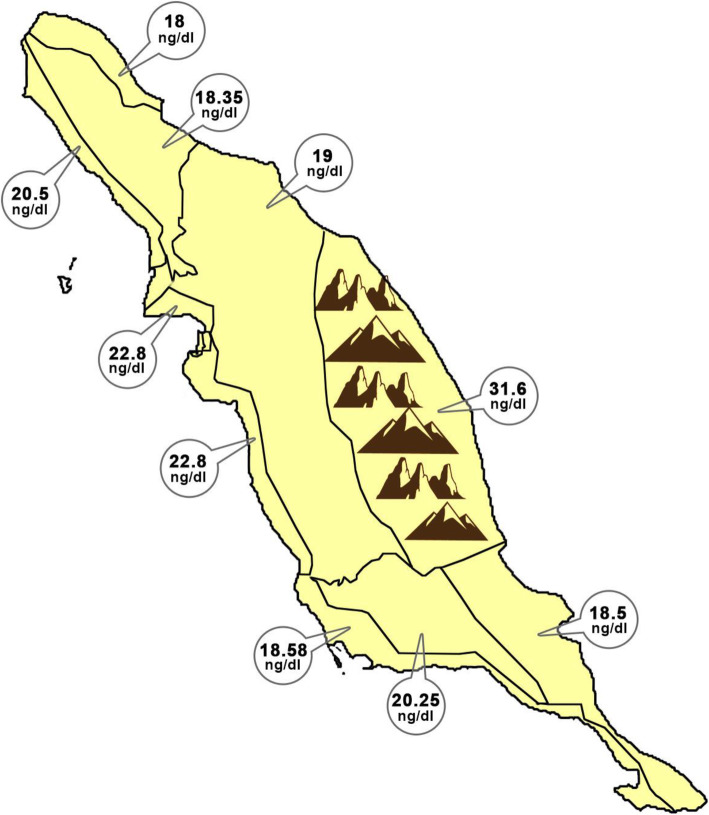
A total of 1806 (means ±SD, 46± 14years old) rural subjects (35 % males and 65 % females) participated in this study. The prevalence of vitamin D deficiency, insufficiency, and sufficiency were 28 %, 50 %, and 22 %, respectively. The deficiency of vitamin D in women was higher than in men (OR=1.27, 95 % CI: 1.05 to 1.54, P=0.04). There was a positive significant correlation between age and serum vitamin D levels. Men with vitamin D deficiency had higher BMI (P=0.008); this association was not observed among women (P=0.7). There was no significant difference between the food item's consumption frequencies, and vitamin D status (P>0.05). The mountainous, and plain areas had the highest and lowest vitamin D levels, respectively.
Although, Bushehr province is located in a sunny part of Iran, the prevalence of vitamin D deficiency was high among its rural population. The shift of their lifestyle patterns and rapid industrialization in these rural areas may be responsible. Therefore, the enrichment of dietary sources with vitamin D and the use of vitamin D supplements are recommended to tackle the high prevalence of vitamin D deficiency in the rural population of the northern part of the Persian Gulf.
过去二十年,全球范围内维生素 D 缺乏的情况日益严重。然而,这些研究大多集中在城市,有关农村地区维生素 D 缺乏情况的信息甚少。本研究的主要目的是调查伊朗布什尔省农村居民维生素 D 缺乏的流行情况及其相关危险因素,该省与波斯湾的边界线最长。
采用分层多聚类随机抽样方法,选择布什尔省三个山区、平原和海滨地区 25 岁以上的农村居民。在获得参与者的人口统计学和人体测量学数据以及既往病史后,采用 ELISA 法检测血清 25-羟维生素 D [25(OH)D]。
共有 1806 名(平均值±标准差,46±14 岁)农村居民(35%为男性,65%为女性)参与了这项研究。维生素 D 缺乏、不足和充足的患病率分别为 28%、50%和 22%。女性维生素 D 缺乏的比例高于男性(OR=1.27,95%CI:1.05-1.54,P=0.04)。年龄与血清维生素 D 水平呈正相关。维生素 D 缺乏的男性体重指数(BMI)较高(P=0.008);而女性则无此关联(P=0.7)。食物摄入频率与维生素 D 状况之间无显著差异(P>0.05)。山区和平原地区的维生素 D 水平最高和最低。
尽管伊朗布什尔省地处阳光明媚的地区,但该省农村居民维生素 D 缺乏的情况仍很普遍。其生活方式的转变和这些农村地区的快速工业化可能是导致这一现象的原因。因此,建议通过增加饮食中维生素 D 的来源和使用维生素 D 补充剂来解决波斯湾北部农村居民维生素 D 缺乏症的高发问题。