Cui Aiyong, Xiao Peilun, Ma Yuzhuo, Fan Zhiqiang, Zhou Fengjin, Zheng Jiang, Zhang Liang
Department of Orthopedics, Honghui Hospital, Xi'an Jiaotong University, Xi'an, China.
Department of Orthopaedics, The Fifth Affiliated Hospital of Sun Yat-sen University, Zhuhai, Guangdong, China.
Front Nutr. 2022 Oct 3;9:965376. doi: 10.3389/fnut.2022.965376. eCollection 2022.
The National Health and Nutrition Examination Surveys (NHANES) collect and release data to the public every 2 years. The latest NHANES study on the vitamin D status of Americans was based on data from 2001 to 2014, and the latest data (2015-2016 and 2017-2018) have not been studied yet. Thus, we extracted all the available data from NHANES (2001-2018), aiming to analyze the prevalence and trends of vitamin D deficiency (VDD) in the US population to bridge the research gap.
According to previous studies and nutritional guidelines for vitamin D, severe VDD was defined as serum 25(OH)D levels of <25 nmol/L, moderate deficiency as 25-50 nmol/L, insufficiency as 50-75 nmol/L, and sufficiency as >75 nmol/L. We comprehensively estimated the prevalence of serum 25(OH)D levels of <25, 25-50, 50-75, and >75 nmol/L in Americans and described trends in vitamin D status from 2001 to 2018. Weighted multivariate linear regression models were used to explore the predictors of VDD. All analyses and the data were adjusted for the complex sampling design of NHANES using Mobile Examination Center (MEC) weights.
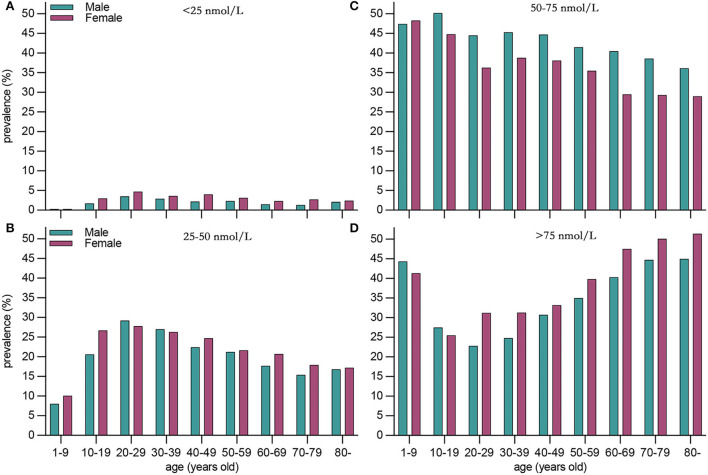
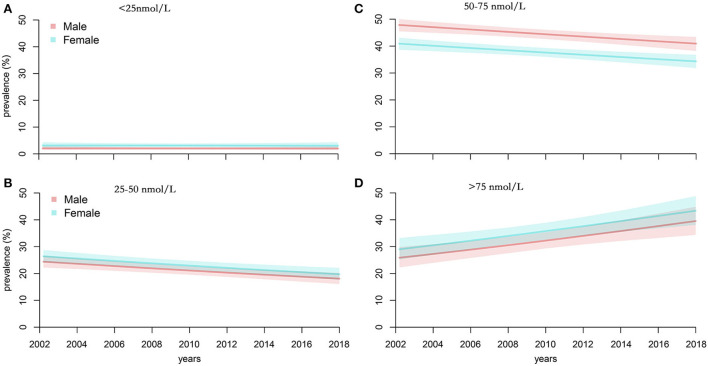
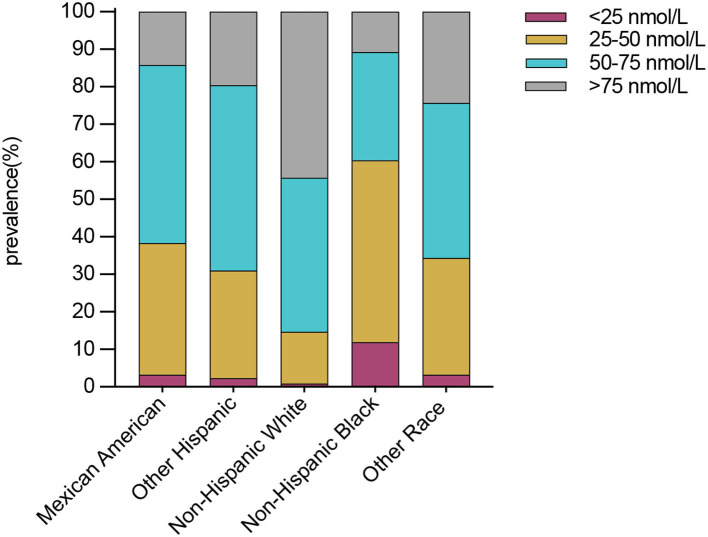
Based on the most recent data of 71,685 participants, our study showed that the weighted prevalence of severe and moderate VDD was 2.6% and 22.0%, and the prevalence of vitamin D insufficiency (VDI) and sufficiency was 40.9% and 34.5%. The prevalence of severe and moderate VDD was higher in women, non-Hispanic black Americans, people aged 20-29 years, and during the season of winter. From 2001 to 2018, we found a slight linear decrease in the prevalence of moderate VDD (coefficient = -0.847; = 0.009) and VDI (coefficient = -0.810; = 0.014). We also found a slight linear increase in vitamin D sufficient (coefficient = 1.693; = 0.004). However, no trend change was observed in severe VDD (coefficient = -0.037; = 0.698). Age, sex, ethnicity, season, sun-protective behaviors, lower BMI, lower socioeconomic status (SES), drinking, and lower milk consumption were predictors of severe VDD.
Vitamin D deficiency is still prevalent in the United States, especially in non-Hispanic black Americans, women, individuals aged 20-29, and during winter. Therefore, individuals, healthcare providers, and policymakers should take public health measures to develop and implement prevention strategies to deal with VDD.
美国国家健康与营养检查调查(NHANES)每两年收集并向公众发布一次数据。美国国家健康与营养检查调查关于美国人维生素D状况的最新研究基于2001年至2014年的数据,而最新数据(2015 - 2016年和2017 - 2018年)尚未得到研究。因此,我们从NHANES(2001 - 2018年)中提取了所有可用数据,旨在分析美国人群中维生素D缺乏(VDD)的患病率和趋势,以填补研究空白。
根据先前的研究和维生素D营养指南,严重维生素D缺乏定义为血清25(OH)D水平<25 nmol/L,中度缺乏为25 - 50 nmol/L,不足为50 - 75 nmol/L,充足为>75 nmol/L。我们全面估计了美国人血清25(OH)D水平<25、25 - 50、50 - 75和>75 nmol/L的患病率,并描述了2001年至2018年维生素D状况的趋势。使用加权多元线性回归模型探索维生素D缺乏的预测因素。所有分析和数据均使用流动检查中心(MEC)权重针对NHANES的复杂抽样设计进行了调整。
基于71,685名参与者的最新数据,我们的研究表明,严重和中度维生素D缺乏的加权患病率分别为2.6%和22.0%,维生素D不足(VDI)和充足的患病率分别为40.9%和34.5%。严重和中度维生素D缺乏在女性、非西班牙裔美国黑人、20 - 29岁人群以及冬季的患病率较高。从2001年到2018年,我们发现中度维生素D缺乏(系数 = -0.847;P = 0.009)和维生素D不足(系数 = -0.810;P = 0.014)的患病率略有线性下降。我们还发现维生素D充足的情况略有线性增加(系数 = 1.693;P = 0.004)。然而,严重维生素D缺乏未观察到趋势变化(系数 = -0.037;P = 0.698)。年龄、性别、种族、季节、防晒行为、较低的体重指数、较低的社会经济地位(SES)、饮酒以及较低的牛奶摄入量是严重维生素D缺乏的预测因素。
维生素D缺乏在美国仍然普遍存在,尤其是在非西班牙裔美国黑人、女性、20 - 29岁的个体以及冬季。因此,个人、医疗保健提供者和政策制定者应采取公共卫生措施来制定和实施预防策略以应对维生素D缺乏。