Bopp Luisa, Wieland Ulrike, Hellmich Martin, Kreuter Alexander, Pfister Herbert, Silling Steffi
Institute of Virology, National Reference Center for Papilloma- and Polyomaviruses, University of Cologne, Faculty of Medicine and University Hospital of Cologne, Cologne, Germany.
Department of Dermatology and Venereology, University of Cologne, Cologne, Germany.
Front Microbiol. 2021 Oct 18;12:740947. doi: 10.3389/fmicb.2021.740947. eCollection 2021.
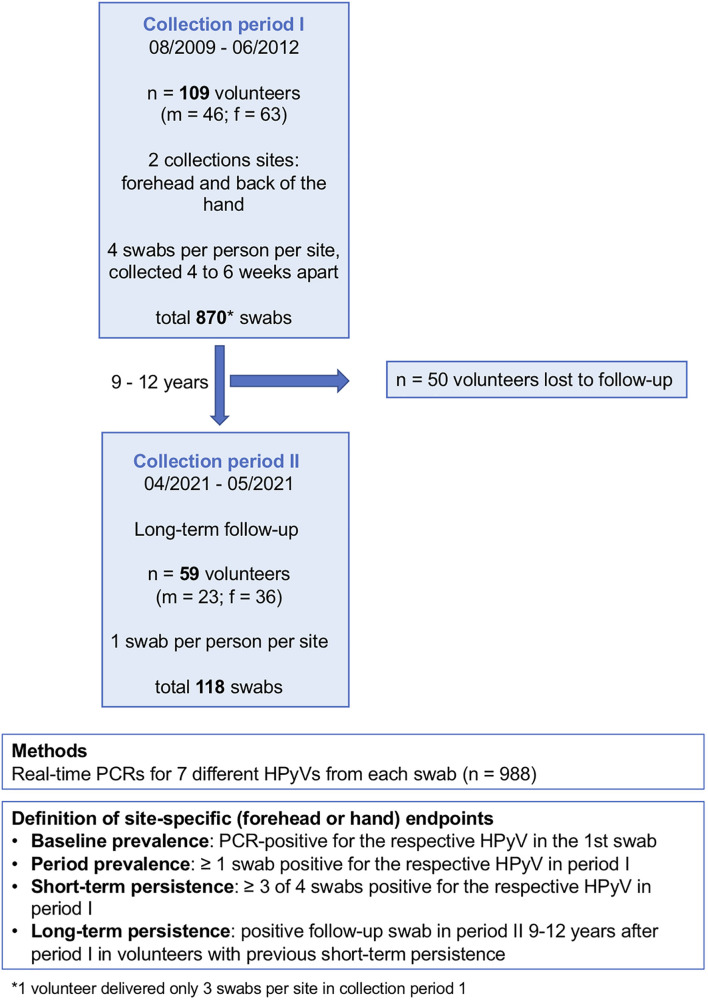
Several human polyomaviruses (HPyVs) were recently discovered. Merkel cell polyomavirus (MCPyV) induces Merkel cell carcinoma. HPyV6, HPyV7, and TSPyV have been associated with rare skin lesions in immunosuppressed patients. HPyV9, HPyV10, and Saint Louis Polyomavirus (STLPyV) have not been convincingly associated with any disease. The aim of this prospective study was to evaluate the cutaneous prevalence, persistence and viral load of HPyVs in healthy individuals. Eight hundred seventy forehead and hand swabs were collected from 109 volunteers 4-6 weeks apart (collection period-1). Fifty-nine participants were available for follow-up a decade later (collection period-2). HPyV-DNA prevalence and viral loads of MCPyV, HPyV6, HPyV7, TSPyV, HPyV9, HPyV10, and STLPyV were determined by virus-specific real-time PCRs. Risk factors for HPyV prevalence, short- and long-term persistence were explored by logistic regression analyses. Baseline prevalence rates were similar for forehead and hand: MCPyV 67.9/67.0%, HPyV6 31.2/25.7%, HPyV7 13.8/11.0%, HPyV10 11.9/15.6%, STLPyV 7.3/8.3%, TSPyV 0.9/0.9%, and HPyV9 0.9/0.9%. Short-term persistence in period-1 was found in 59.6% (MCPyV), 23.9% (HPyV6), 10.1% (HPyV7), 6.4% (HPyV10), 5.5% (STLPyV), and 0% (TSPyV and HPyV9) on the forehead, with similar values for the hand. Long-term persistence for 9-12 years occurred only for MCPyV (forehead/hand 39.0%/44.1% of volunteers), HPyV6 (16.9%/11.9%), and HPyV7 (3.4%/5.1%). Individuals with short-term persistence had significantly higher viral loads at baseline compared to those with transient DNA-positivity ( < 0.001 for MCPyV, HPyV6, HPyV7, and HPyV10, respectively). This was also true for median viral loads in period-1 of MCPyV, HPyV6, and HPyV7 of volunteers with long-term persistence. Multiplicity (two or more different HPyVs) was a risk factor for prevalence and persistence for most HPyVs. Further risk factors were older age for HPyV6 and male sex for MCPyV on the forehead. Smoking was not a risk factor. In contrast to MCPyV, HPyV6, HPyV7, and rarely STLPyV, polyomaviruses TSPyV, HPyV9, and HPyV10 do not seem to be long-term constituents of the human skin virome of healthy individuals. Furthermore, this study showed that higher viral loads are associated with both short- and long-term persistence of HPyVs on the skin. HPyV multiplicity is a risk factor for prevalence, short-term and/or long-term persistence of MCPyV, HPyV6, HPyV7, and HPyV10.
最近发现了几种人类多瘤病毒(HPyVs)。默克尔细胞多瘤病毒(MCPyV)可诱发默克尔细胞癌。HPyV6、HPyV7和TSPyV与免疫抑制患者的罕见皮肤病变有关。HPyV9、HPyV10和圣路易斯多瘤病毒(STLPyV)尚未被确凿地证明与任何疾病有关。这项前瞻性研究的目的是评估健康个体中HPyVs的皮肤感染率、持续性和病毒载量。从109名志愿者那里采集了870份额头和手部拭子,间隔4 - 6周(采集期1)。十年后,59名参与者可供随访(采集期2)。通过病毒特异性实时PCR测定MCPyV、HPyV6、HPyV7、TSPyV、HPyV9、HPyV10和STLPyV的HPyV - DNA感染率和病毒载量。通过逻辑回归分析探索HPyV感染率、短期和长期持续性的风险因素。额头和手部的基线感染率相似:MCPyV为67.9%/67.0%,HPyV6为31.2%/25.7%,HPyV7为13.8%/11.0%,HPyV10为11.9%/15.6%,STLPyV为7.3%/8.3%,TSPyV为0.9%/0.9%,HPyV9为0.9%/0.9%。在额头,59.6%(MCPyV)、23.9%(HPyV6)、10.1%(HPyV7)、6.4%(HPyV10)、5.5%(STLPyV)在采集期1有短期持续性,手部情况类似。9至12年的长期持续性仅发生在MCPyV(额头/手部,分别为39.0%/44.1%的志愿者)、HPyV6(16.9%/11.9%)和HPyV7(3.4%/5.1%)。与短暂DNA阳性者相比,短期持续性个体在基线时的病毒载量显著更高(MCPyV、HPyV6、HPyV7和HPyV10分别<0.001)。对于长期持续性志愿者在采集期1的MCPyV、HPyV6和HPyV7的中位病毒载量也是如此。多种感染(两种或更多不同的HPyVs)是大多数HPyVs感染率和持续性的风险因素。其他风险因素包括额头感染HPyV6时年龄较大以及额头感染MCPyV时为男性。吸烟不是风险因素。与MCPyV、HPyV6、HPyV7以及很少见的STLPyV不同,多瘤病毒TSPyV、HPyV9和HPyV10似乎不是健康个体人类皮肤病毒组的长期组成部分。此外,这项研究表明,较高的病毒载量与HPyVs在皮肤上的短期和长期持续性都有关。HPyV多种感染是MCPyV、HPyV6、HPyV7和HPyV10感染率、短期和/或长期持续性的风险因素。