Tao Yanqiu, Rahn Christopher D, Archer Lynden A, You Fengqi
Robert Frederick Smith School of Chemical and Biomolecular Engineering, Cornell University, Ithaca, NY 14853, USA.
Department of Mechanical Engineering, The Pennsylvania State University, University Park, PA 16802, USA.
Sci Adv. 2021 Nov 5;7(45):eabi7633. doi: 10.1126/sciadv.abi7633.
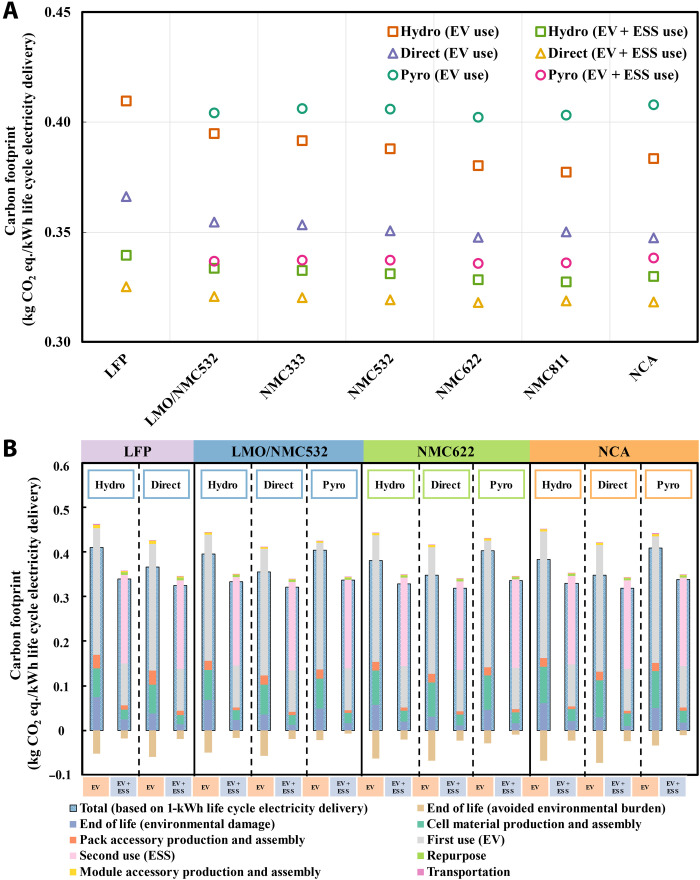
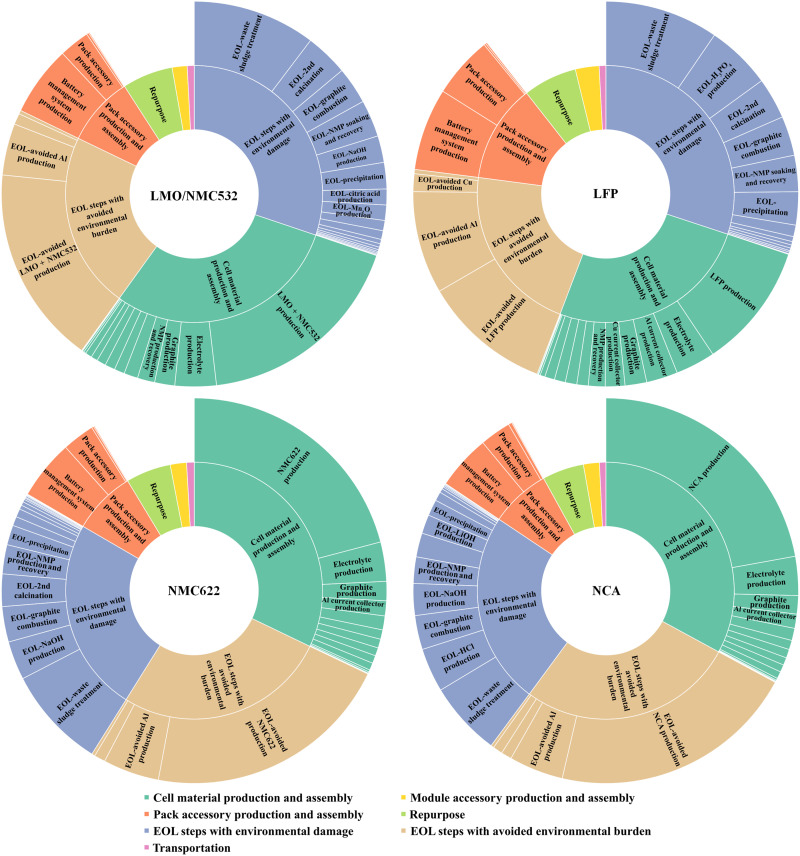
Second life and recycling of retired automotive lithium-ion batteries (LIBs) have drawn growing attention, as large volumes of LIBs will retire in the coming decade. Here, we illustrate how battery chemistry, use, and recycling can influence the energy and environmental sustainability of LIBs. We find that LIBs with higher specific energy show better life cycle environmental performances, but their environmental benefits from second life application are less pronounced. Direct cathode recycling is found to be the most effective in reducing life cycle environmental impacts, while hydrometallurgical recycling provides limited sustainability benefits for high-performance LIBs. Battery design with less aluminum and alternative anode materials, such as silicon-based anode, could enable more sustainable LIB recycling. Compared to directly recycling LIBs after their electric vehicle use, carbon footprint and energy use of LIBs recycled after their second life can be reduced by 8 to 17% and 2 to 6%, respectively.
随着大量锂离子电池(LIBs)将在未来十年退役,退役汽车锂离子电池的二次利用和回收越来越受到关注。在此,我们阐述了电池化学、使用和回收如何影响锂离子电池的能源和环境可持续性。我们发现,比能量较高的锂离子电池在生命周期内表现出更好的环境性能,但其二次利用带来的环境效益不太明显。直接回收阴极被认为是减少生命周期环境影响最有效的方法,而湿法冶金回收对高性能锂离子电池的可持续性效益有限。采用较少铝含量的电池设计以及替代负极材料,如硅基负极,可实现更可持续的锂离子电池回收。与电动汽车使用后直接回收锂离子电池相比,二次利用后回收的锂离子电池的碳足迹和能源消耗可分别减少8%至17%和2%至6%。