Collegium de Lyon, Université de Lyon, Lyon, France.
School of International Service, American University, Washington, DC, United States.
Int J Public Health. 2021 Jun 15;66:1604055. doi: 10.3389/ijph.2021.1604055. eCollection 2021.
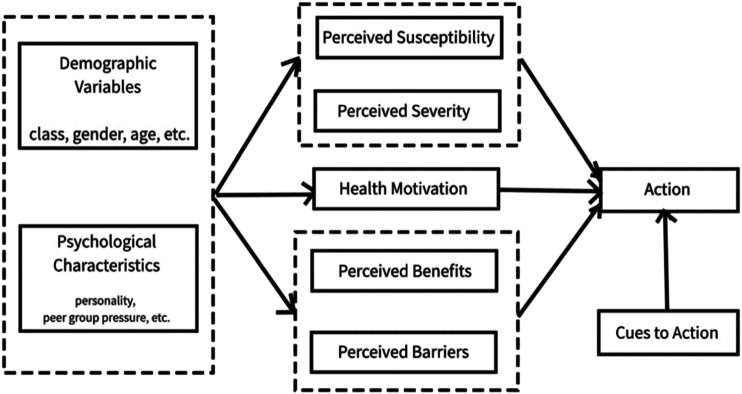
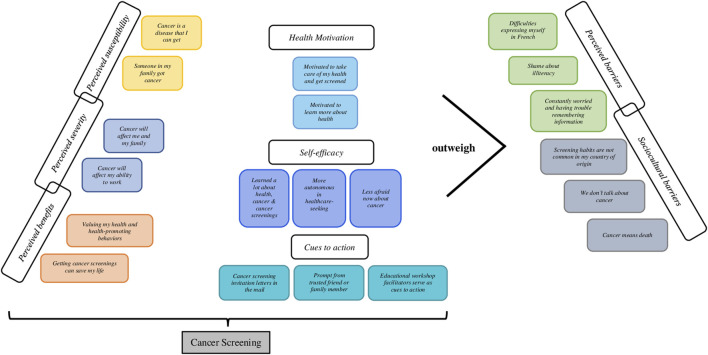
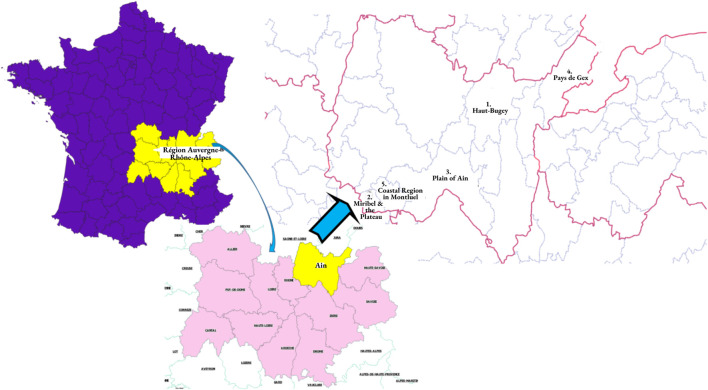
Cancer screening rates are suboptimal for disadvantaged populations in France, yet little evidence exists on their cancer-related knowledge and screening barriers. The main objective of this study was to examine cancer-related knowledge, awareness, self-efficacy, and perceptions of screening barriers among low-income, illiterate immigrant women in France following an 8-weeks cancer educational intervention. Semi-structured qualitative interviews were conducted with 164 female participants in the Ain department of France between January 2019 and March 2020. Adopting the Health Belief Model as an intervention and analytic framework, salient themes were identified using qualitative thematic analysis. Increased levels of perceived susceptibility to and perceived severity of cancer contributed to higher motivation to get screened. Barriers to screening included low French proficiency, shame surrounding illiteracy, and constant worries due to precarious living conditions. Perceived benefits (e.g., valuing one's health and health-promoting behaviors), cues to action from a trusted source, and greater self-efficacy (e.g., more autonomous in healthcare-seeking) outweighed perceived barriers, including cultural barriers. Implications include developing audience-responsive targeted cancer screening communication strategies and educational materials to increase screening rates and reduce cancer and cancer screening inequities.
法国弱势群体的癌症筛查率不理想,但关于他们的癌症相关知识和筛查障碍的证据很少。本研究的主要目的是在对法国 8 周的癌症教育干预之后,调查法国贫困、文盲移民妇女的癌症相关知识、意识、自我效能感和对筛查障碍的看法。 2019 年 1 月至 2020 年 3 月期间,在法国 Ain 省对 164 名女性参与者进行了半结构化定性访谈。采用健康信念模型作为干预和分析框架,使用定性主题分析确定了突出的主题。 更高的癌症易感性和严重程度感知水平有助于提高筛查的动机。筛查障碍包括法语水平低、对文盲的羞耻感以及由于不稳定的生活条件而不断担忧。感知到的益处(例如,重视健康和促进健康的行为)、来自信任来源的行动线索以及更大的自我效能感(例如,在寻求医疗保健方面更加自主)超过了感知到的障碍,包括文化障碍。 这意味着要制定针对目标受众的癌症筛查传播策略和教育材料,以提高筛查率,减少癌症和癌症筛查的不平等。