Department of Maternal and Child Health School of Public Health Tongji Medical CollegeHuazhong University of Science and Technology Wuhan China.
Ministry of Education Key Laboratory of Environment and Health, and State Key Laboratory of Environmental Health (Incubating) School of Public Health Tongji Medical CollegeHuazhong University of Science and Technology Wuhan China.
J Am Heart Assoc. 2021 Nov 16;10(22):e022502. doi: 10.1161/JAHA.121.022502. Epub 2021 Nov 10.
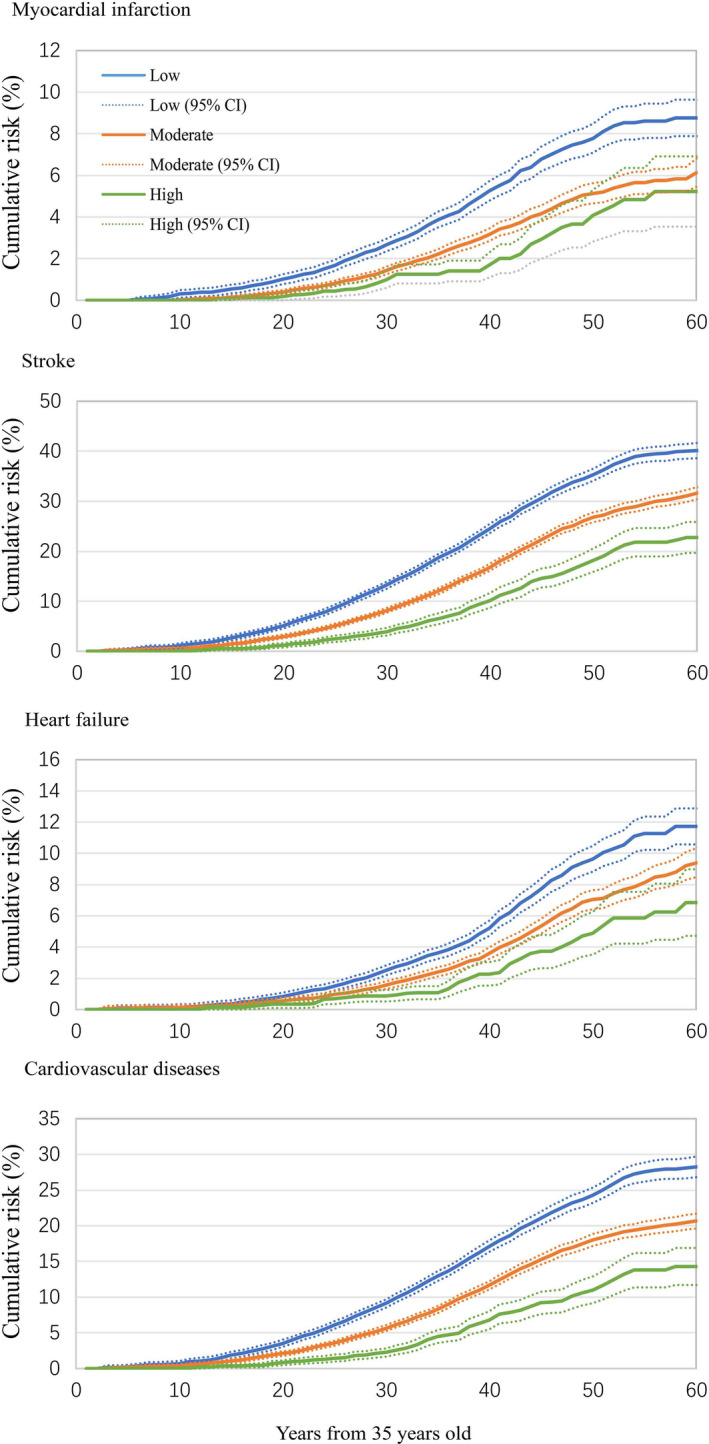
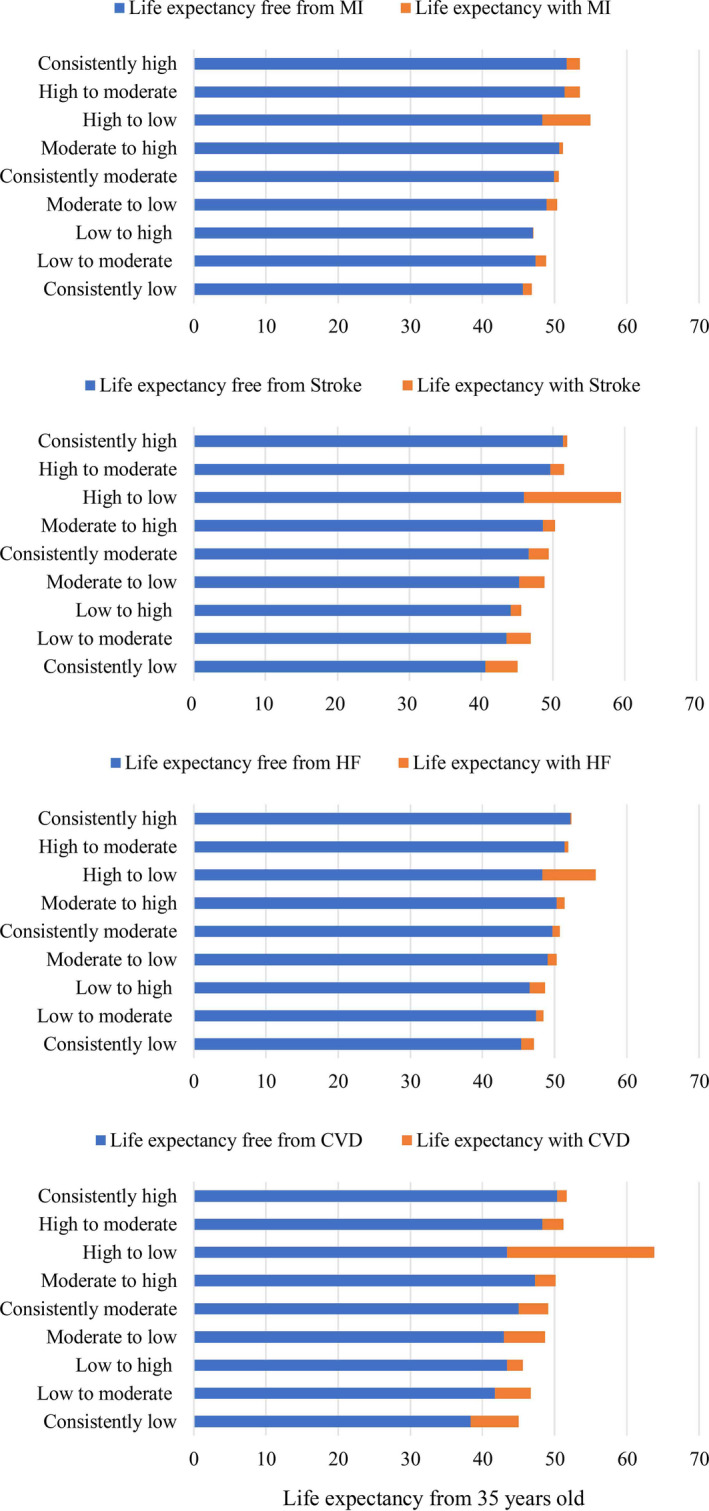
Background Cardiovascular health (CVH) status is associated with cardiovascular diseases (CVD). However, evidence for association of CVH change with risk of CVD is scarce. Methods and Results Seven metrics (smoking status, body mass index, physical activity, diet, total cholesterol, blood pressure, and fasting blood glucose) were used to evaluate the CVH status. Having 0 to 2, 3 to 4, and 5 to 7 ideal cardiovascular metrics were categorized as low, moderate, and high CVH status, respectively. Change in CVH status was assessed from 2006/2007 to 2010/2011. We calculated lifetime risk of CVD using a modified Kaplan-Meier method, and life expectancy was evaluated via the multistate lifetable method. There were 82 349 participants included in our analysis. At 35 years index age, the age-adjusted incident rate and lifetime risk of CVD were increased with decreasing number of ideal CVH metrics. The direction of change in status of CVH was consistently associated with age-adjusted incident rate and lifetime risk of CVD. At 35 years index age, improvement from low to moderate (37.6% [95% CI, 32.8%-42.4%]) or to high status (24.4% [95% CI, 12.7%-36.0%]) had lower lifetime risk of CVD compared with consistently low status (44.6% [95% CI, 40.8%-48.5%]). The improvement in CVH could prolong the years of life free from CVD. The pattern of incident rate and lifetime risk across change in CVH status was similar at 45 and 55 years index age. Conclusions Higher number of CVH metrics was associated with lower lifetime risk of CVD. The improvement of CVH status could reduce the lifetime risk of CVD and prolonged the year of life free from CVD.
心血管健康(CVH)状况与心血管疾病(CVD)相关。然而,CVH 变化与 CVD 风险之间关联的证据很少。
使用 7 项指标(吸烟状况、体重指数、身体活动、饮食、总胆固醇、血压和空腹血糖)评估 CVH 状况。将 0 至 2、3 至 4 和 5 至 7 项理想心血管指标分别归类为低、中、高 CVH 状态。从 2006/2007 年到 2010/2011 年评估 CVH 状态的变化。我们使用改良的 Kaplan-Meier 方法计算 CVD 的终生风险,通过多状态生命表方法评估预期寿命。我们的分析包括 82349 名参与者。在 35 岁指数年龄时,随着理想 CVH 指标数量的减少,校正年龄后的 CVD 发生率和终生风险增加。CVH 状态变化的方向与校正年龄后的 CVD 发生率和终生风险始终相关。在 35 岁指数年龄时,与持续低状态相比,从低到中(37.6%[95%CI,32.8%-42.4%])或高状态(24.4%[95%CI,12.7%-36.0%])的改善状态具有较低的 CVD 终生风险(44.6%[95%CI,40.8%-48.5%])。改善 CVH 可延长无 CVD 的寿命。在 45 和 55 岁指数年龄时,CVH 状态变化的发生率和终生风险模式相似。
更多的 CVH 指标与较低的 CVD 终生风险相关。改善 CVH 状态可以降低 CVD 的终生风险并延长无 CVD 的寿命。