Rafiee Shabnam, Faryabi Roghaye, Yargholi Alireza, Zareian Mohammad Ali, Hawkins Jessie, Shivappa Nitin, Shirbeigi Laila
Department of Traditional Medicine, School of Persian Medicine, Tehran University of Medical Sciences (TUMS), Tehran, Iran.
Integrative Health, Franklin School of Integrative Health Sciences, Franklin, TN, USA.
Evid Based Complement Alternat Med. 2021 Nov 1;2021:6622981. doi: 10.1155/2021/6622981. eCollection 2021.
Existing evidence produces conflicting findings regarding the effect of sesame intake on inflammatory biomarkers; this knowledge gap has yet to be met through systematic review and meta-analysis. This meta-analysis of randomized, controlled clinical trials (RCTs) was conducted to evaluate the effects of sesame consumption on markers of inflammation in humans.
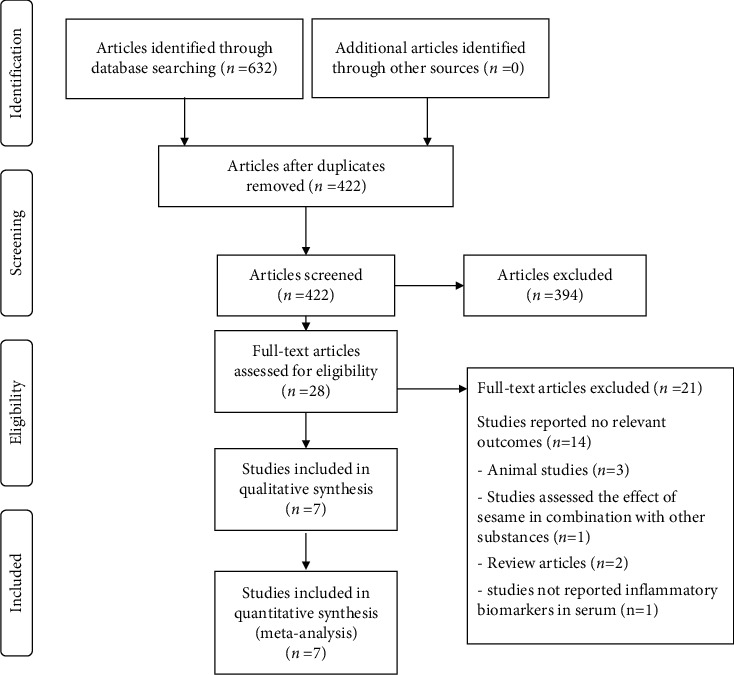
PubMed, Scopus, and the Cochrane Database of Systematic Reviews were searched through August 2020 to identify relevant papers for inclusion. Using the random-effects model, data were evaluated as weighted mean differences (WMD) with 95% confidence intervals (CI). Cochrane's and -squared ( ) tests were used to identify within-studies heterogeneity.
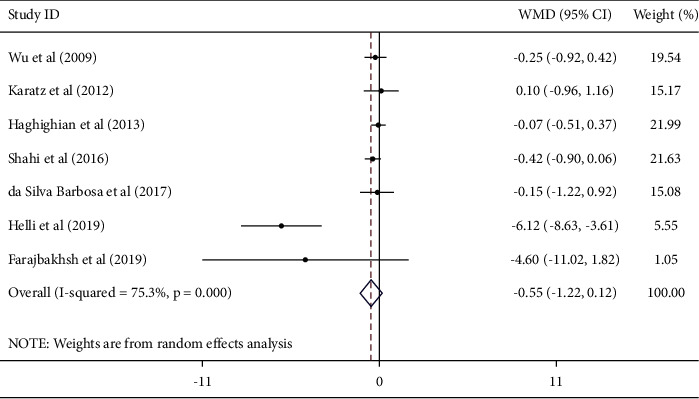
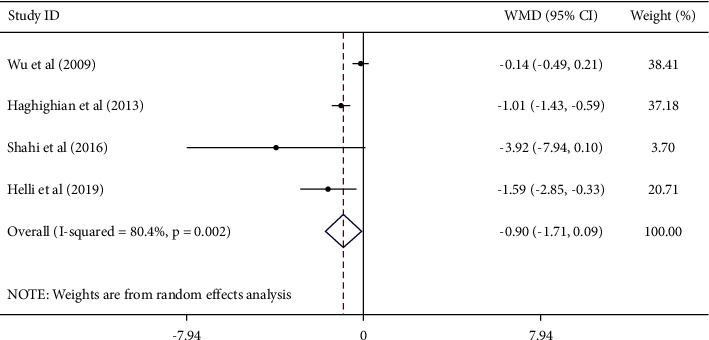
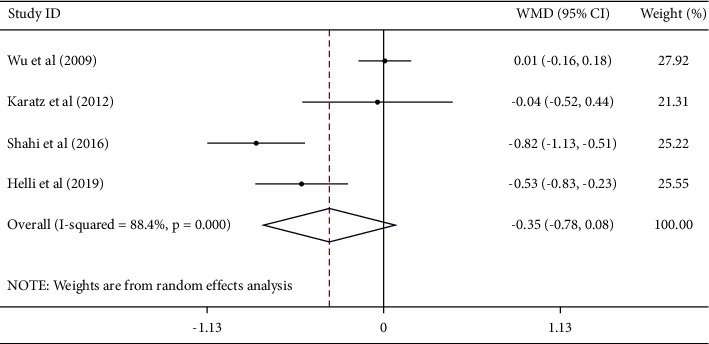
Seven RCTs with 310 participants (157 intervention and 153 control) were included in the meta-analysis. Sesame consumption reduced serum level interleukin-6 (IL-6) (WMD - 0.90; 95% CI (-1.71, -0.09), = 80.4%) compared to the control group. However, sesame intake had no significant effects on C-reactive protein (CRP) and tumor necrosis factor- (TNF-) compared to the control group. Subgroup analysis identified a reduction in serum CRP, TNF-, and IL-6 concentration among studies with participants who had a higher level of these biomarkers at baseline, those which used sesamin capsules, and those with a bigger sample size, those conducted in Asia, and studies on females.
Sesame consumption reduced serum levels of IL-6 but did not affect CRP and TNF- in humans. Additional trials should be conducted utilizing a larger and longer treatment duration, along with studies using different sesame formulations (capsule, oil, and seed) and conducting on participants with varied health conditions.
现有证据对于芝麻摄入对炎症生物标志物的影响产生了相互矛盾的结果;这一知识空白尚未通过系统评价和荟萃分析得到填补。本随机对照临床试验(RCT)的荟萃分析旨在评估芝麻消费对人体炎症标志物的影响。
检索截至2020年8月的PubMed、Scopus和Cochrane系统评价数据库,以确定纳入的相关论文。使用随机效应模型,数据以加权平均差(WMD)和95%置信区间(CI)进行评估。采用Cochrane's Q检验和I²检验来识别研究内的异质性。
荟萃分析纳入了7项RCT,共310名参与者(157名干预组和153名对照组)。与对照组相比,食用芝麻可降低血清白细胞介素-6(IL-6)水平(WMD -0.90;95%CI(-1.71,-0.09),I² = 80.4%)。然而,与对照组相比,芝麻摄入对C反应蛋白(CRP)和肿瘤坏死因子-α(TNF-α)没有显著影响。亚组分析发现,在基线时这些生物标志物水平较高的参与者、使用芝麻素胶囊的参与者、样本量较大的参与者、在亚洲进行的研究以及女性研究中,血清CRP、TNF-α和IL-6浓度有所降低。
食用芝麻可降低人体血清IL-6水平,但不影响CRP和TNF-α。应进行更多试验,采用更大的样本量和更长的治疗时间,以及使用不同芝麻制剂(胶囊、油和种子)并针对不同健康状况参与者的研究。