Cubo-Mateo Nieves, Gelinsky Michael
Centre for Translational Bone, Joint and Soft Tissue Research, University Hospital Carl Gustav Carus and Faculty of Medicine, Technische Universität Dresden, Dresden, Germany.
Escuela Superior de Ciencia y Tecnología, Universidad Internacional de Valencia, Valencia, Spain.
Front Bioeng Biotechnol. 2021 Oct 25;9:720217. doi: 10.3389/fbioe.2021.720217. eCollection 2021.
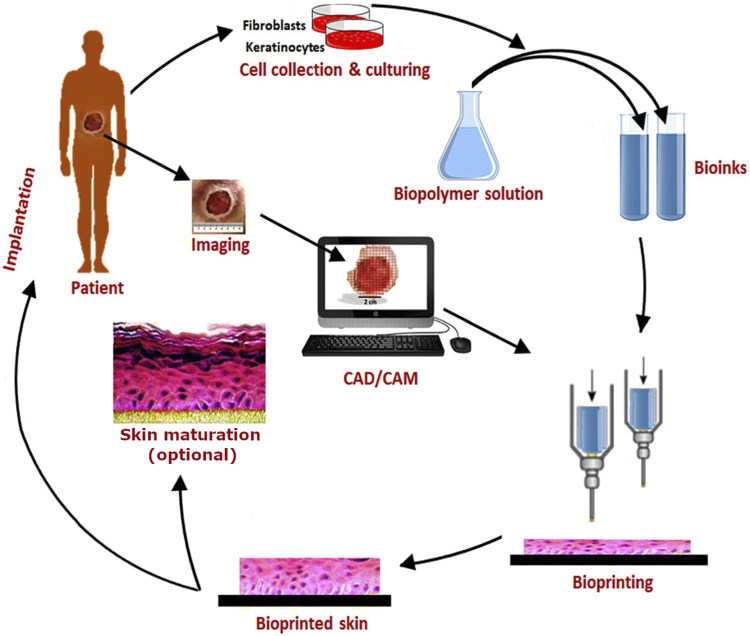
Skin wound healing is known to be impaired in space. As skin is the tissue mostly at risk to become injured during manned space missions, there is the need for a better understanding of the biological mechanisms behind the reduced wound healing capacity in space. In addition, for far-distant and long-term manned space missions like the exploration of Mars or other extraterrestrial human settlements, e.g., on the Moon, new effective treatment options for severe skin injuries have to be developed. However, these need to be compatible with the limitations concerning the availability of devices and materials present in space missions. Three-dimensional (3D) bioprinting (BP) might become a solution for both demands, as it allows the manufacturing of multicellular, complex and 3D tissue constructs, which can serve as models in basic research as well as transplantable skin grafts. The perspective article provides an overview of the state of the art of skin BP and approach to establish this additive manufacturing technology in space. In addition, the several advantages of BP for utilization in future manned space missions are highlighted.
众所周知,太空环境会损害皮肤伤口愈合。由于在载人航天任务中,皮肤是最容易受伤的组织,因此有必要更好地了解太空伤口愈合能力下降背后的生物学机制。此外,对于像火星探索或其他外星人类定居点(如月球)这样的远距离和长期载人航天任务,必须开发针对严重皮肤损伤的新的有效治疗方案。然而,这些方案需要与航天任务中设备和材料可用性的限制相兼容。三维(3D)生物打印(BP)可能成为满足这两种需求的解决方案,因为它能够制造多细胞、复杂的3D组织构建体,这些构建体既可以作为基础研究的模型,也可以作为可移植的皮肤移植物。这篇观点文章概述了皮肤生物打印的现状以及在太空中建立这种增材制造技术的方法。此外,还强调了生物打印在未来载人航天任务中的几个优势。