Institute for Chemical and Bioengineering, Department of Chemistry and Applied Biosciences, ETH Zürich, Vladimir-Prelog-Weg 1, 8093, Zürich, Switzerland.
Department of Chemical, Environmental and Materials Engineering, University of Jaén, Campus Las Lagunillas s/n, 23071, Jaén, Spain.
Nat Commun. 2021 Nov 11;12(1):6490. doi: 10.1038/s41467-021-26680-3.
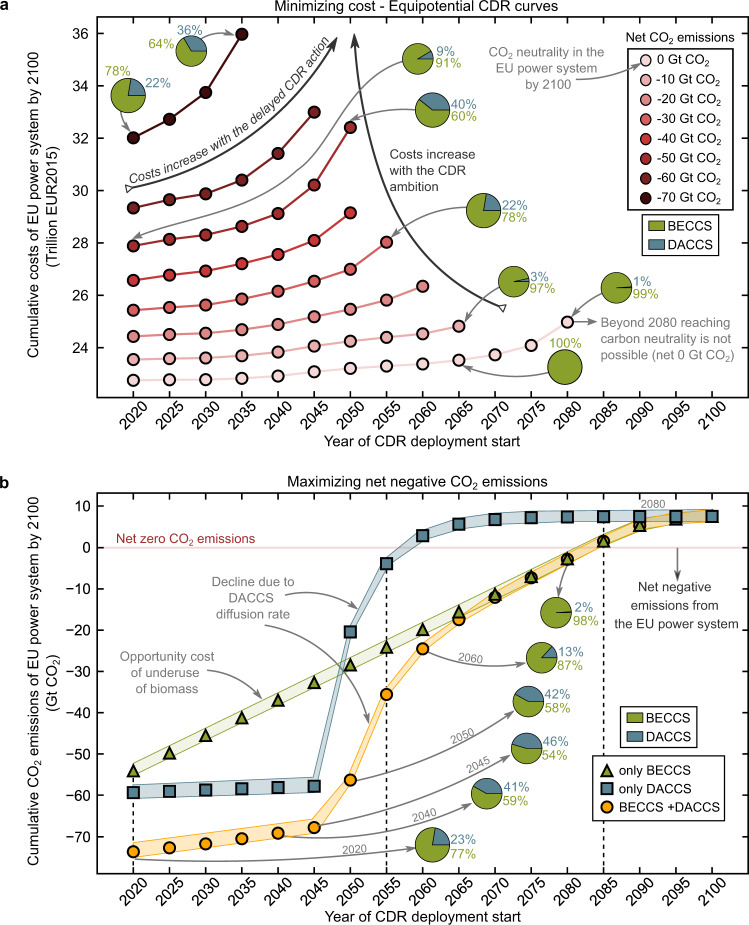
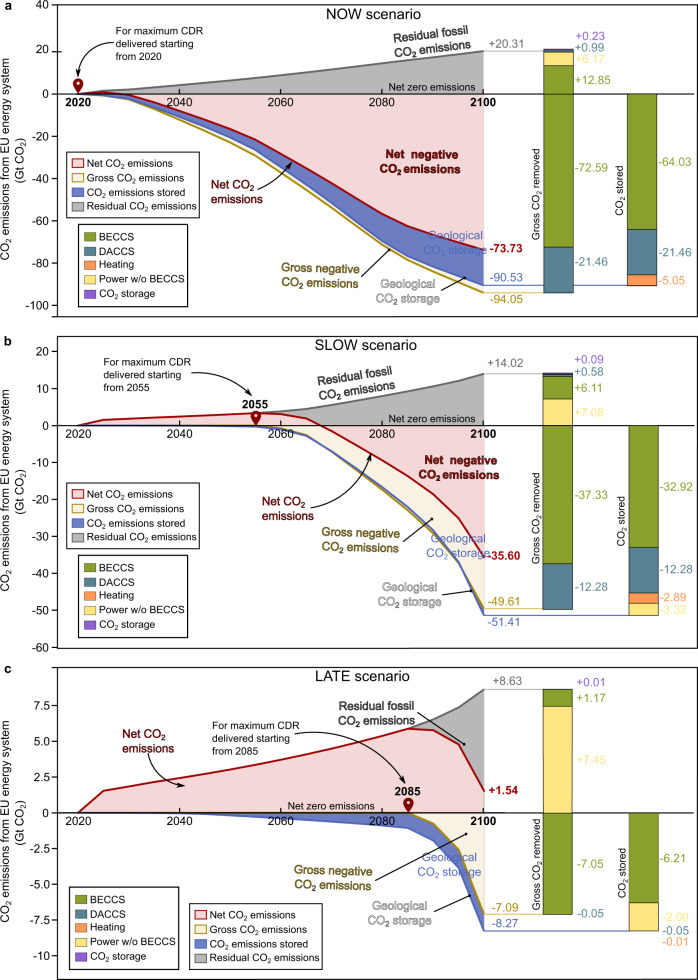
Carbon dioxide removal (CDR) will be essential to meet the climate targets, so enabling its deployment at the right time will be decisive. Here, we investigate the still poorly understood implications of delaying CDR actions, focusing on integrating direct air capture and bioenergy with carbon capture and storage (DACCS and BECCS) into the European Union power mix. Under an indicative target of -50 Gt of net CO by 2100, delayed CDR would cost an extra of 0.12-0.19 trillion EUR per year of inaction. Moreover, postponing CDR beyond mid-century would substantially reduce the removal potential to almost half (-35.60 Gt CO) due to the underused biomass and land resources and the maximum technology diffusion speed. The effective design of BECCS and DACCS systems calls for long-term planning starting from now and aligned with the evolving power systems. Our quantitative analysis of the consequences of inaction on CDR-with climate targets at risk and fair CDR contributions at stake-should help to break the current impasse and incentivize early actions worldwide.
二氧化碳去除(CDR)对于实现气候目标至关重要,因此适时部署将具有决定性意义。在这里,我们研究了延迟 CDR 行动仍未被充分理解的影响,重点研究了将直接空气捕集和生物能源与碳捕集和封存(DACCS 和 BECCS)纳入欧盟电力组合。在 2100 年实现净 CO2 排放减少 500 亿吨的目标下,每年不采取行动将额外增加 0.12-0.19 万亿欧元的成本。此外,由于生物量和土地资源的利用不足以及技术扩散速度的最大值,将 CDR 推迟到本世纪中叶以后,将大大降低去除潜力,接近一半(-356 亿吨 CO2)。为了有效地设计 BECCS 和 DACCS 系统,需要从现在开始进行长期规划,并与不断发展的电力系统保持一致。我们对 CDR 不作为的后果进行了定量分析,其中包括面临风险的气候目标和利益相关的公平 CDR 贡献,这应该有助于打破当前的僵局,并激励全球采取早期行动。