Aayanifard Zahra, Alebrahim Talieh, Pourmadadi Mehrab, Yazdian Fatemeh, Dinani Homayoon Soleimani, Rashedi Hamid, Omidi Meisam
School of Chemical Engineering College of Engineering University of Tehran Tehran Iran.
Protein Research Center Shahid Beheshti University Tehran Iran.
Eng Life Sci. 2021 Aug 22;21(11):739-752. doi: 10.1002/elsc.202000118. eCollection 2021 Nov.
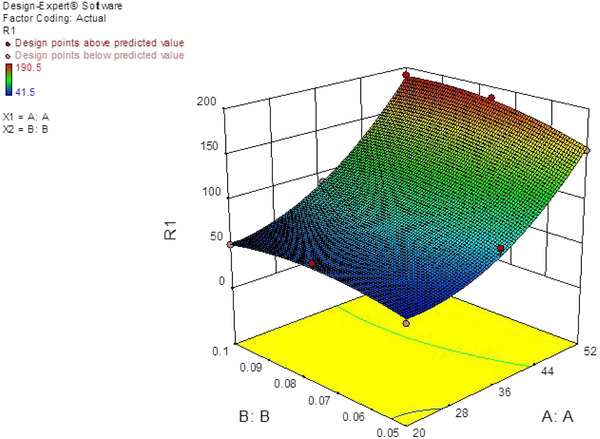
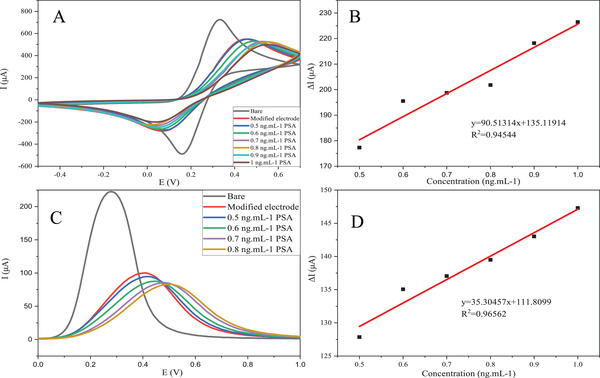
The development of a rapid, sensitive, and straightforward detection method of prostate-specific antigen (PSA) is indispensable for the early diagnosis of prostate cancer (PCa). This work relates an electrochemical method using functionalized single-stranded DNA aptamer to diagnose PCa and benign prostate hyperplasia. The sensing platform relies on PSA recognition by aptamer/Au/GO-nanohybrid-modified glassy carbon electrode. Besides ferrocyanide TiO/carbon quantum dots (CQDs) probe is used to investigate the effect of nanoparticle-containing electrolyte. Optimization of incubation time of aptamer/Au/GO-nanohybrid and volume fraction of nafion were done using Design Expert 10 software reporting 42.4 h and 0.095% V/V, respectively. In ferrocyanide medium, PSA detection as low as 3, 2.96, and 0.85 ng mL was achieved with a dynamic range from 0.5 to 7 ng ml, in accord with clinical values, using cyclic voltammetry, square wave voltammetry, and electrochemical impedance spectroscopy, respectively. Moreover, this sensor exhibited conspicuous performance in TiO/CQDs-containing medium with different pH values of 5.4 and 8 to distinguish total PSA and free PSA, resulting in very low limit of detections, 0.028, and 0.007 ng ml, respectively. The results manifested the proposed system as a forthcoming sensor in a clinical and point of care analysis of PSA.
开发一种快速、灵敏且简便的前列腺特异性抗原(PSA)检测方法对于前列腺癌(PCa)的早期诊断至关重要。这项工作涉及一种使用功能化单链DNA适配体的电化学方法来诊断PCa和良性前列腺增生。传感平台依赖于适配体/Au/GO纳米杂化物修饰的玻碳电极对PSA的识别。此外,使用亚铁氰化钛/碳量子点(CQDs)探针来研究含纳米颗粒电解质的影响。使用Design Expert 10软件对适配体/Au/GO纳米杂化物的孵育时间和Nafion的体积分数进行了优化,分别报告为42.4小时和0.095% V/V。在亚铁氰化物介质中,使用循环伏安法、方波伏安法和电化学阻抗谱分别实现了低至3、2.96和0.85 ng/mL的PSA检测,动态范围为0.5至7 ng/mL,符合临床值。此外,该传感器在含有不同pH值(5.4和8)的TiO/CQDs介质中表现出显著性能,可区分总PSA和游离PSA,检测限分别低至0.028和0.007 ng/mL。结果表明所提出的系统是一种即将用于PSA临床和即时护理分析的传感器。