du Fossé Indy, Lal Snigdha, Hossaini Aydin Najl, Infante Ivan, Houtepen Arjan J
Optoelectronic Materials Section, Faculty of Applied Sciences, Delft University of Technology, Van der Maasweg 9, 2629 HZ Delft, The Netherlands.
Department of Nanochemistry, Istituto Italiano di Tecnologia, Via Morego 30, 16163 Genova, Italy.
J Phys Chem C Nanomater Interfaces. 2021 Nov 4;125(43):23968-23975. doi: 10.1021/acs.jpcc.1c07464. Epub 2021 Oct 26.
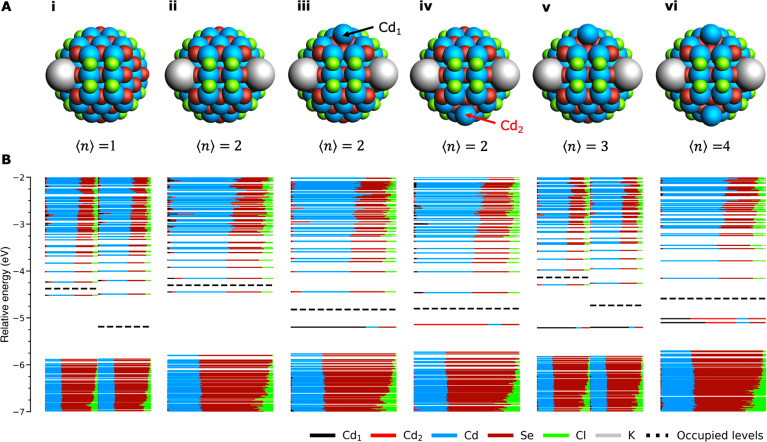
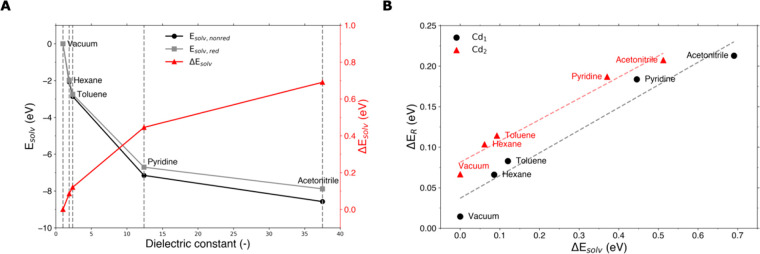
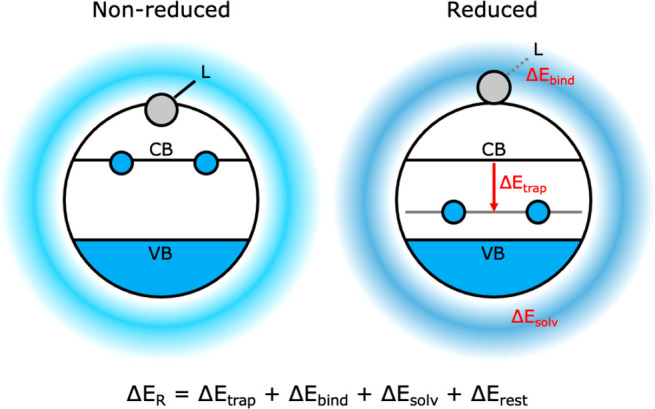
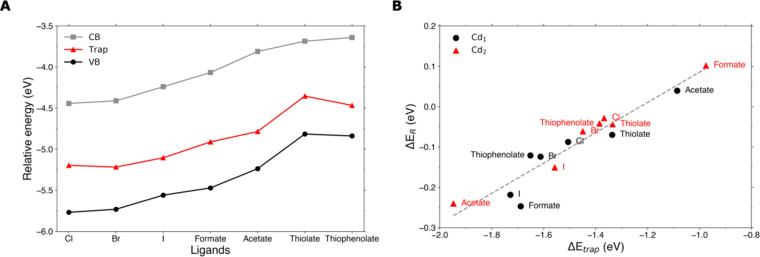
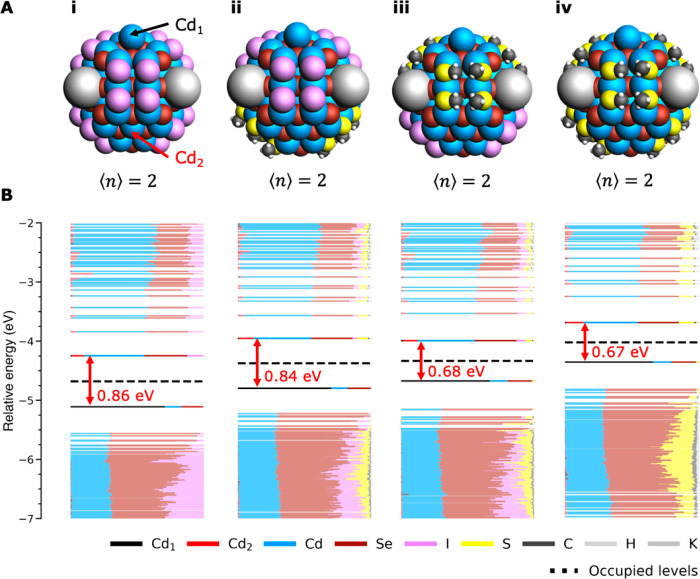
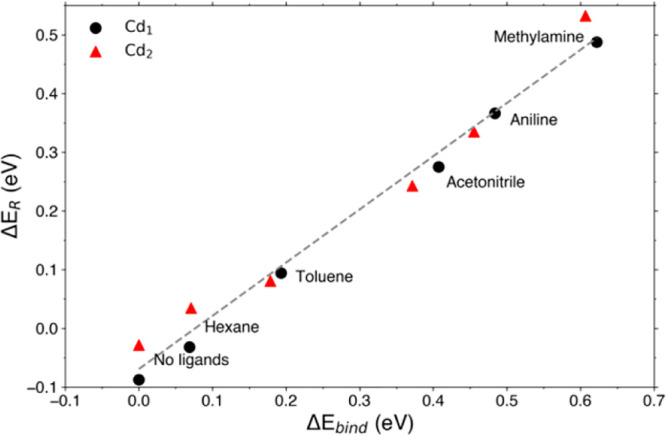
Many colloidal quantum dot (QD)-based devices involve charging of the QD, either via intentional electronic doping or via electrical charge injection or photoexcitation. Previous research has shown that this charging can give rise to undesirable electrochemical surface reactions, leading to the formation of localized in-gap states. However, little is known about the factors that influence the stability of charged QDs against surface oxidation or reduction. Here, we use density functional theory to investigate the effect of various ligands and solvents on the reduction of surface Cd in negatively charged CdSe QDs. We find that X-type ligands can lead to significant shifts in the energy of the band edges but that the in-gap state related to reduced surface Cd is shifted in the same direction. As a result, shifting the band edges to higher energies does not necessarily lead to less stable electron charging. However, subtle changes in the local electrostatic environment lead to a clear correlation between the position of the in-gap state in the bandgap and the energy gained upon surface reduction. Binding ligands directly to the Cd sites most prone to reduction was found to greatly enhance the stability of the electron charged QDs. We find that ligands bind much more weakly after reduction of the Cd site, leading to a loss in binding energy that makes charge localization no longer energetically favorable. Lastly, we show that increasing the polarity of the solvent also increases the stability of QDs charged with electrons. These results highlight the complexity of surface reduction reactions in QDs and provide valuable strategies for improving the stability of charged QDs.
许多基于胶体量子点(QD)的器件都涉及量子点的充电过程,其充电方式包括有意的电子掺杂、电荷注入或光激发。先前的研究表明,这种充电会引发不良的电化学表面反应,导致形成局域的带隙态。然而,对于影响带电量子点抵抗表面氧化或还原稳定性的因素,人们了解甚少。在此,我们使用密度泛函理论来研究各种配体和溶剂对带负电的CdSe量子点表面Cd还原的影响。我们发现,X型配体可导致带边能量发生显著偏移,但与表面Cd还原相关的带隙态会向相同方向移动。因此,将带边能量向更高能量方向移动并不一定会导致电子充电稳定性降低。然而,局部静电环境的细微变化会导致带隙中带隙态的位置与表面还原时获得的能量之间存在明显的相关性。发现将配体直接与最容易还原的Cd位点结合可大大提高带电量子点的稳定性。我们发现,Cd位点还原后配体的结合力会弱得多,导致结合能损失,使得电荷局域化在能量上不再有利。最后,我们表明增加溶剂的极性也会提高带负电量子点的稳定性。这些结果突出了量子点表面还原反应的复杂性,并为提高带电量子点的稳定性提供了有价值的策略。