LIBio Laboratory, University of Lorraine, 54505 Vandoeuvre-lès-Nancy, France.
UR AFPA Laboratory, Qualivie Team, University of Lorraine, 54505 Vandoeuvre-lès-Nancy, France.
Int J Mol Sci. 2021 Nov 1;22(21):11859. doi: 10.3390/ijms222111859.
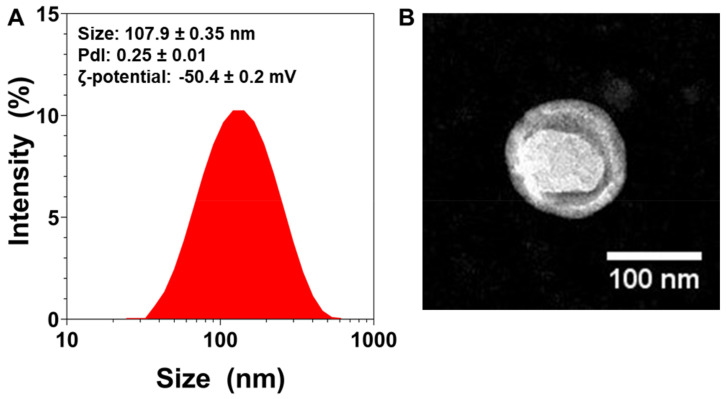
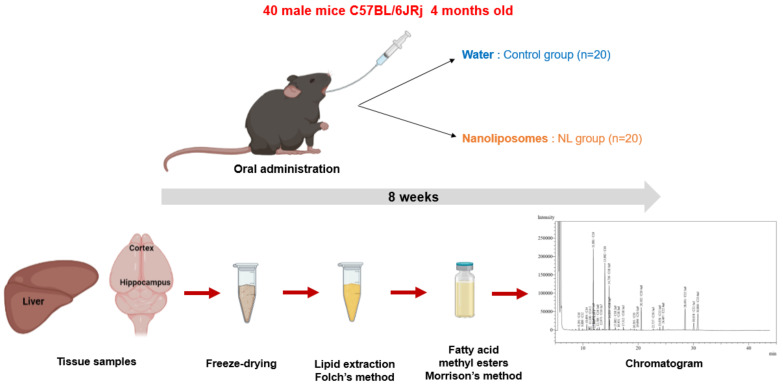
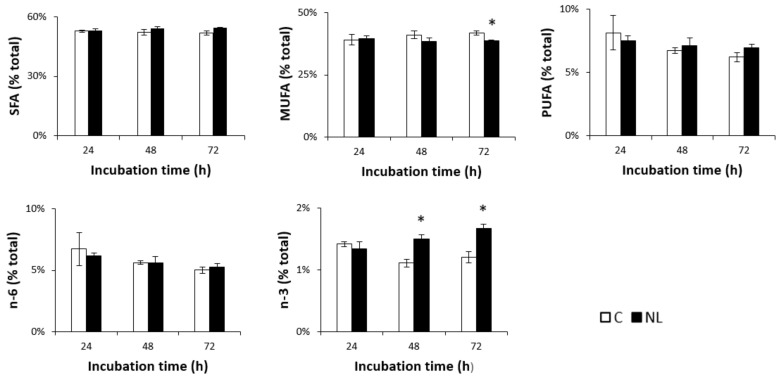
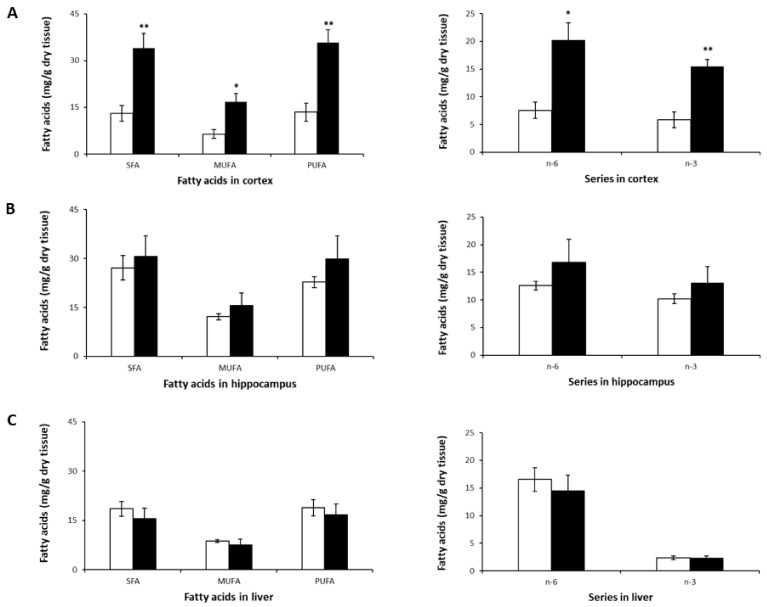
Omega-3 polyunsaturated fatty acids (n-3 PUFAs) play an important role in the development, maintenance, and function of the brain. Dietary supplementation of n-3 PUFAs in neurological diseases has been a subject of particular interest in preventing cognitive deficits, and particularly in age-related neurodegeneration. Developing strategies for the efficient delivery of these lipids to the brain has presented a challenge in recent years. We recently reported the preparation of n-3 PUFA-rich nanoliposomes (NLs) from salmon lecithin, and demonstrated their neurotrophic effects in rat embryo cortical neurons. The objective of this study was to assess the ability of these NLs to deliver PUFAs in cellulo and in vivo (in mice). NLs were prepared using salmon lecithin rich in n-3 PUFAs (29.13%), and characterized with an average size of 107.90 ± 0.35 nm, a polydispersity index of 0.25 ± 0.01, and a negative particle-surface electrical charge (-50.4 ± 0.2 mV). Incubation of rat embryo cortical neurons with NLs led to a significant increase in docosahexaenoic acid (DHA) (51.5%, < 0.01), as well as palmitic acid, and a small decrease in oleic acid after 72 h (12.2%, < 0.05). Twenty mice on a standard diet received oral administration of NLs (12 mg/mouse/day; 5 days per week) for 8 weeks. Fatty acid profiles obtained via gas chromatography revealed significant increases in cortical levels of saturated, monounsaturated, and n-3 (docosahexaenoic acid,) and n-6 (docosapentaenoic acid and arachidonic acid) PUFAs. This was not the case for the hippocampus or in the liver. There were no effects on plasma lipid levels, and daily monitoring confirmed NL biocompatibility. These results demonstrate that NLs can be used for delivery of PUFAs to the brain. This study opens new research possibilities in the development of preventive as well as therapeutic strategies for age-related neurodegeneration.
ω-3 多不饱和脂肪酸(n-3 PUFAs)在大脑的发育、维持和功能中发挥着重要作用。在预防认知功能障碍,特别是在与年龄相关的神经退行性疾病中,膳食补充 n-3 PUFAs 一直是一个特别关注的话题。近年来,开发将这些脂质有效递送到大脑的策略一直是一个挑战。我们最近报道了从三文鱼卵磷脂中制备富含 n-3 PUFAs 的纳米脂质体(NLs),并证明了它们在大鼠胚胎皮质神经元中的神经营养作用。本研究的目的是评估这些 NLs 在细胞内和体内(在小鼠中)递送 PUFAs 的能力。NLs 是用富含 n-3 PUFAs(29.13%)的三文鱼卵磷脂制备的,并具有平均粒径为 107.90 ± 0.35nm、多分散指数为 0.25 ± 0.01 和负的粒子表面电荷(-50.4 ± 0.2 mV)的特点。将 NLs 孵育在大鼠胚胎皮质神经元中可导致二十二碳六烯酸(DHA)(51.5%,<0.01)以及棕榈酸显著增加,而油酸在 72 小时后略有减少(12.2%,<0.05)。20 只标准饮食的小鼠每周 5 天接受 NLs(12mg/小鼠/天)的口服给药 8 周。通过气相色谱法获得的脂肪酸图谱显示,大脑皮层中饱和、单不饱和和 n-3(二十二碳六烯酸)和 n-6(二十二碳五烯酸和花生四烯酸)PUFAs 的水平显著增加。这种情况在海马体或肝脏中均未发生。血浆脂质水平没有变化,每日监测证实 NL 具有生物相容性。这些结果表明 NLs 可用于将 PUFAs 递送到大脑。本研究为开发与年龄相关的神经退行性疾病的预防和治疗策略开辟了新的研究可能性。