Institute for Bioengineering of Catalonia (IBEC), the Barcelona Institute of Technology (BIST), 08028, Barcelona, Spain.
Universitat Politècnica de Catalunya (UPC), Campus Nord, Carrer de Jordi Girona, 1, 3, 08034, Barcelona, Spain.
Nat Commun. 2021 Nov 12;12(1):6550. doi: 10.1038/s41467-021-26591-3.
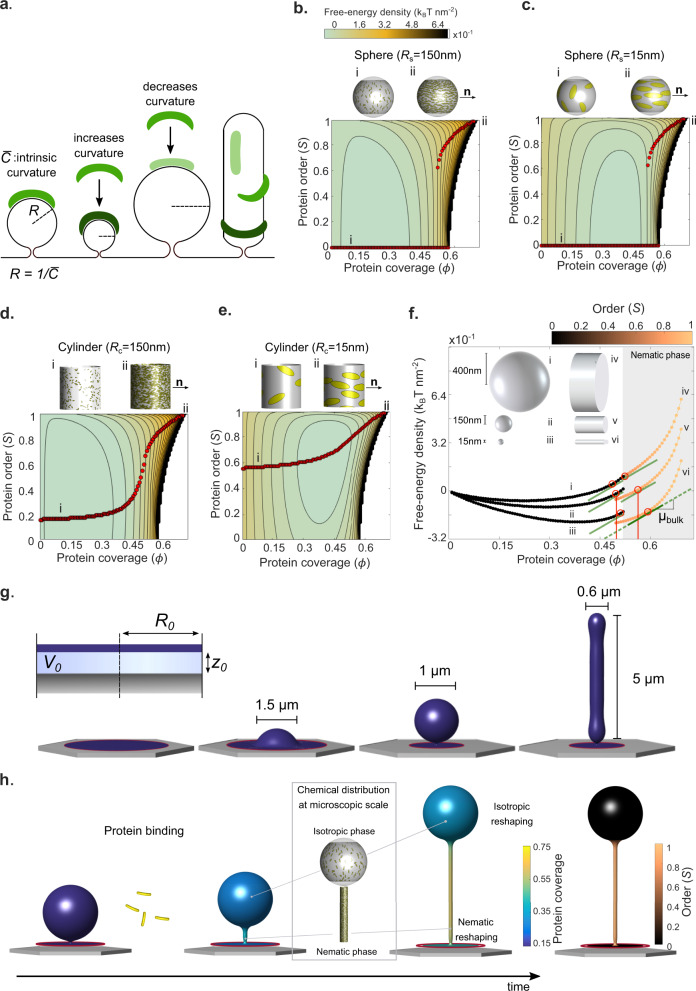
In many physiological situations, BAR proteins reshape membranes with pre-existing curvature (templates), contributing to essential cellular processes. However, the mechanism and the biological implications of this reshaping process remain unclear. Here we show, both experimentally and through modelling, that BAR proteins reshape low curvature membrane templates through a mechanochemical phase transition. This phenomenon depends on initial template shape and involves the co-existence and progressive transition between distinct local states in terms of molecular organization (protein arrangement and density) and membrane shape (template size and spherical versus cylindrical curvature). Further, we demonstrate in cells that this phenomenon enables a mechanotransduction mode, in which cellular stretch leads to the mechanical formation of membrane templates, which are then reshaped into tubules by BAR proteins. Our results demonstrate the interplay between membrane mechanics and BAR protein molecular organization, integrating curvature sensing and generation in a comprehensive framework with implications for cell mechanical responses.
在许多生理情况下,BAR 蛋白会重塑具有预先存在曲率(模板)的膜,从而促进重要的细胞过程。然而,这个重塑过程的机制和生物学意义仍不清楚。在这里,我们通过实验和建模表明,BAR 蛋白通过机械化学相转变重塑低曲率膜模板。这种现象取决于初始模板的形状,并涉及分子组织(蛋白质排列和密度)和膜形状(模板大小和球形与圆柱形曲率)方面的不同局部状态的共存和逐步转变。此外,我们在细胞中证明,这种现象能够实现一种机械转导模式,其中细胞拉伸导致膜模板的机械形成,然后由 BAR 蛋白将其重塑成管状。我们的结果表明,膜力学和 BAR 蛋白分子组织之间存在相互作用,将曲率感应和产生整合到一个具有细胞机械响应意义的综合框架中。