Valentini Nadia C, de Borba Luana S, Panceri Carolina, Smith Beth A, Procianoy Renato S, Silveira Rita C
Escola de Educação Física, Fisioterapia e Dança, Universidade Federal do Rio Grande do Sul, Porto Alegre, Brazil.
Escola de Fisioterapia, Centro Universitário Ritter dos Reis (UniRitter), Porto Alegre, Brazil.
Front Psychol. 2021 Oct 28;12:753551. doi: 10.3389/fpsyg.2021.753551. eCollection 2021.
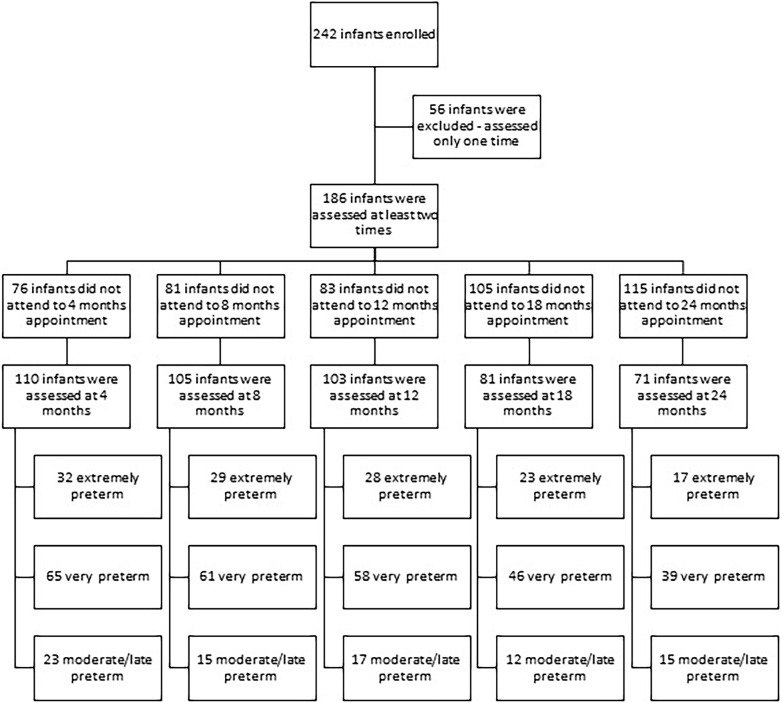
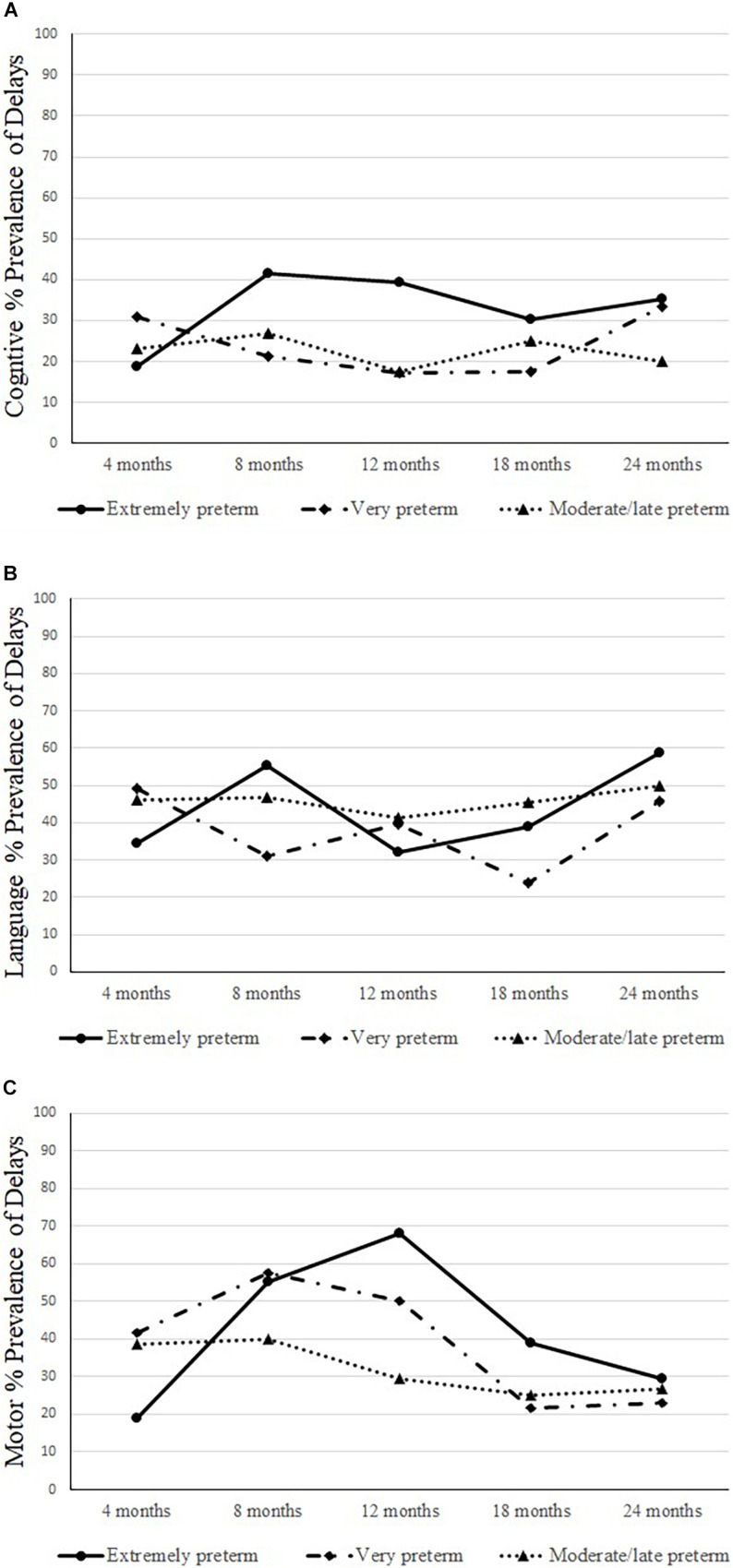
This study examined the neurodevelopment trajectories, the prevalence of delays, and the risks and protective factors (adverse outcomes, environment, and maternal factors) associated with cognitive, motor, and language development for preterm infants from 4- to 24-months. We assessed 186 preterm infants (24.7% extremely preterm; 54.8% very preterm; 20.4% moderate/late preterm) from 4- to 24-months using the Bayley Scales of Infant Development - III. Maternal practices and knowledge were assessed using the Daily Activities of Infant Scale and the Knowledge of Infant Development Inventory. Birth risks and adverse outcomes were obtained from infant medical profiles. A high prevalence of delays was found; red flags for delays at 24-months were detected at 4- and 8-months of age. The neurodevelopmental trajectories showed steady scores across time for cognitive composite scores for extremely- and very-preterm infants and for language composite scores for the extremely- and moderate/late-preterm; a similar trend was observed for the motor trajectories of moderate/late preterm. Changes over time were restricted to motor composite scores for extremely- and very-preterm infants and for cognitive composite scores for moderate/late preterm; declines, stabilization, and improvements were observed longitudinally. Positive, strong, and significant correlations were for the neurodevelopment scores at the first year of life and later neurodevelopment at 18 and 24 months. The cognitive, language, and motor composite scores of extremely and very preterm groups were associated with more risk factors (adverse outcomes, environment, and maternal factors). However, for moderate/late preterm infants, only APGAR and maternal practices significantly explained the variance in neurodevelopment. Although adverse outcomes were strongly associated with infant neurodevelopment, the environment and the parents' engagement in play and breastfeeding were protective factors for most preterm infants. Intervention strategies for preterm infants should start at 4- to 8-months of age to prevent unwanted outcomes later in life.
本研究考察了4至24个月大的早产儿在认知、运动和语言发展方面的神经发育轨迹、发育迟缓的患病率以及相关的风险和保护因素(不良后果、环境和母亲因素)。我们使用贝利婴幼儿发展量表第三版对186名4至24个月大的早产儿(24.7%为极早产儿;54.8%为超早产儿;20.4%为中度/晚期早产儿)进行了评估。使用婴儿日常活动量表和婴儿发育知识量表对母亲的养育行为和知识进行了评估。从婴儿病历中获取出生风险和不良后果信息。结果发现发育迟缓的患病率很高;在4个月和8个月大时就检测到了24个月大时发育迟缓的警示信号。神经发育轨迹显示,极早产儿和超早产儿的认知综合得分以及极早产儿和中度/晚期早产儿的语言综合得分随时间呈稳定状态;中度/晚期早产儿的运动轨迹也观察到类似趋势。随时间的变化仅限于极早产儿和超早产儿的运动综合得分以及中度/晚期早产儿的认知综合得分;纵向观察到了下降、稳定和改善的情况。一岁时的神经发育得分与18个月和24个月时的后期神经发育之间存在正相关、强相关且显著相关。极早产儿和超早产儿组的认知、语言和运动综合得分与更多的风险因素(不良后果、环境和母亲因素)相关。然而,对于中度/晚期早产儿,只有阿氏评分和母亲的养育行为能显著解释神经发育的差异。尽管不良后果与婴儿神经发育密切相关,但环境以及父母在玩耍和母乳喂养方面的参与对大多数早产儿来说是保护因素。早产儿的干预策略应在4至8个月大时开始,以预防日后出现不良后果。