Zajki-Zechmeister Krisztina, Kaira Gaurav Singh, Eibinger Manuel, Seelich Klara, Nidetzky Bernd
Institute of Biotechnology and Biochemical Engineering, Graz University of Technology, Petersgasse 10-12/1, 8010 Graz, Austria.
Austrian Centre of Industrial Biotechnology, Petersgasse 14, 8010 Graz, Austria.
ACS Catal. 2021 Nov 5;11(21):13530-13542. doi: 10.1021/acscatal.1c03465. Epub 2021 Oct 25.
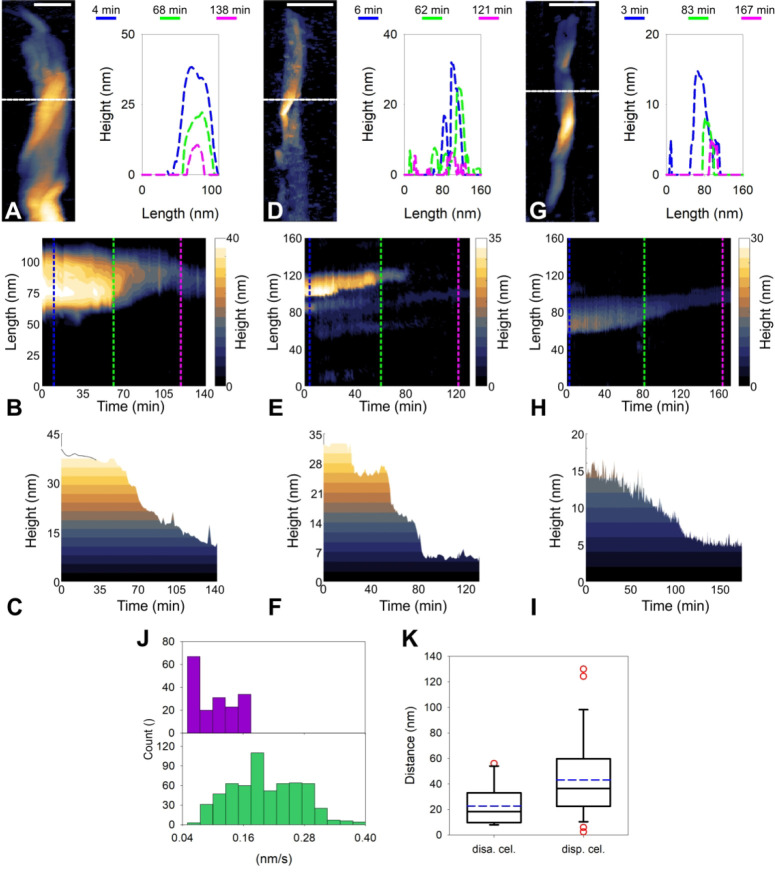
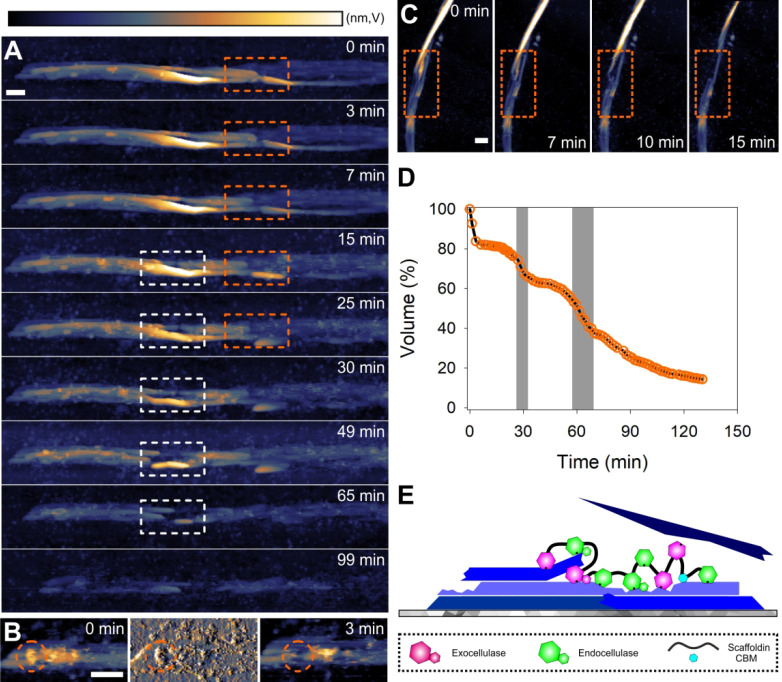
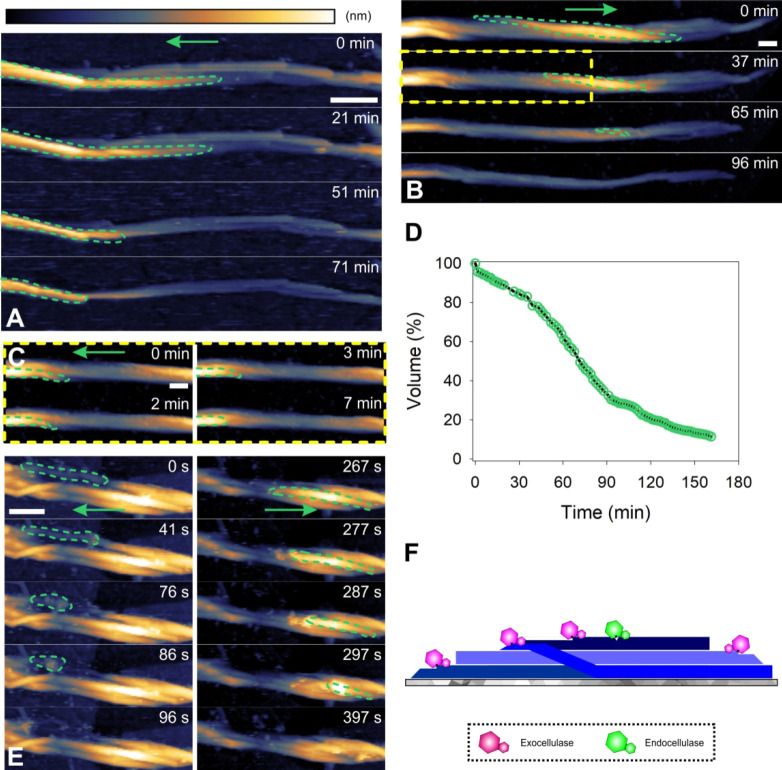
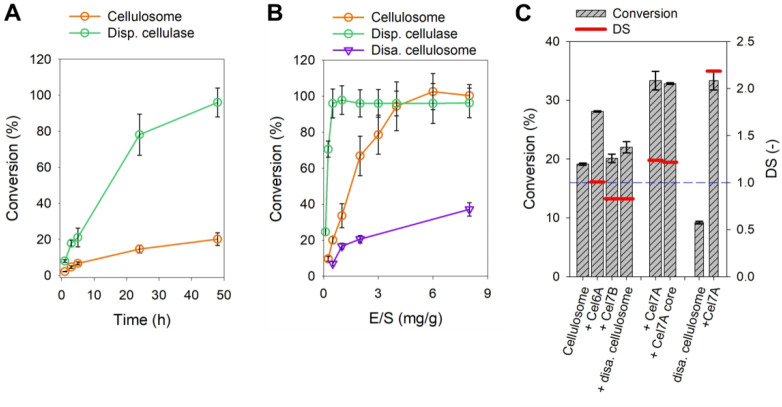
Biological deconstruction of polymer materials gains efficiency from the spatiotemporally coordinated action of enzymes with synergetic function in polymer chain depolymerization. To perpetuate enzyme synergy on a solid substrate undergoing deconstruction, the overall attack must alternate between focusing the individual enzymes locally and dissipating them again to other surface sites. Natural cellulases working as multienzyme complexes assembled on a scaffold protein (the cellulosome) maximize the effect of local concentration yet restrain the dispersion of individual enzymes. Here, with evidence from real-time atomic force microscopy to track nanoscale deconstruction of single cellulose fibers, we show that the cellulosome forces the fiber degradation into the transversal direction, to produce smaller fragments from multiple local attacks ("cuts"). Noncomplexed enzymes, as in fungal cellulases or obtained by dissociating the cellulosome, release the confining force so that fiber degradation proceeds laterally, observed as directed ablation of surface fibrils and leading to whole fiber "thinning". Processive cellulases that are enabled to freely disperse evoke the lateral degradation and determine its efficiency. Our results suggest that among natural cellulases, the dispersed enzymes are more generally and globally effective in depolymerization, while the cellulosome represents a specialized, fiber-fragmenting machinery.
聚合物材料的生物解构通过具有聚合物链解聚协同功能的酶在时空上的协同作用提高了效率。为了在进行解构的固体底物上保持酶的协同作用,整体攻击必须在局部聚焦单个酶和再次将它们分散到其他表面位点之间交替进行。作为组装在支架蛋白(纤维小体)上的多酶复合物发挥作用的天然纤维素酶,最大化了局部浓度的效果,但限制了单个酶的分散。在这里,通过实时原子力显微镜跟踪单根纤维素纤维纳米级解构的证据,我们表明纤维小体迫使纤维降解沿横向进行,通过多次局部攻击(“切割”)产生更小的片段。非复合酶,如真菌纤维素酶或通过解离纤维小体获得的酶,释放了限制力,使得纤维降解沿横向进行,表现为表面原纤维的定向烧蚀并导致整个纤维“变细”。能够自由分散的进行性纤维素酶引发横向降解并决定其效率。我们的结果表明,在天然纤维素酶中,分散的酶在解聚方面更普遍且更具全局有效性,而纤维小体代表一种专门的纤维破碎机制。