Davies Bethan, Araghi Marzieh, Moshe Maya, Gao He, Bennet Kimberly, Jenkins Jordan, Atchison Christina, Darzi Ara, Ashby Deborah, Riley Steven, Barclay Wendy, Elliott Paul, Ward Helen, Cooke Graham
Department of Epidemiology and Biostatistics, School of Public Health, Imperial College London, London, United Kingdom.
Department of Infectious Diseases, Imperial College London, London, United Kingdom.
Open Forum Infect Dis. 2021 Oct 4;8(11):ofab496. doi: 10.1093/ofid/ofab496. eCollection 2021 Nov.
Seroprevalence studies are essential to understand the epidemiology of severe acute respiratory syndrome coronavirus 2 (SARS-CoV-2). Various technologies, including laboratory assays and point-of-care self-tests, are available for antibody testing. The interpretation of seroprevalence studies requires comparative data on the performance of antibody tests.
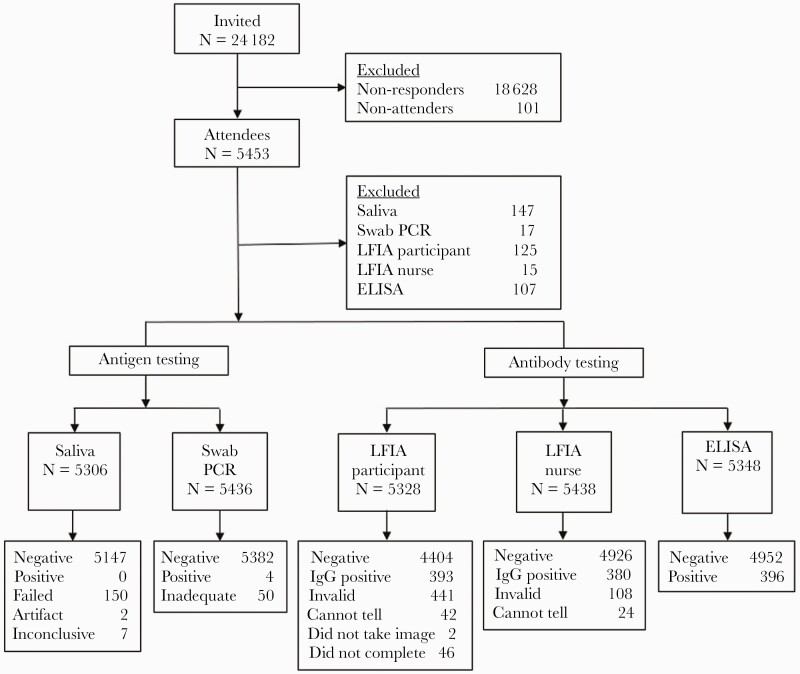
In June 2020, current and former members of the United Kingdom police forces and fire service performed a self-test lateral flow immunoassay (LFIA), had a nurse-performed LFIA, and provided a venous blood sample for enzyme-linked immunosorbent assay (ELISA). We present the prevalence of antibodies to SARS-CoV-2 and the acceptability and usability of self-test LFIAs, and we determine the sensitivity and specificity of LFIAs compared with laboratory ELISA.
In this cohort of 5189 current and former members of the police service and 263 members of the fire service, 7.4% (396 of 5348; 95% confidence interval [CI], 6.7-8.1) were antibody positive. Seroprevalence was 8.9% (95% CI, 6.9-11.4) in those under 40 years, 11.5% (95% CI, 8.8-15.0) in those of nonwhite ethnicity, and 7.8% (95% CI, 7.1-8.7) in those currently working. Self-test LFIA had an acceptability of 97.7% and a usability of 90.0%. There was substantial agreement between within-participant LFIA results (kappa 0.80; 95% CI, 0.77-0.83). The LFIAs had a similar performance: compared with ELISA, sensitivity was 82.1% (95% CI, 77.7-86.0) self-test and 76.4% (95% CI, 71.9-80.5) nurse-performed with specificity of 97.8% (95% CI, 97.3-98.2) and 98.5% (95% CI, 98.1-98.8), respectively.
A greater proportion of this nonhealthcare key worker cohort showed evidence of previous infection with SARS-CoV-2 than the general population at 6.0% (95% CI, 5.8-6.1) after the first wave in England. The high acceptability and usability reported by participants and similar performance of self-test and nurse-performed LFIAs indicate that the self-test LFIA is fit for purpose for home testing in occupational and community prevalence studies.
血清流行率研究对于了解严重急性呼吸综合征冠状病毒2(SARS-CoV-2)的流行病学至关重要。包括实验室检测和即时检测自检在内的各种技术可用于抗体检测。血清流行率研究的解读需要关于抗体检测性能的比较数据。
2020年6月,英国警察部队和消防部门的在职和离职人员进行了自检侧向流动免疫分析(LFIA),由护士进行了LFIA检测,并提供静脉血样本用于酶联免疫吸附测定(ELISA)。我们呈现了SARS-CoV-2抗体的流行率、自检LFIA的可接受性和可用性,并确定了与实验室ELISA相比LFIA的敏感性和特异性。
在这个由5189名在职和离职警察以及263名消防人员组成的队列中,7.4%(5348人中的396人;95%置信区间[CI],6.7 - 8.1)抗体呈阳性。40岁以下人群的血清流行率为8.9%(95%CI,6.9 - 11.4),非白人种族人群为11.5%(95%CI,8.8 - 15.0),在职人员为7.8%(95%CI,7.1 - 8.7)。自检LFIA的可接受性为97.7%,可用性为90.0%。参与者自身LFIA检测结果之间有高度一致性(kappa值为0.80;95%CI,0.7;7 - 0.83)。LFIA检测表现相似:与ELISA相比,自检的敏感性为82.1%(95%CI,77.7 - 86.0),护士操作的为76.4%(95%CI,71.9 - 80.5),特异性分别为97.8%(95%CI,97.3 - 98.2)和98.5%(95%CI,98.1 - 98.)。
在英国第一波疫情过后,这一非医疗关键工作者队列中曾感染SARS-CoV-2的比例高于普通人群(普通人群为6.0%,95%CI,5.8 - 6.1)。参与者报告的高可接受性和可用性以及自检和护士操作的LFIA检测表现相似,表明自检LFIA适用于职业和社区流行率研究中的家庭检测。