Department of Infectious Diseases, Graduate School of Medical Science, Kyoto Prefectural University of Medicine, 465 Kajii-cho, Kawaramachi-Hirokoji, Kamigyo-ku, Kyoto, 602-8566, Japan; Department of Molecular Gastroenterology and Hepatology, Graduate School of Medical Science, Kyoto Prefectural University of Medicine, 465 Kajii-cho, Kawaramachi-Hirokoji, Kamigyo-ku, Kyoto, 602-8566, Japan.
Department of Infectious Diseases, Graduate School of Medical Science, Kyoto Prefectural University of Medicine, 465 Kajii-cho, Kawaramachi-Hirokoji, Kamigyo-ku, Kyoto, 602-8566, Japan.
J Infect Chemother. 2022 Feb;28(2):252-256. doi: 10.1016/j.jiac.2021.11.006. Epub 2021 Nov 13.
The assessment of the risk of virus transmission through papers, such as postcards, is important. However, the stability of severe acute respiratory syndrome coronavirus 2 (SARS-CoV-2) and influenza A virus (IAV) on different types of papers is currently unknown. Investigation of the survival time of these viruses on different types of papers will provide insights into their risk of long-distance transport by postal items.
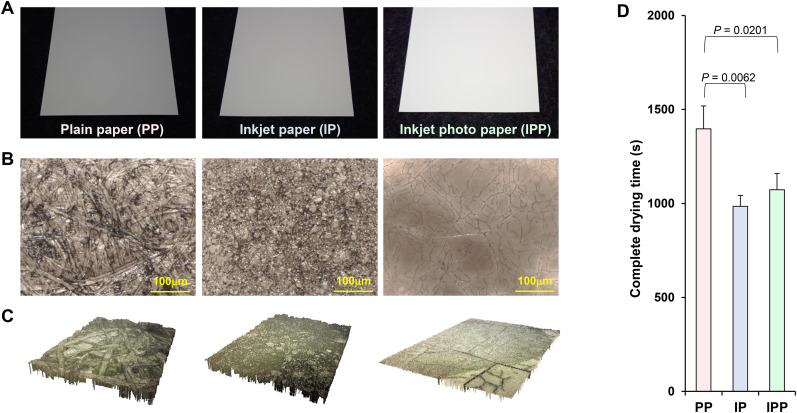
We evaluated the stability of SARS-CoV-2 and IAV, mixed with a culture medium, on the surface of postcards with various coatings, including plain paper (PP), inkjet paper (IP), and inkjet photo paper (IPP). The surface structure of each paper was microscopically assessed.
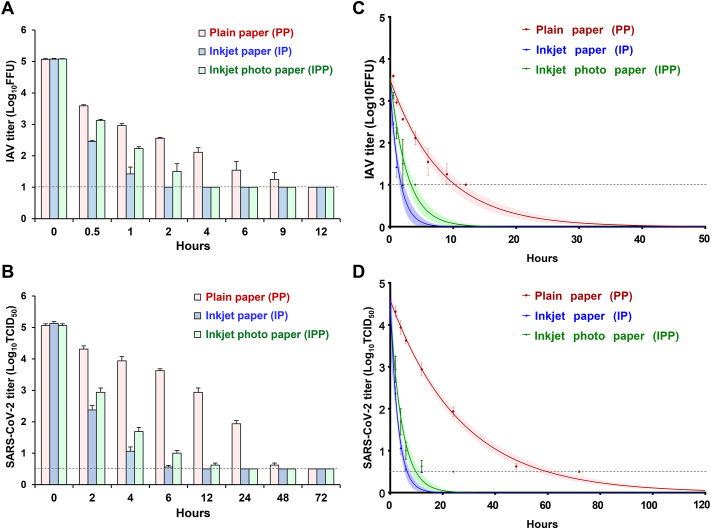
The surface structures of PP, IP, and IPP varied greatly depending on the presence or absence, and type, of coat layer, regardless of the base material. IP and IPP surfaces were less conducive to virus survival than PP surfaces, because of the difference in surface shapes. The survival times of SARS-CoV-2 on each paper were approximately 59.8 (PP), 6.5 (IP), and 9.8 h (IPP), and significantly longer than those of IAV (10.3, 1.8, and 3.3 h, respectively).
The risk of SARS-CoV-2 transmission via paper, such as postcards, is significantly higher than that of IAV transmission. While PP, IP, and IPP have the same base material, their surface structures differ, which affects viral stability. The IP and IPP surfaces are less suitable for virus survival. This study provides novel insights into the risks of viral transmission via paper.
评估通过明信片等纸张传播病毒的风险很重要。然而,目前尚不清楚严重急性呼吸综合征冠状病毒 2 (SARS-CoV-2) 和甲型流感病毒 (IAV) 在不同类型纸张上的稳定性。研究这些病毒在不同类型纸张上的存活时间将有助于了解通过邮政物品长途传播的风险。
我们评估了 SARS-CoV-2 和 IAV 在不同涂层明信片表面的稳定性,包括普通纸 (PP)、喷墨纸 (IP) 和喷墨照片纸 (IPP)。评估了每种纸的表面结构。
无论基础材料如何,PP、IP 和 IPP 的表面结构都因涂层的存在与否和类型而有很大差异。由于表面形状的差异,IP 和 IPP 表面比 PP 表面不利于病毒存活。SARS-CoV-2 在每种纸张上的存活时间约为 59.8(PP)、6.5(IP)和 9.8 h(IPP),明显长于 IAV(分别为 10.3、1.8 和 3.3 h)。
通过明信片等纸张传播 SARS-CoV-2 的风险明显高于 IAV 传播。虽然 PP、IP 和 IPP 具有相同的基础材料,但它们的表面结构不同,这影响了病毒的稳定性。IP 和 IPP 表面不利于病毒存活。本研究为通过纸张传播病毒的风险提供了新的见解。