College of Health and Medical Sciences, Haramaya University, Harar, Ethiopia
London School of Hygiene & Tropical Medicine, London, UK.
BMJ Open. 2021 Nov 24;11(11):e055834. doi: 10.1136/bmjopen-2021-055834.
We conducted serosurveillance of anti-SARS-CoV-2 antibodies among pregnant women attending their first antenatal care.
The surveillance was set in one referral hospital in Harar, one district hospital and one health centre located in Haramaya district in rural eastern Ethiopia.
We collected questionnaire data and a blood sample from 3312 pregnant women between 1 April 2020 and 31 March 2021. We selected 1447 blood samples at random and assayed these for anti-SARS-CoV-2 antibodies at Hararghe Health Research laboratory using WANTAI SARS-CoV-2 Rapid Test for total immunoglobulin.
We assayed for anti-SARS-CoV-2 antibodies and temporal trends in seroprevalence were analysed with a χ test for trend and multivariable binomial regression.
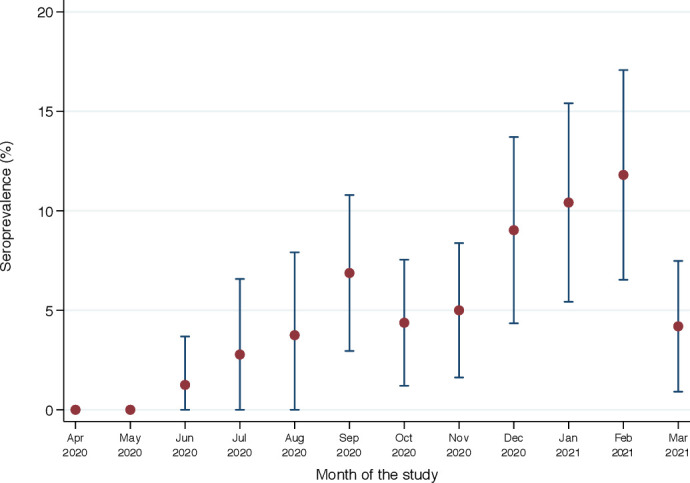
Among 1447 sera tested, 83 were positive for anti-SARS-CoV-2 antibodies giving a crude seroprevalence of 5.7% (95% CI 4.6% to 7.0%). Of 160 samples tested in April-May 2020, none was seropositive; the first seropositive sample was identified in June and seroprevalence rose steadily thereafter (χ test for trend, p=0.003) reaching a peak of 11.8% in February 2021. In the multivariable model, seroprevalence was approximately 3% higher in first-trimester mothers compared with later presentations, and rose by 0.75% (95% CI 0.31% to 1.20%) per month of calendar time.
This clinical convenience sample illustrates the dynamic of the SARS-CoV-2 epidemic in pregnant women in eastern Ethiopia; infection was rare before June 2020 but it spread in a linear fashion thereafter, rather than following intermittent waves, and reached 10% by the beginning of 2021. After 1 year of surveillance, most pregnant mothers remained susceptible.
我们对在第一次产前保健就诊的孕妇进行了抗 SARS-CoV-2 抗体的血清学监测。
监测在埃塞俄比亚东部哈拉雷区的一家转诊医院、一家区医院和一家健康中心进行。
我们于 2020 年 4 月 1 日至 2021 年 3 月 31 日期间从 3312 名孕妇中收集了问卷调查数据和血样。我们随机选择了 1447 份血样,并在哈拉雷健康研究实验室使用万泰 SARS-CoV-2 快速检测试剂盒检测总免疫球蛋白的抗 SARS-CoV-2 抗体。
我们检测了抗 SARS-CoV-2 抗体,并使用趋势 χ 检验和多变量二项式回归分析了血清阳性率的时间趋势。
在 1447 份检测的血清中,有 83 份抗 SARS-CoV-2 抗体阳性,总血清阳性率为 5.7%(95%CI 4.6%至 7.0%)。在 2020 年 4 月至 5 月检测的 160 份样本中,无一例血清阳性;第一个血清阳性样本于 6 月发现,此后血清阳性率稳步上升(趋势 χ 检验,p=0.003),于 2021 年 2 月达到 11.8%的峰值。在多变量模型中,与晚期就诊的孕妇相比,早孕母亲的血清阳性率约高 3%,且日历时间每增加 1 个月,血清阳性率增加 0.75%(95%CI 0.31%至 1.20%)。
本临床便利样本说明了 SARS-CoV-2 在埃塞俄比亚东部孕妇中的流行情况;在 2020 年 6 月之前,感染很少见,但此后呈线性传播,而不是间歇性波状传播,到 2021 年初达到 10%。经过 1 年的监测,大多数孕妇仍然易感。