Institute of Biomedicine, Department of Medical Biochemistry and Cell Biology, University of Gothenburg, Gothenburg, Sweden.
Instituto de Investigación Sanitaria de Aragón (IIS Aragón), Zaragoza, Spain.
Front Endocrinol (Lausanne). 2021 Nov 8;12:748254. doi: 10.3389/fendo.2021.748254. eCollection 2021.
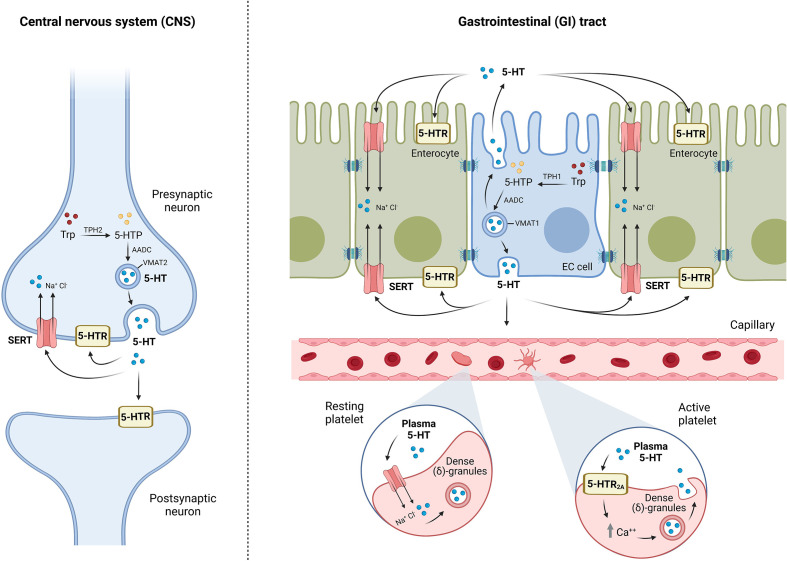
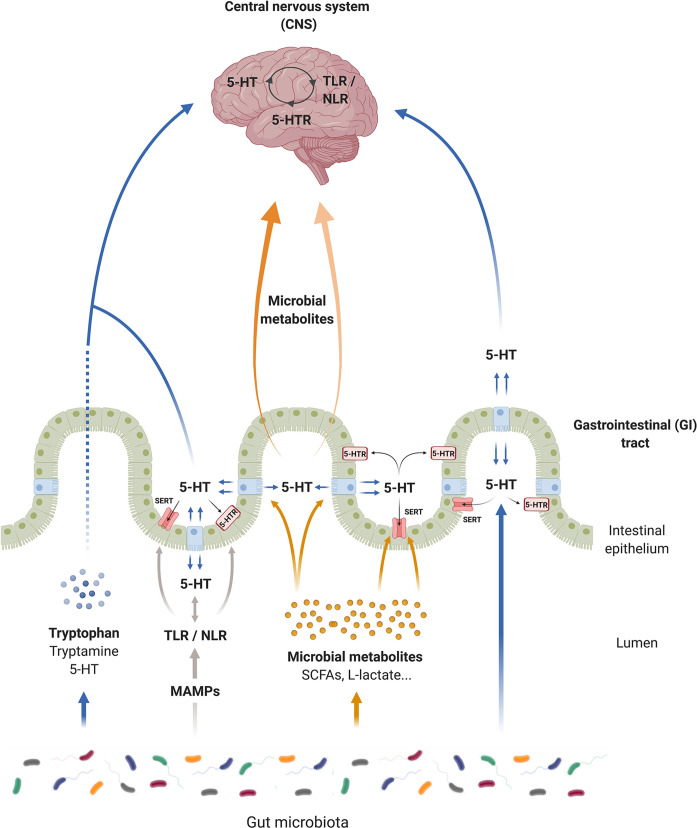
Disruption of the microbiota-gut-brain axis results in a wide range of pathologies that are affected, from the brain to the intestine. Gut hormones released by enteroendocrine cells to the gastrointestinal (GI) tract are important signaling molecules within this axis. In the search for the language that allows microbiota to communicate with the gut and the brain, serotonin seems to be the most important mediator. In recent years, serotonin has emerged as a key neurotransmitter in the gut-brain axis because it largely contributes to both GI and brain physiology. In addition, intestinal microbiota are crucial in serotonin signaling, which gives more relevance to the role of the serotonin as an important mediator in microbiota-host interactions. Despite the numerous investigations focused on the gut-brain axis and the pathologies associated, little is known regarding how serotonin can mediate in the microbiota-gut-brain axis. In this review, we will mainly discuss serotonergic system modulation by microbiota as a pathway of communication between intestinal microbes and the body on the microbiota-gut-brain axis, and we explore novel therapeutic approaches for GI diseases and mental disorders.
微生物群-肠道-大脑轴的破坏会导致广泛的病理变化,从大脑到肠道都受到影响。肠内分泌细胞释放到胃肠道的肠道激素是该轴内的重要信号分子。在寻找允许微生物群与肠道和大脑交流的语言时,血清素似乎是最重要的介质。近年来,血清素已成为肠道-大脑轴中的关键神经递质,因为它在很大程度上有助于胃肠道和大脑的生理机能。此外,肠道微生物群在血清素信号中起着至关重要的作用,这使得血清素作为微生物群-宿主相互作用中的重要介质的作用更加重要。尽管有许多针对肠道-大脑轴和相关病理的研究,但对于血清素如何在微生物群-肠道-大脑轴中发挥介导作用,我们知之甚少。在这篇综述中,我们将主要讨论微生物群对 5-羟色胺能系统的调节作为肠道微生物与身体在微生物群-肠道-大脑轴上的一种交流途径,并探索治疗胃肠道疾病和精神障碍的新方法。