Lodrini Alessandra Maria, Goumans Marie-José
Department of Cell and Chemical Biology, Leiden University Medical Center, Leiden, Netherlands.
Front Cardiovasc Med. 2021 Nov 8;8:750510. doi: 10.3389/fcvm.2021.750510. eCollection 2021.
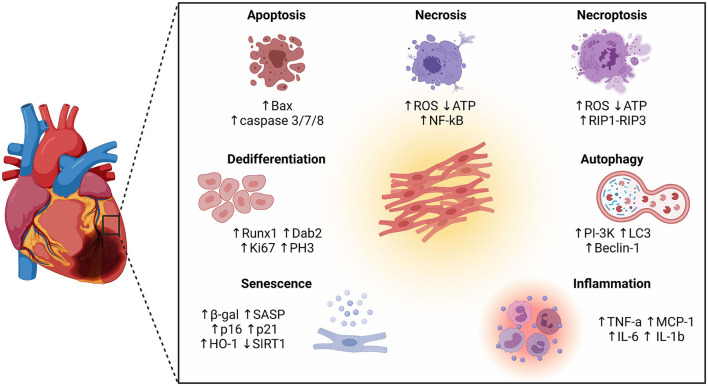
Despite the increasing success of interventional coronary reperfusion strategies, mortality related to acute myocardial infarction (MI) is still substantial. MI is defined as sudden death of myocardial tissue caused by an ischemic episode. Ischaemia leads to adverse remodelling in the affected myocardium, inducing metabolic and ionic perturbations at a single cell level, ultimately leading to cell death. The adult mammalian heart has limited regenerative capacity to replace lost cells. Identifying and enhancing physiological cardioprotective processes may be a promising therapy for patients with MI. Studies report an increasing amount of evidence stating the intricacy of the pathophysiology of the infarcted heart. Besides apoptosis, other cellular phenotypes have emerged as key players in the ischemic myocardium, in particular senescence, inflammation, and dedifferentiation. Furthermore, some cardiomyocytes in the infarct border zone uncouple from the surviving myocardium and dedifferentiate, while other cells become senescent in response to injury and start to produce a pro-inflammatory secretome. Enhancing electric coupling between cardiomyocytes in the border zone, eliminating senescent cells with senolytic compounds, and upregulating cardioprotective cellular processes like autophagy, may increase the number of functional cardiomyocytes and therefore enhance cardiac contractility. This review describes the different cellular phenotypes and pathways implicated in injury, remodelling, and regeneration of the myocardium after MI. Moreover, we discuss implications of the complex pathophysiological attributes of the infarcted heart in designing new therapeutic strategies.
尽管冠状动脉介入再灌注策略越来越成功,但急性心肌梗死(MI)相关的死亡率仍然很高。心肌梗死被定义为缺血发作导致的心肌组织猝死。缺血会导致受影响心肌出现不良重塑,在单细胞水平上引发代谢和离子紊乱,最终导致细胞死亡。成年哺乳动物心脏替换丢失细胞的再生能力有限。识别和增强生理性心脏保护过程可能是治疗心肌梗死患者的一种有前景的疗法。研究报告了越来越多的证据表明梗死心脏病理生理学的复杂性。除了细胞凋亡外,其他细胞表型已成为缺血心肌中的关键因素,特别是衰老、炎症和去分化。此外,梗死边缘区的一些心肌细胞与存活心肌解偶联并去分化,而其他细胞则因损伤而衰老并开始产生促炎分泌组。增强边缘区心肌细胞之间的电偶联,用衰老溶解化合物消除衰老细胞,并上调自噬等心脏保护细胞过程,可能会增加功能性心肌细胞的数量,从而增强心脏收缩力。本综述描述了心肌梗死后心肌损伤、重塑和再生中涉及的不同细胞表型和途径。此外,我们还讨论了梗死心脏复杂病理生理特征在设计新治疗策略中的意义。