Department of Biomedical Engineering and Center for Science & Engineering of Living Systems (CSELS), Washington University in St. Louis, St. Louis, Missouri.
Department of Biomedical Engineering and Center for Science & Engineering of Living Systems (CSELS), Washington University in St. Louis, St. Louis, Missouri.
Biophys J. 2021 Dec 21;120(24):5438-5453. doi: 10.1016/j.bpj.2021.11.2886. Epub 2021 Nov 23.
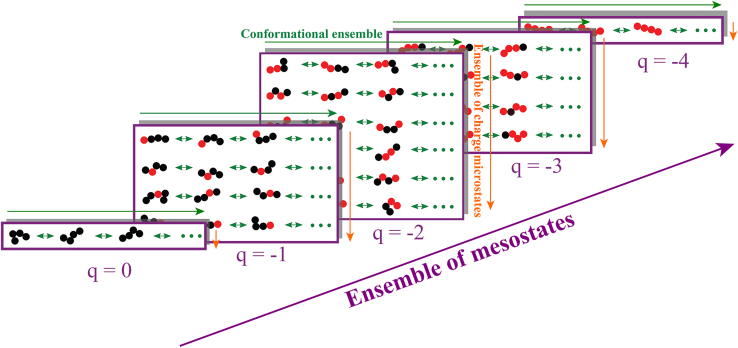
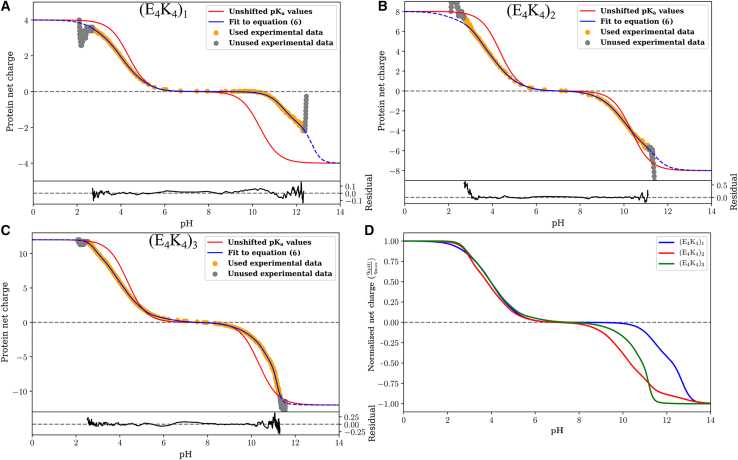
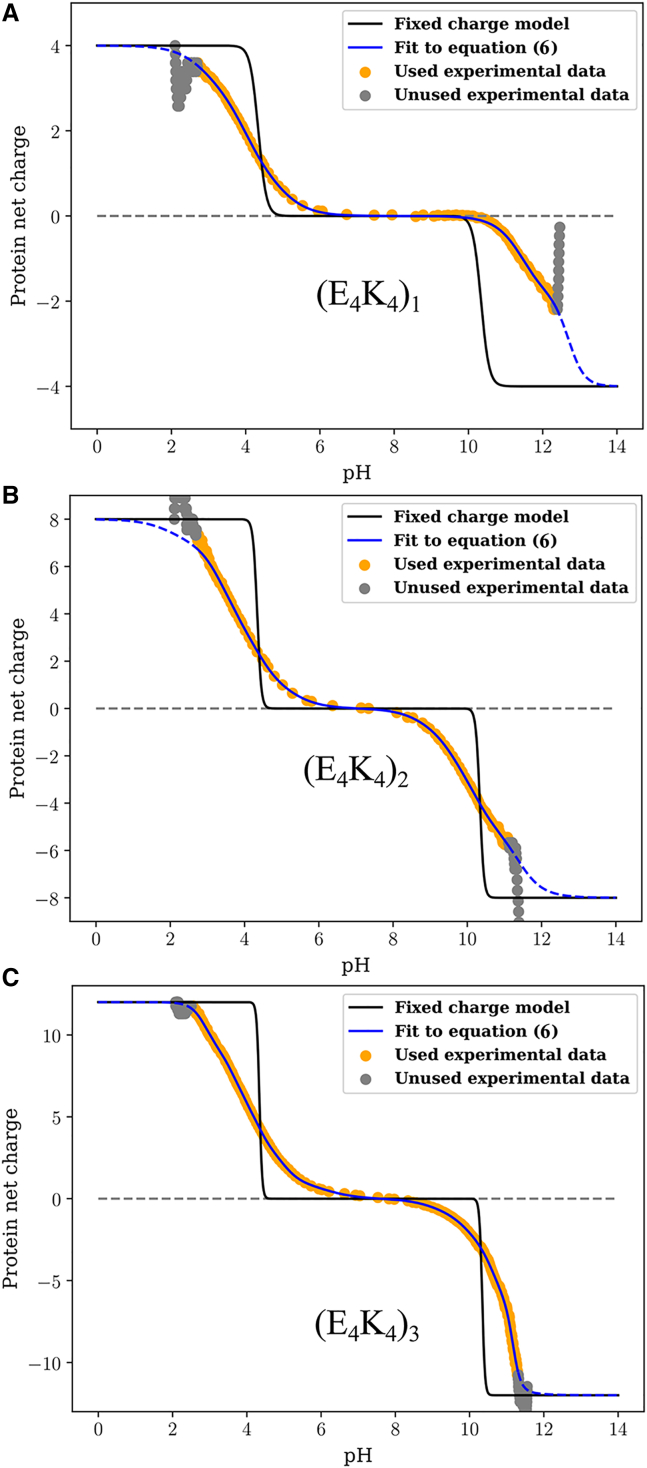
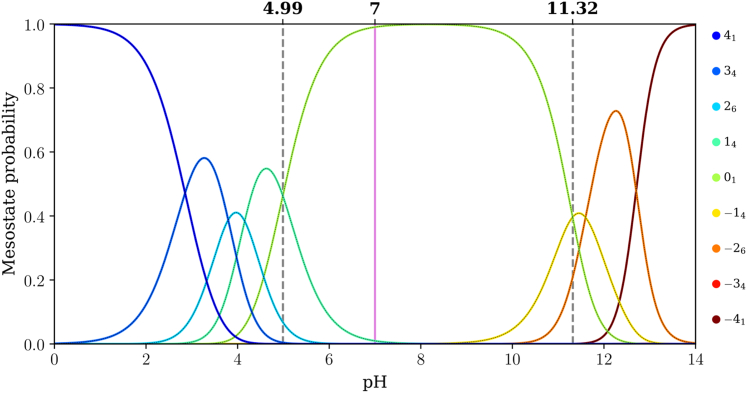
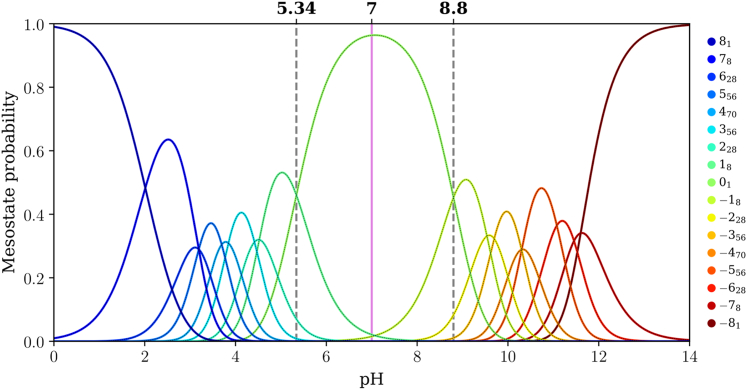
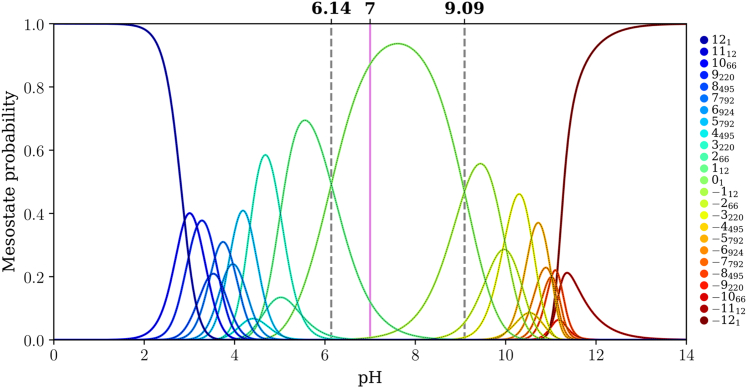
Ionizable residues can release and take up protons and this has an influence on protein structure and function. The extent of protonation is linked to the overall pH of the solution and the local environments of ionizable residues. Binding or unbinding of a single proton generates a distinct charge microstate defined by a specific pattern of charges. Accordingly, the overall partition function is a sum over all charge microstates and Boltzmann weights of all conformations associated with each of the charge microstates. This ensemble-of-ensembles description recast as a q-canonical ensemble allows us to analyze and interpret potentiometric titrations that provide information regarding net charge as a function of pH. In the q-canonical ensemble, charge microstates are grouped into mesostates where each mesostate is a collection of microstates of the same net charge. Here, we show that leveraging the structure of the q-canonical ensemble allows us to decouple contributions of net proton binding and release from proton arrangement and conformational considerations. Through application of the q-canonical formalism to analyze potentiometric measurements of net charge in proteins with repetitive patterns of Lys and Glu residues, we determine the underlying mesostate pK values and, more importantly, we estimate relative mesostate populations as a function of pH. This is a strength of using the q-canonical approach that cannot be replicated using purely site-specific analyses. Overall, our work shows how measurements of charge equilibria, decoupled from measurements of conformational equilibria, and analyzed using the framework of the q-canonical ensemble, provide protein-specific quantitative descriptions of pH-dependent populations of mesostates. This method is of direct relevance for measuring and understanding how different charge states contribute to conformational, binding, and phase equilibria of proteins.
可离子化残基可以释放和吸收质子,这会影响蛋白质的结构和功能。质子化的程度与溶液的总 pH 值和可离子化残基的局部环境有关。单个质子的结合或释放会产生一个独特的电荷微观状态,由特定的电荷模式定义。因此,总配分函数是所有电荷微观状态的和,以及与每个电荷微观状态相关的所有构象的玻尔兹曼权重的和。这种集合的集合描述被重铸为 q-正则系综,使我们能够分析和解释提供净电荷随 pH 变化信息的电位滴定。在 q-正则系综中,电荷微观状态被分组到介观状态中,其中每个介观状态是相同净电荷的微观状态的集合。在这里,我们表明,利用 q-正则系综的结构,我们可以将净质子结合和释放的贡献与质子排列和构象考虑因素分离。通过将 q-正则形式主义应用于具有 Lys 和 Glu 残基重复模式的蛋白质净电荷的电位测量进行分析,我们确定了潜在的介观状态 pK 值,更重要的是,我们估计了 pH 下相对介观状态的种群。这是使用 q-正则方法的优势,无法通过纯位点特异性分析复制。总的来说,我们的工作表明,如何将电荷平衡的测量与构象平衡的测量分离,并使用 q-正则系综的框架进行分析,可以为 pH 依赖性介观状态种群提供蛋白质特异性的定量描述。该方法对于测量和理解不同电荷状态如何影响蛋白质的构象、结合和相平衡具有直接意义。