Giurgi-Oncu Catalina, Tudoran Cristina, Pop Gheorghe Nicusor, Bredicean Cristina, Pescariu Silvius Alexandru, Giurgiuca Ana, Tudoran Mariana
Department VIII Neurosciences, Discipline of Psychiatry, "Victor Babes" University of Medicine and Pharmacy Timisoara, No. 2 E. Murgu Square, 300041 Timisoara, Romania.
"Pius Brinzeu" County Emergency Hospital, 300723 Timisoara, Romania.
Brain Sci. 2021 Nov 2;11(11):1456. doi: 10.3390/brainsci11111456.
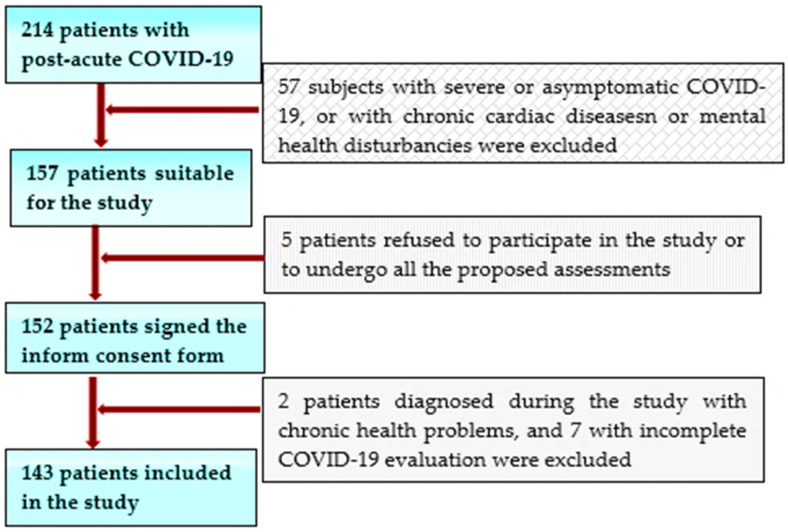
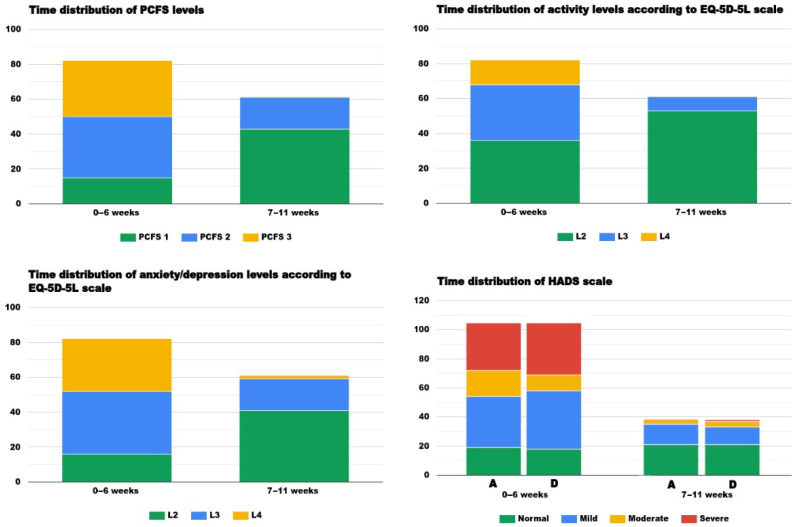
(1) Background: Post-acute COVID-19 syndrome, characterized by persisting symptoms up to 12 weeks after the acute illness, impairs numerous people's physical and mental health. (2) Methods: 64 inpatients and 79 outpatients, aged under 55 years, with post-acute COVID-19, were evaluated by a transthoracic echocardiography (TTE), mental health examination, Quality of Life (QoL) questionnaire, post-COVID-19 functional status scale (PCFS) and Hospital Anxiety and Depression Scale (HADS). (3) Results: all inpatients had mild/moderate pulmonary injury during acute COVID-19, in contrast to 37.97% of outpatients. Inpatients who reported an average of 5 persisting symptoms, had, predominantly, level 3 PCFS and a median QoL of 62, compared to outpatients, who reported an average of 3 symptoms, level 1 PCFS and a median QoL score of 70. Increased pulmonary artery pressure was detected in 28.11% of inpatients, compared to 17.72% of outpatients, while diastolic dysfunction was diagnosed in 28.12% of inpatients, in comparison with 20.25% of outpatients ( = 0.02). Abnormal systolic function was assessed in 9.37% of inpatients, and 7.58% of outpatients. According to the HADS depression subscale, 46.87% of inpatients and 27.84% of outpatients had clinical depression. Concomitantly, anxiety was detected in 34.37% of inpatients and 40.5% of outpatients (4) Conclusions: cardiovascular and mental health difficulties were frequently detected in patients with post-acute symptoms of COVID-19, which correlated with the number and intensity of persisting symptoms and reduced QoL scores.
(1)背景:急性新冠肺炎后综合征的特征是在急性疾病后长达12周仍存在症状,损害了许多人的身心健康。(2)方法:对64名年龄在55岁以下的急性新冠肺炎后住院患者和79名门诊患者进行经胸超声心动图(TTE)、心理健康检查、生活质量(QoL)问卷、新冠肺炎后功能状态量表(PCFS)和医院焦虑抑郁量表(HADS)评估。(3)结果:所有住院患者在急性新冠肺炎期间均有轻度/中度肺损伤,而门诊患者的这一比例为37.97%。报告平均有5种持续症状的住院患者,主要为3级PCFS,QoL中位数为62,相比之下,报告平均有3种症状的门诊患者为1级PCFS,QoL评分中位数为70。28.11%的住院患者检测到肺动脉压升高,门诊患者为17.72%,而28.12%的住院患者被诊断为舒张功能障碍,门诊患者为20.25%(P = 0.02)。9.37%的住院患者和7.58%的门诊患者评估有收缩功能异常。根据HADS抑郁子量表,46.87%的住院患者和27.84%的门诊患者有临床抑郁。同时,34.37%的住院患者和40.5%的门诊患者检测到焦虑。(4)结论:在急性新冠肺炎后有症状的患者中经常检测到心血管和心理健康问题,这与持续症状的数量和强度以及QoL评分降低相关。