Lo Muzio Francesco Paolo, Rozzi Giacomo, Rossi Stefano, Luciani Giovanni Battista, Foresti Ruben, Cabassi Aderville, Fassina Lorenzo, Miragoli Michele
Department of Surgery, Dentistry, Pediatrics and Gynecology, University of Verona, 37134 Verona, Italy.
Department of Medicine and Surgery, University of Parma, 43126 Parma, Italy.
J Clin Med. 2021 Nov 16;10(22):5330. doi: 10.3390/jcm10225330.
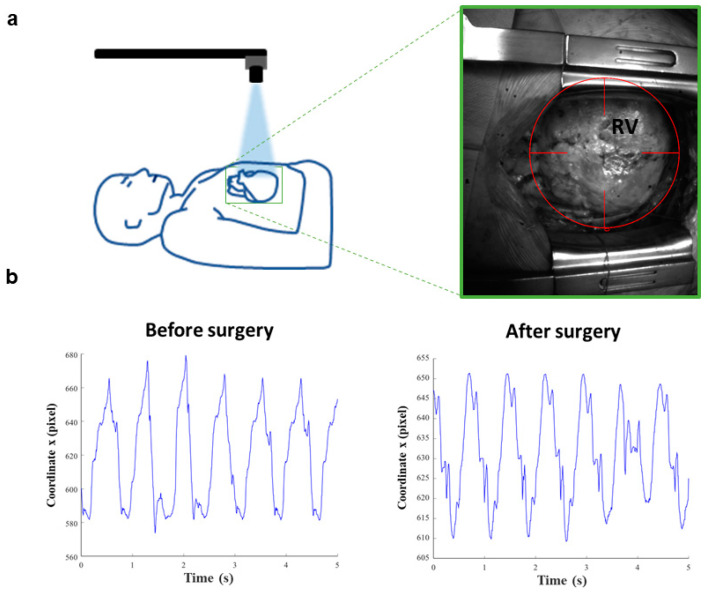
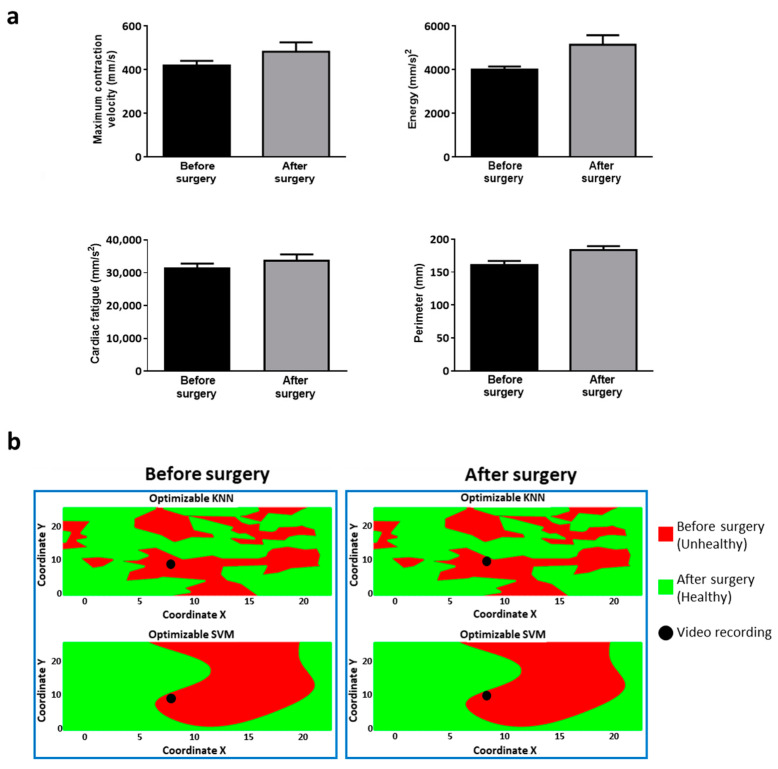
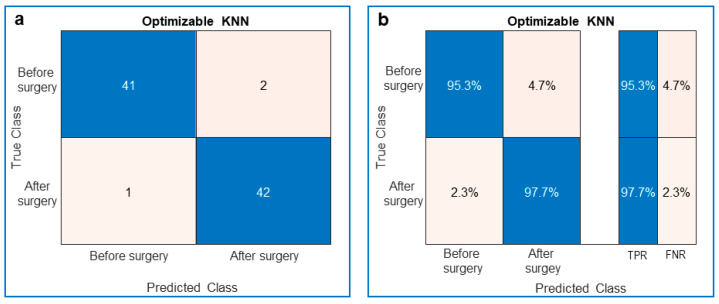
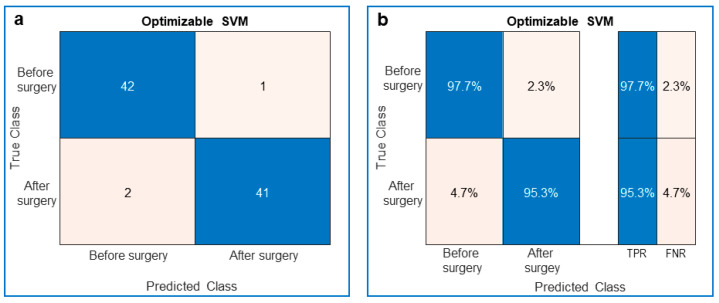
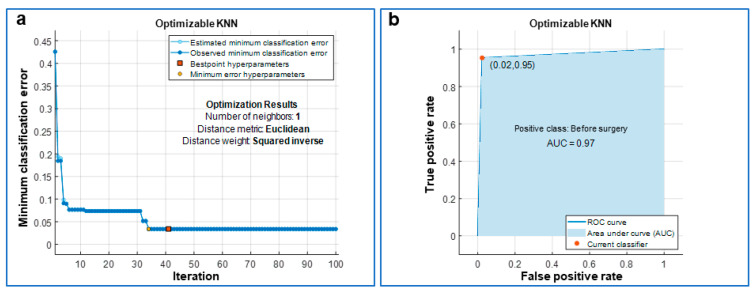
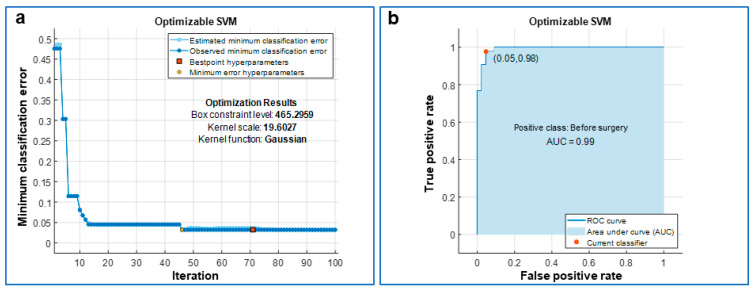
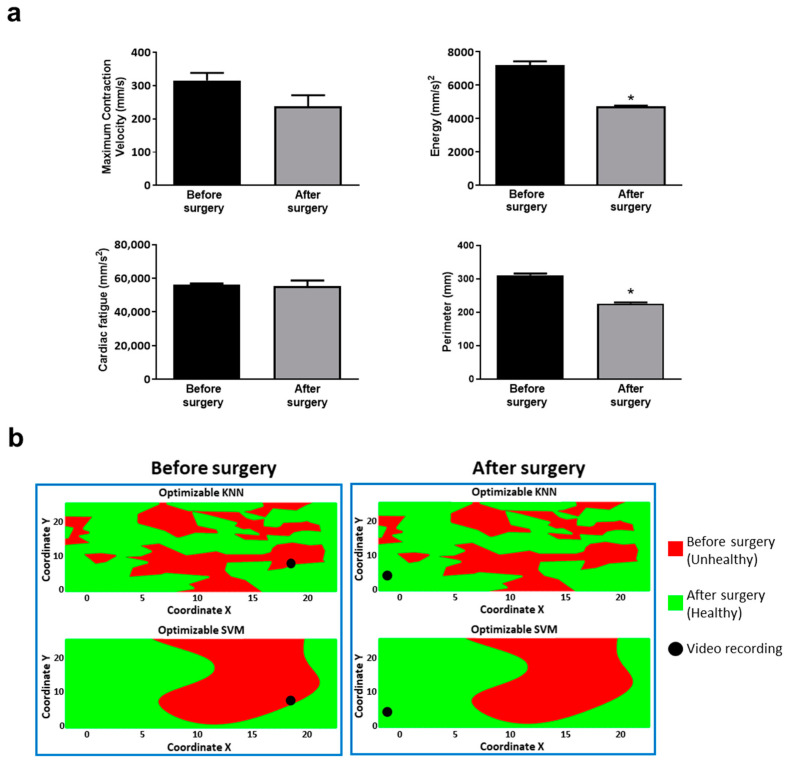
The human right ventricle is barely monitored during open-chest surgery due to the absence of intraoperative imaging techniques capable of elaborating its complex function. Accordingly, artificial intelligence could not be adopted for this specific task. We recently proposed a video-based approach for the real-time evaluation of the epicardial kinematics to support medical decisions. Here, we employed two supervised machine learning algorithms based on our technique to predict the patients' outcomes before chest closure. Videos of the beating hearts were acquired before and after pulmonary valve replacement in twelve Tetralogy of Fallot patients and recordings were properly labeled as the "unhealthy" and "healthy" classes. We extracted frequency-domain-related features to train different supervised machine learning models and selected their best characteristics via 10-fold cross-validation and optimization processes. Decision surfaces were built to classify two additional patients having good and unfavorable clinical outcomes. The k-nearest neighbors and support vector machine showed the highest prediction accuracy; the patients' class was identified with a true positive rate ≥95% and the decision surfaces correctly classified the additional patients in the "healthy" (good outcome) or "unhealthy" (unfavorable outcome) classes. We demonstrated that classifiers employed with our video-based technique may aid cardiac surgeons in decision making before chest closure.
由于缺乏能够详细阐述其复杂功能的术中成像技术,在开胸手术期间几乎无法监测人体右心室。因此,无法将人工智能用于这一特定任务。我们最近提出了一种基于视频的方法,用于实时评估心外膜运动学,以辅助医疗决策。在此,我们基于我们的技术采用了两种监督机器学习算法,以在关闭胸腔前预测患者的预后。在12例法洛四联症患者进行肺动脉瓣置换术前后,采集了跳动心脏的视频,并将记录正确标记为“不健康”和“健康”类别。我们提取了与频域相关的特征,以训练不同的监督机器学习模型,并通过10折交叉验证和优化过程选择其最佳特征。构建决策面以对另外两名具有良好和不良临床结果的患者进行分类。k近邻算法和支持向量机显示出最高的预测准确率;患者类别以≥95%的真阳性率被识别,并且决策面将另外两名患者正确分类为“健康”(良好结果)或“不健康”(不良结果)类别。我们证明,采用我们基于视频的技术的分类器可能有助于心脏外科医生在关闭胸腔前进行决策。