Baek Jae Yun, Kang Kyung Mook, Kim Hyeong Jun, Kim Ju Hyeon, Lee Ju Hwan, Shin Gilyong, Jeon Jei Gyeong, Lee Junho, Han Yusu, So Byeong Jun, Kang Tae June
Advanced Materials Lab, Department of Mechanical Engineering, Inha University, Incheon 22212, Korea.
Micromachines (Basel). 2021 Nov 5;12(11):1364. doi: 10.3390/mi12111364.
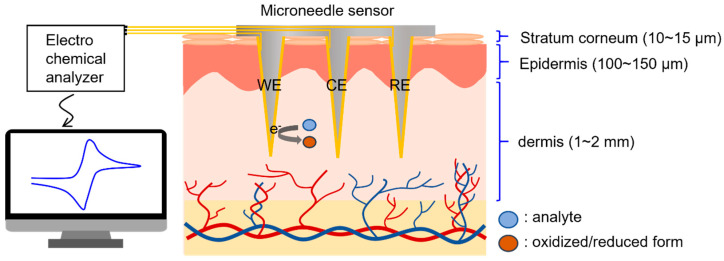
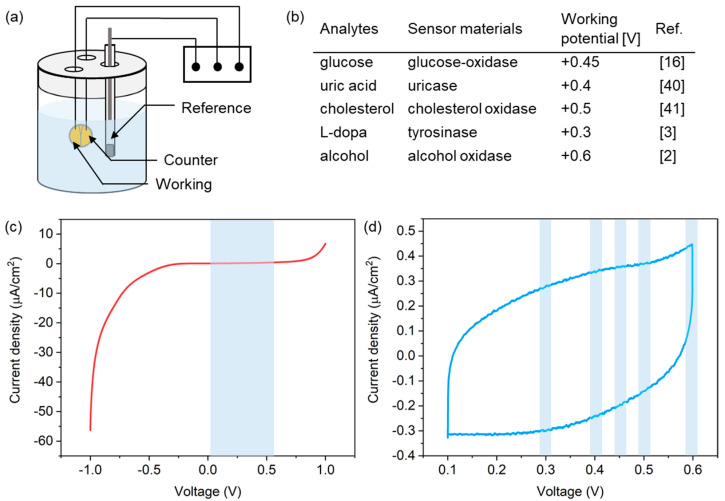
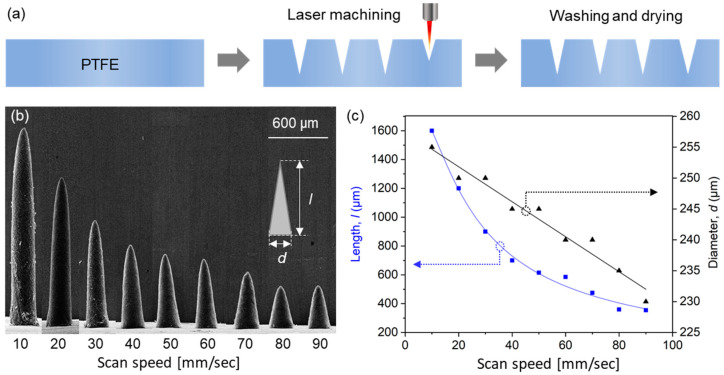
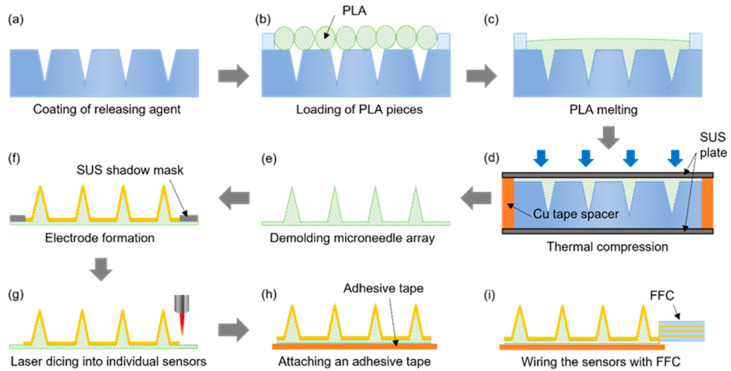
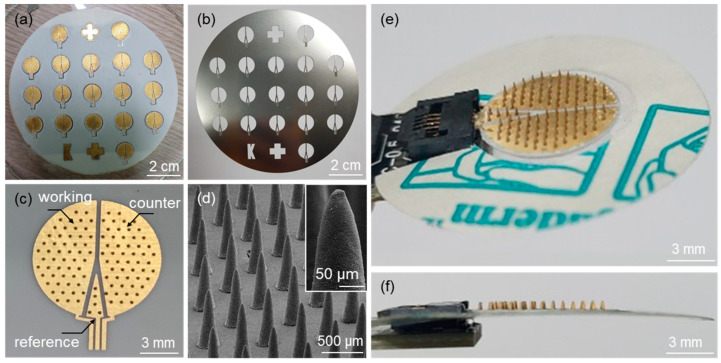
In this work, we present a fabrication process for microneedle sensors made of polylactic acid (PLA), which can be utilized for the electrochemical detection of various biomarkers in interstitial fluid. Microneedles were fabricated by the thermal compression molding of PLA into a laser machined polytetrafluoroethylene (PTFE) mold. Sensor fabrication was completed by forming working, counter, and reference electrodes on each sensor surface by Au sputtering through a stencil mask, followed by laser dicing to separate individual sensors from the substrate. The devised series of processes was designed to be suitable for mass production, where multiple microneedle sensors can be produced at once on a 4-inch wafer. The operational stability of the fabricated sensors was confirmed by linear sweep voltammetry and cyclic voltammetry at the range of working potentials of various biochemical molecules in interstitial fluid.
在这项工作中,我们展示了一种由聚乳酸(PLA)制成的微针传感器的制造工艺,该传感器可用于电化学检测组织液中的各种生物标志物。通过将PLA热压成型到激光加工的聚四氟乙烯(PTFE)模具中来制造微针。通过使用模板掩膜进行金溅射,在每个传感器表面形成工作电极、对电极和参比电极,然后进行激光切割以从基板上分离出单个传感器,从而完成传感器的制造。所设计的一系列工艺旨在适用于大规模生产,即在4英寸晶圆上一次可以生产多个微针传感器。通过线性扫描伏安法和循环伏安法,在组织液中各种生化分子的工作电位范围内,证实了所制造传感器的操作稳定性。