Computational Biology Group, Biological Science Division, Pacific Northwest National Laboratory, 902 Battelle Blvd, Richland, WA 99352, USA.
Molecules. 2021 Nov 9;26(22):6761. doi: 10.3390/molecules26226761.
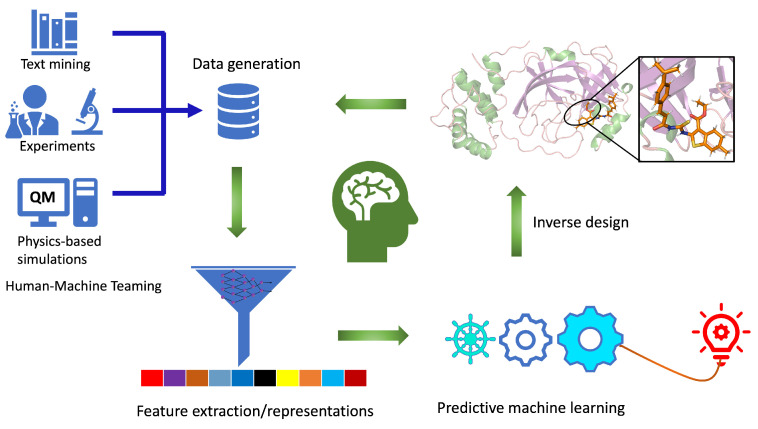
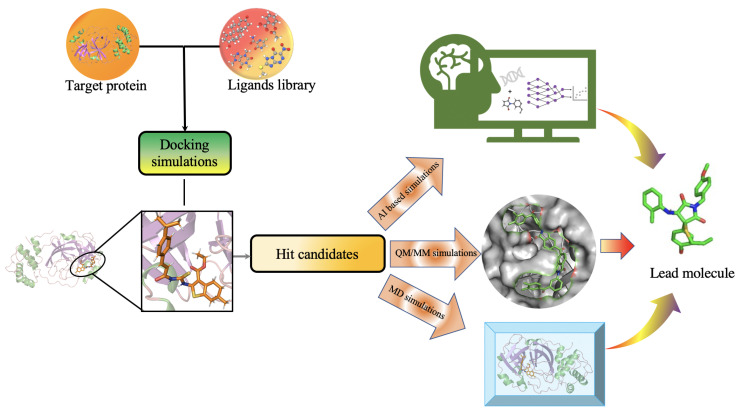
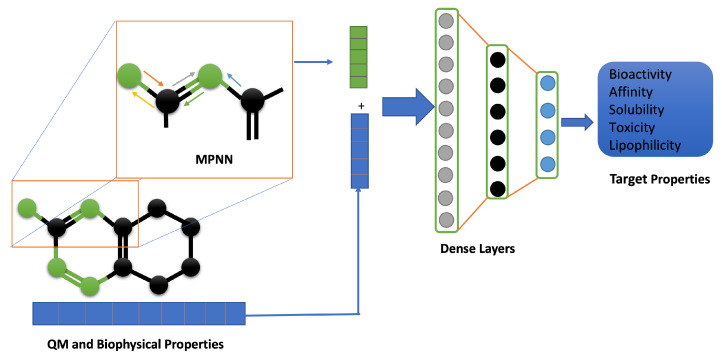
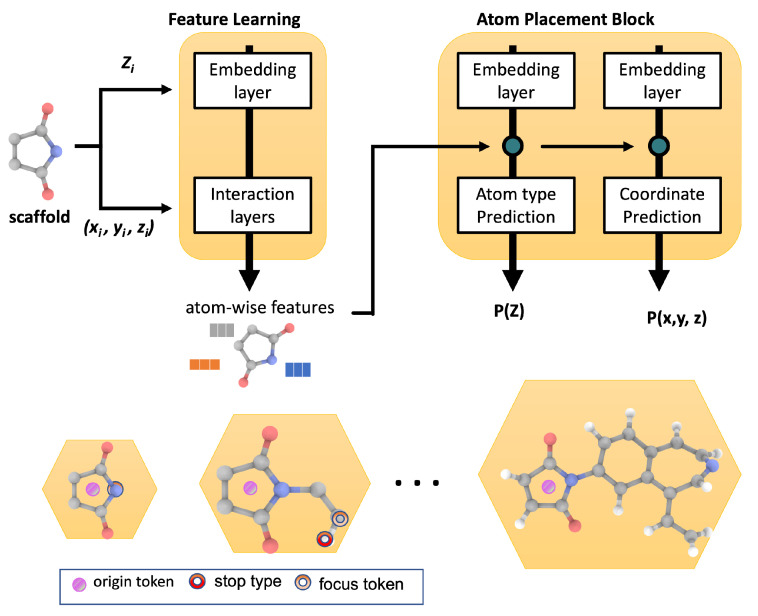
Domain-aware artificial intelligence has been increasingly adopted in recent years to expedite molecular design in various applications, including drug design and discovery. Recent advances in areas such as physics-informed machine learning and reasoning, software engineering, high-end hardware development, and computing infrastructures are providing opportunities to build scalable and explainable AI molecular discovery systems. This could improve a design hypothesis through feedback analysis, data integration that can provide a basis for the introduction of end-to-end automation for compound discovery and optimization, and enable more intelligent searches of chemical space. Several state-of-the-art ML architectures are predominantly and independently used for predicting the properties of small molecules, their high throughput synthesis, and screening, iteratively identifying and optimizing lead therapeutic candidates. However, such deep learning and ML approaches also raise considerable conceptual, technical, scalability, and end-to-end error quantification challenges, as well as skepticism about the current AI hype to build automated tools. To this end, synergistically and intelligently using these individual components along with robust quantum physics-based molecular representation and data generation tools in a closed-loop holds enormous promise for accelerated therapeutic design to critically analyze the opportunities and challenges for their more widespread application. This article aims to identify the most recent technology and breakthrough achieved by each of the components and discusses how such autonomous AI and ML workflows can be integrated to radically accelerate the protein target or disease model-based probe design that can be iteratively validated experimentally. Taken together, this could significantly reduce the timeline for end-to-end therapeutic discovery and optimization upon the arrival of any novel zoonotic transmission event. Our article serves as a guide for medicinal, computational chemistry and biology, analytical chemistry, and the ML community to practice autonomous molecular design in precision medicine and drug discovery.
近年来,领域感知人工智能越来越多地被应用于各种应用,包括药物设计和发现,以加速分子设计。物理学启发的机器学习和推理、软件工程、高端硬件开发和计算基础设施等领域的最新进展为构建可扩展和可解释的人工智能分子发现系统提供了机会。这可以通过反馈分析改进设计假设,通过数据集成为化合物发现和优化的端到端自动化引入提供基础,并使化学空间的搜索更加智能化。几种最先进的 ML 架构主要独立用于预测小分子的性质、它们的高通量合成和筛选,迭代地识别和优化先导治疗候选物。然而,这种深度学习和 ML 方法也带来了相当大的概念、技术、可扩展性和端到端误差量化方面的挑战,以及对当前人工智能炒作的怀疑,以构建自动化工具。为此,协同和智能地使用这些单个组件,以及基于稳健量子物理学的分子表示和数据生成工具的闭环,为加速治疗设计提供了巨大的潜力,以批判性地分析它们更广泛应用的机会和挑战。本文旨在确定每个组件所取得的最新技术和突破,并讨论如何将这种自主 AI 和 ML 工作流程集成在一起,以从根本上加速基于蛋白质靶标或疾病模型的探针设计,这些设计可以通过实验迭代验证。总的来说,这可以在任何新的人畜共患传播事件发生时,显著缩短端到端治疗发现和优化的时间线。我们的文章为医学、计算化学和生物学、分析化学以及 ML 社区提供了在精准医学和药物发现中实践自主分子设计的指南。