Institute of Clinical Medical Science, China Medical University, Taichung, Taiwan, ROC.
Department of Psychiatry and Brain Disease Research Center, China Medical University Hospital, Taichung, Taiwan, ROC.
Sci Rep. 2021 Nov 26;11(1):22996. doi: 10.1038/s41598-021-02040-5.
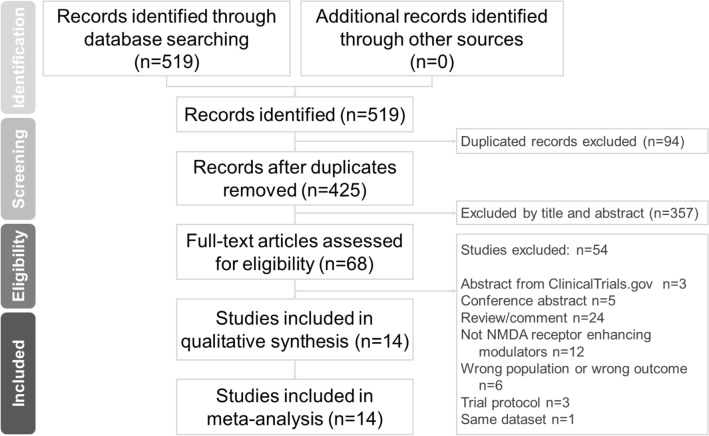
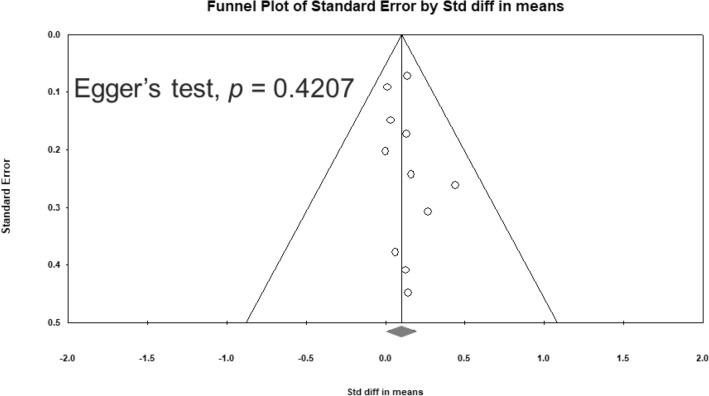
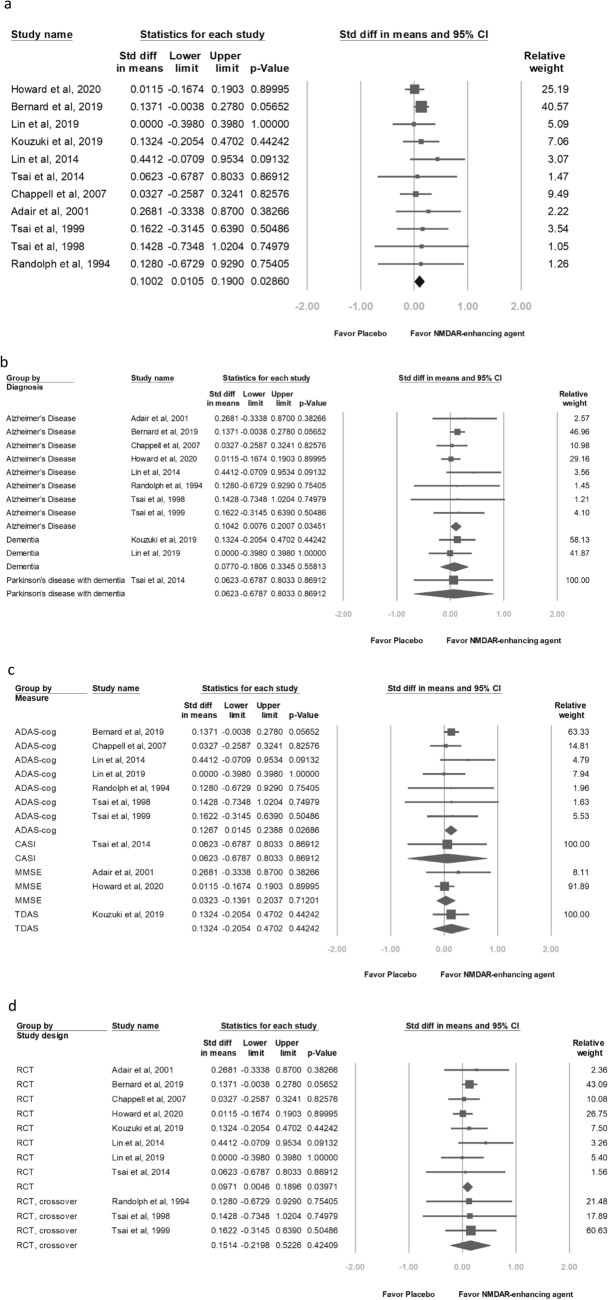
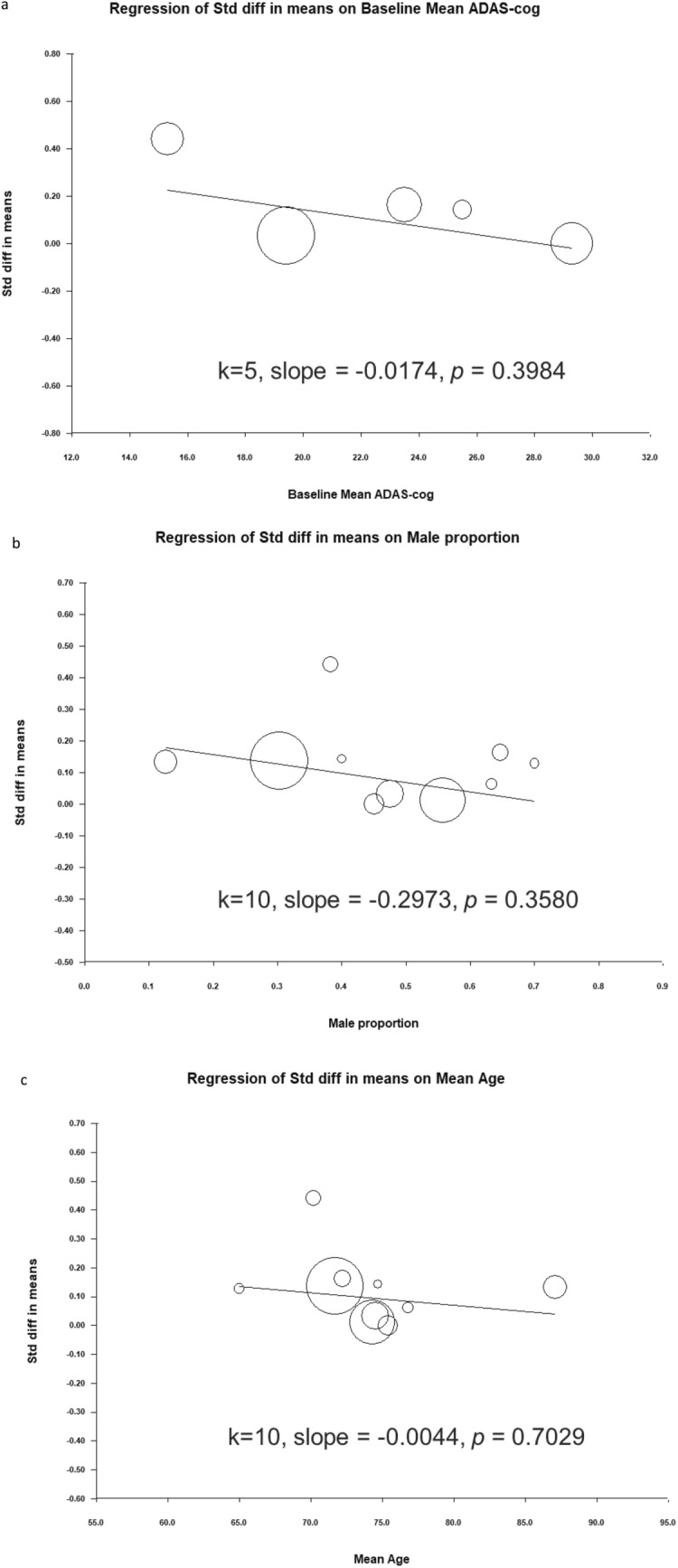
Multiple N-methyl-D-aspartate (NMDA) receptor enhancing agents have had promising effects on cognition among patients with dementia. However, the results remain inconsistent. This exploratory meta-analysis investigated the effectiveness of NMDA receptor enhancing agents for cognitive function. PubMed, the Cochrane Central Register of Controlled Trials, and the Cochrane Database of Systematic Reviews were searched for randomized controlled trials (RCTs). Controlled trials assessing add-on NMDA receptor enhancing agent treatment in patients with dementia and using cognition rating scales were eligible and pooled using a random-effect model for comparisons. The standardized mean difference (SMD) was calculated in each study from the effect size; positive values indicated that NMDA receptor enhancing agent treatment improved cognitive function. Funnel plots and the I2 statistic were evaluated for statistical heterogeneity. Moderators were evaluated using meta-regression. We identified 14 RCTs with 2224 participants meeting the inclusion criteria. Add-on NMDA receptor enhancing agents had small positive significant effects on overall cognitive function among patients with dementia (SMD = 0.1002, 95% CI 0.0105-0.1900, P = 0.02860). Subgroup meta-analysis showed patients with Alzheimer's Disease and trials using the Alzheimer Disease Assessment Scale-cognitive subscale as the primary outcome had small positive significant effects (SMD = 0.1042, 95% CI 0.0076-0.2007, P = 0.03451; SMD = 0.1267, 95% CI 0.0145-0.2388, P = 0.2686). This exploratory meta-analysis showed a very small, positive, and significant effect on overall cognition function in patients with dementia. Studies with larger samples are needed to evaluate different cognitive domains and phases of dementia.
多种 N-甲基-D-天冬氨酸(NMDA)受体增强剂在痴呆患者的认知功能方面具有显著效果。然而,结果仍不一致。本探索性荟萃分析旨在研究 NMDA 受体增强剂对认知功能的有效性。通过检索 PubMed、Cochrane 对照试验中心注册库和 Cochrane 系统评价数据库,纳入评估痴呆患者 NMDA 受体增强剂附加治疗并使用认知量表的随机对照试验(RCT),使用随机效应模型进行比较,并对每项研究的效应量进行标准化均数差(SMD)计算;正值表示 NMDA 受体增强剂治疗改善了认知功能。采用漏斗图和 I2 统计量评估统计异质性。采用元回归评估调节因素。我们共纳入了 14 项 RCT,共 2224 名患者符合纳入标准。NMDA 受体增强剂对痴呆患者的整体认知功能有较小的积极显著影响(SMD=0.1002,95%CI 0.0105-0.1900,P=0.02860)。亚组荟萃分析显示,阿尔茨海默病患者和以阿尔茨海默病评估量表认知分量表为主要结局的试验具有较小的积极显著影响(SMD=0.1042,95%CI 0.0076-0.2007,P=0.03451;SMD=0.1267,95%CI 0.0145-0.2388,P=0.2686)。本探索性荟萃分析表明,NMDA 受体增强剂对痴呆患者的整体认知功能有非常小但积极且显著的影响。需要更大样本量的研究来评估不同的认知领域和痴呆阶段。