Institute of Environmental Medicine, Karolinska Institutet, Box 210, 171 77, Stockholm, Sweden.
Department of Obstetrics and Gynecology, West China Second University Hospital, Sichuan University, Chengdu, China.
Int J Behav Nutr Phys Act. 2021 Nov 27;18(1):153. doi: 10.1186/s12966-021-01227-3.
Depression imposes immense public health burden, demonstrating an urgent need of the identification of modifiable risk factors. Only a few cohort studies have analyzed the association between Mediterranean dietary pattern (MDP) and depression but with mixed results. We examined the impact of MDP on clinically ascertained depression in a large population-based dataset.
In 1991/92, detailed information on diet, using a food frequency questionnaire, and potential confounding factors (body weight, height, educational attainment, smoking, previous diabetes and hypertension, and physical activity) was collected, in a random sample of 49,261 Swedish women aged 29-49. Adherence to MDP was calculated. Clinical depression was extracted from the National Patient Register. Study participants were followed up through 2012.
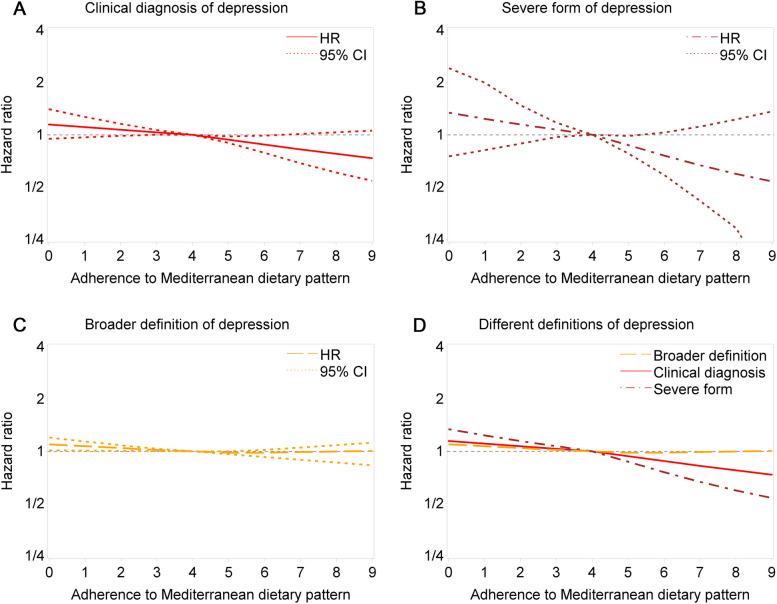
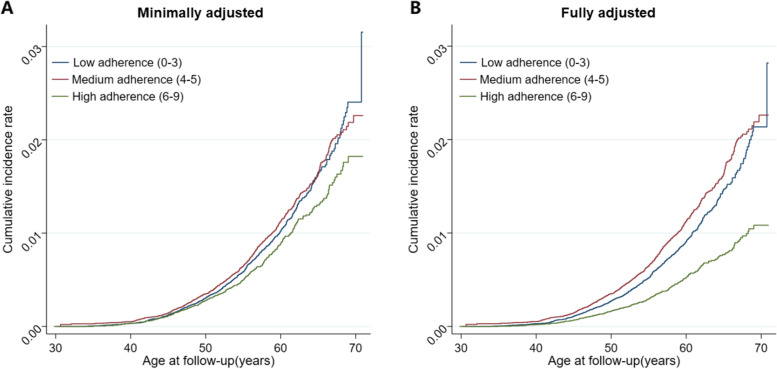
During an average follow-up of 20.4 years, 1677 incident cases of depression were diagnosed. We observed a lower risk of depression for medium (score 4-5) and high (6-9) adherence to MDP, compared with low (0-3) adherence (Medium: hazard ratio (HR) = 0.90, 95% confidence interval (CI) = 0.81-1.00; High: HR = 0.82, 95%CI = 0.71-0.94). Per unit increase of adherence, the risk of depression was reduced by 5% (HR = 0.95, 95%CI = 0.92-0.98). The association became stronger when restricting to severe form of depression (HR = 0.51, 95%CI = 0.33-0.76). The HRs were higher from age 50 onward both over the first and the second 10-year follow-up period, compared with before age 50, indicating stronger association with increasing age. Results remained after extensive sensitivity analyses.
Higher adherence to a Mediterranean diet at middle age was associated with a lower risk of depression later in life among Swedish women.
抑郁症给公共健康带来了巨大的负担,迫切需要识别可改变的风险因素。只有少数队列研究分析了地中海饮食模式(MDP)与抑郁症之间的关系,但结果不一。我们在一个大型基于人群的数据集上研究了 MDP 对临床确诊的抑郁症的影响。
1991/92 年,在瑞典随机抽取的 49261 名 29-49 岁女性中,使用食物频率问卷详细记录了饮食信息和潜在的混杂因素(体重、身高、教育程度、吸烟、既往糖尿病和高血压以及体力活动)。计算了 MDP 的依从性。从国家患者登记处提取临床抑郁症的信息。研究参与者随访至 2012 年。
在平均 20.4 年的随访期间,诊断出 1677 例抑郁症。与低(0-3)依从性相比,中(4-5)和高(6-9)MDP 依从性与较低的抑郁症风险相关(中:危险比(HR)=0.90,95%置信区间(CI)=0.81-1.00;高:HR=0.82,95%CI=0.71-0.94)。依从性每增加一个单位,抑郁症的风险就降低 5%(HR=0.95,95%CI=0.92-0.98)。当限制为严重的抑郁症形式时,关联变得更强(HR=0.51,95%CI=0.33-0.76)。与 50 岁之前相比,50 岁以后的两个 10 年随访期内的 HR 均更高,这表明随着年龄的增长,与抑郁症的关联更强。经过广泛的敏感性分析后,结果仍然成立。
在瑞典女性中,中年时较高的地中海饮食依从性与晚年较低的抑郁症风险相关。