Kikuchi Toru
Department of Pediatrics, Saitama Medical University, Saitama, Japan.
Clin Exp Pediatr. 2022 Jun;65(6):283-290. doi: 10.3345/cep.2021.00920. Epub 2021 Nov 26.
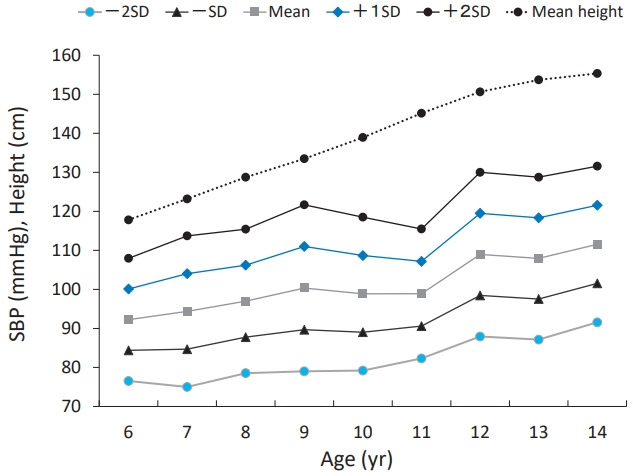
Blood pressure (BP) in children and adolescents is associated with their growth. BP is most strongly associated with height during height gain and with degree of obesity after reaching final height. BP in childhood and adolescence is correlated with BP in adulthood. The pathophysiology of pediatric essential hypertension is associated with obesity, excess salt intake, and a low birth weight. The common causes of pediatric secondary hypertension are renal parenchymal and renovascular diseases. The significance of diagnosing pediatric hypertension involves detecting secondary hypertension and preventing organ damage due to hypertension as well as tracking essential hypertension in adulthood. Appropriate BP measurement procedures are required for diagnosing pediatric hypertension. The inflatable bladder of an appropriately sized cuff should exceed 40% of the arm circumference. BP measurements should be performed consecutively at least 3 times using an appropriately sized cuff. The diagnosis of hypertension requires that all BP values measured on 3 or more occasions be above the reference value. The criteria for pediatric hypertension are determined based on the distribution of BP in healthy children and adolescents, with values above the 95th percentile of normal representing hypertension. Japanese criteria define pediatric hypertension as ≥120/70 mmHg for preschool children, ≥130/80 mmHg for 1st-3rd graders, ≥135/80 mmHg for 4th-6th graders, ≥140/85 mmHg for 7th-9th grade boys, ≥135/80 mmHg for 7th-9th grade girls, and ≥140/85 mmHg for senior high school boys and girls. The prevalence of Japanese pediatric hypertension was 0.9% based on proper measurement protocols. The basis of managing pediatric essential hypertension is healthy lifestyle modifications. Pharmacotherapy is indicated for persistent hypertension, symptomatic hypertension, secondary hypertension, the development of target organ damage, the presence of chronic kidney disease, and diabetes mellitus. Screening for pediatric hypertension is important; therefore, BP should be routinely measured in children and adolescents.
儿童和青少年的血压与他们的生长发育相关。在身高增长期间,血压与身高的关联最为紧密;在达到最终身高后,血压则与肥胖程度密切相关。儿童期和青少年期的血压与成年期的血压相关。小儿原发性高血压的病理生理学与肥胖、盐摄入过多和低出生体重有关。小儿继发性高血压的常见病因是肾实质和肾血管疾病。诊断小儿高血压的意义在于检测继发性高血压、预防高血压所致的器官损害以及追踪成年期的原发性高血压。诊断小儿高血压需要采用适当的血压测量程序。合适尺寸袖带的充气气囊应超过手臂周长的40%。应使用合适尺寸的袖带连续测量血压至少3次。高血压的诊断要求在3次或更多次测量中所有血压值均高于参考值。小儿高血压的标准是根据健康儿童和青少年的血压分布确定的,正常血压值高于第95百分位数即代表高血压。日本的标准将学龄前儿童高血压定义为≥120/70 mmHg,一年级至三年级学生为≥130/80 mmHg,四年级至六年级学生为≥135/80 mmHg,七年级至九年级男生为≥140/85 mmHg,七年级至九年级女生为≥135/80 mmHg,高中男生和女生为≥140/85 mmHg。根据正确的测量方案,日本小儿高血压的患病率为0.9%。管理小儿原发性高血压的基础是改变健康的生活方式。对于持续性高血压、症状性高血压、继发性高血压、靶器官损害的发生、慢性肾病的存在以及糖尿病,需要进行药物治疗。筛查小儿高血压很重要;因此,应定期测量儿童和青少年的血压。