Universidade do Estado do Rio de Janeiro. Instituto de Medicina Social. Rio de Janeiro, RJ, Brasil.
Universidade Federal do Rio de Janeiro. Instituto de Estudos em Saúde Coletiva. Rio de Janeiro, RJ, Brasil.
Rev Saude Publica. 2021 Nov 26;55(Supl 1):4s. doi: 10.11606/s1518-8787.2021055003406. eCollection 2021.
To describe the evolution of food consumption by the Brazilian population in 2008-2009 to 2017-2018.
Data from the National Dietary Surveys of 2008-2009 and 2017-2018 were used. Both surveys estimated food consumption of two non-consecutive days of individuals aged 10 years or older. The first survey collected consumption data from 34,003 individuals through food records; the second, obtained data from 46,164 individuals, through 24-hour recalls. The twenty most frequently reported food groups in the two surveys were identified. The probability of consumption of each food group in the two surveys was estimated according to sex, age and income. This study presents the foods that had a change in the frequency of consumption of 5% or higher between the two surveys. The probability of consumption was corrected for intra-individual variability using the method developed by the National Cancer Institute.
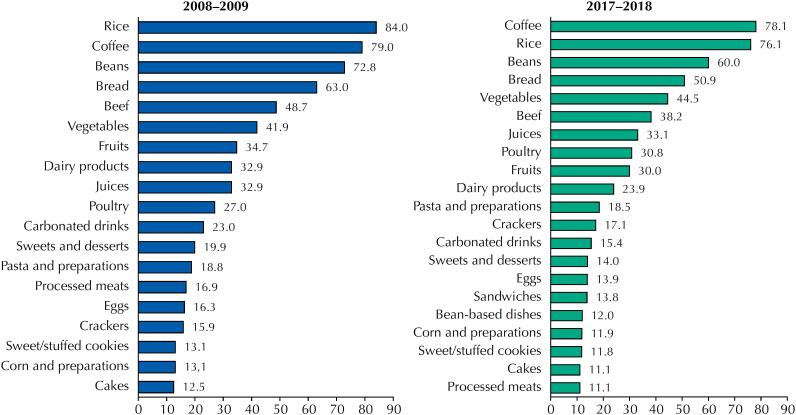
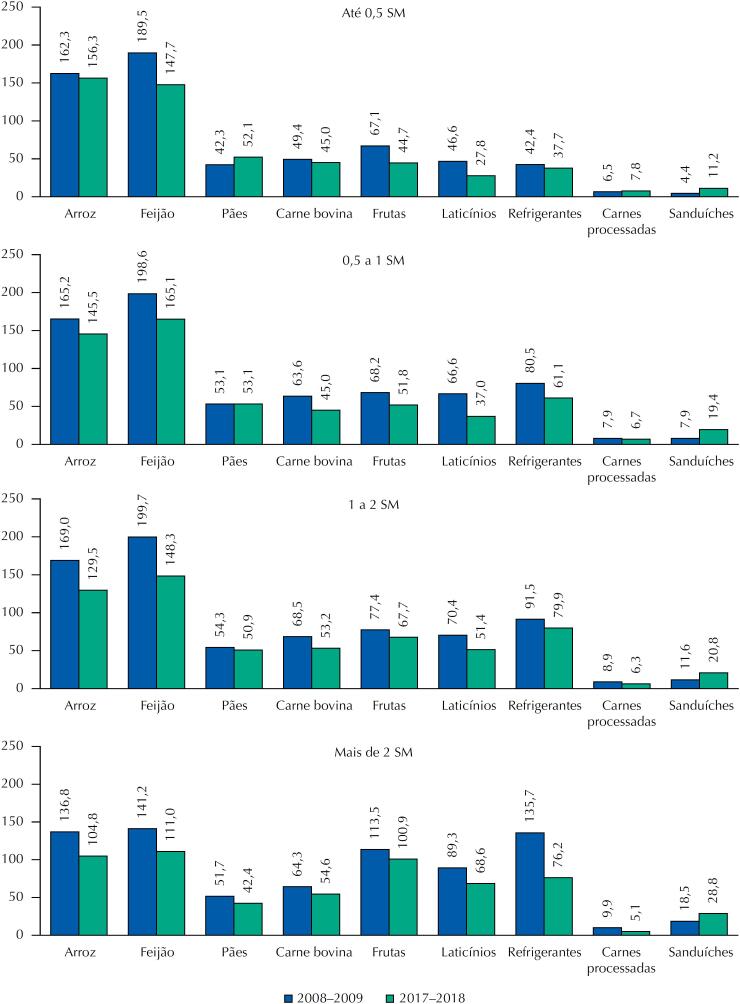
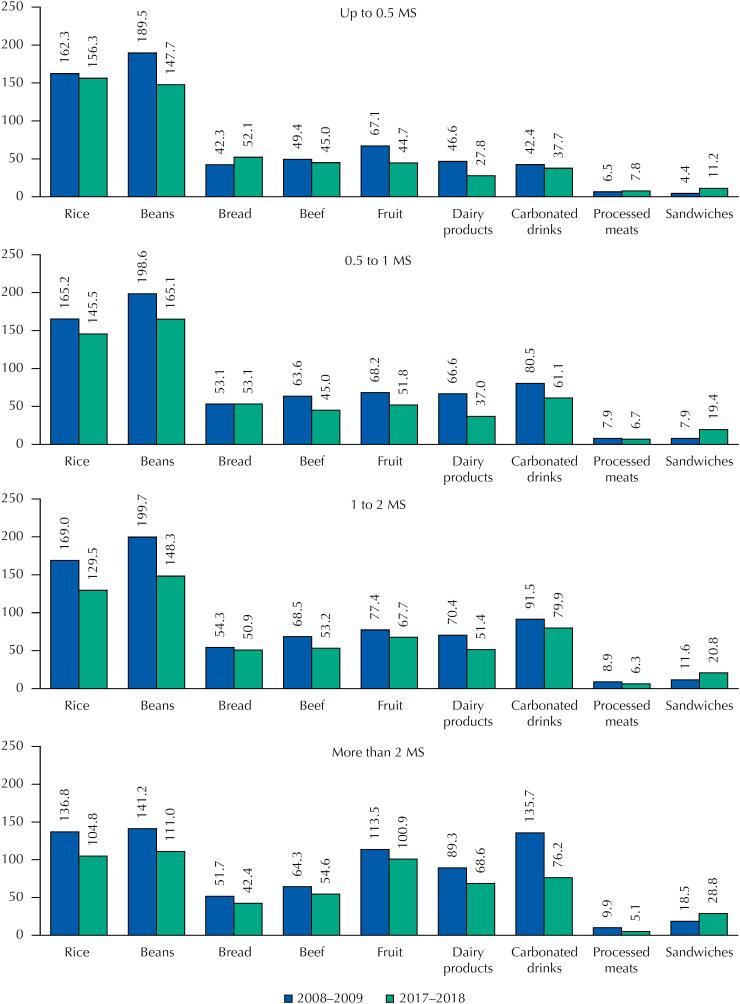
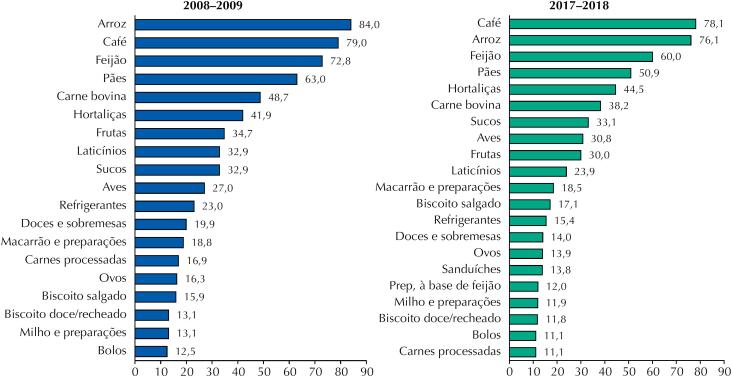
Rice, beans, coffee, bread, vegetables and beef remained the staple Brazilian diet, ranking as the six most consumed items in both surveys. Ultra-processed foods such as sweet/stuffed cookies, savory cookies, processed meats and carbonated drinks also remained among the 20 most consumed foods. Trend analyses showed, regardless of gender, age and income range, a decrease in the consumption of rice, beans, beef, bread, fruit, milk and dairy, processed meats and carbonated drinks, and an increase in the consumption of sandwiches.
The Brazilian diet is still characterized by consumption of traditional foods, such as rice and beans, and by high frequency of consumption of ultra-processed foods, such as cookies and carbonated drinks. However, between the years of 2008-2009 and 20172018, there was a decrease in the consumption of rice, beans, beef, bread, fruit, milk and dairy, processed meats and carbonated drinks, but an increase in the consumption of sandwiches. The results show a decrease in quality in the Brazilian diet.
描述 2008-2009 年至 2017-2018 年巴西人口的食物消费演变。
使用 2008-2009 年和 2017-2018 年国家饮食调查的数据。这两项调查均估计了 10 岁及以上个体两天的非连续食物消费。第一项调查通过食物记录收集了 34003 名个体的消费数据;第二项调查通过 24 小时回忆收集了 46164 名个体的数据。确定了这两项调查中报告频率最高的二十种食物组。根据性别、年龄和收入估计了这两项调查中每种食物组的消费概率。本研究介绍了在这两项调查中消费频率变化幅度在 5%或以上的食物。使用国家癌症研究所开发的方法,对个体内变异性进行校正后,对消费概率进行了校正。
大米、豆类、咖啡、面包、蔬菜和牛肉仍然是巴西饮食的主食,在这两项调查中均排名前六。超加工食品,如甜/夹心饼干、咸饼干、加工肉类和碳酸饮料,也仍然是消费最多的 20 种食物之一。趋势分析表明,无论性别、年龄和收入范围如何,大米、豆类、牛肉、面包、水果、牛奶和奶制品、加工肉类和碳酸饮料的消费均呈下降趋势,而三明治的消费则呈上升趋势。
巴西饮食仍然以传统食物(如大米和豆类)为主,超加工食品(如饼干和碳酸饮料)的消费频率也很高。然而,在 2008-2009 年至 2017-2018 年期间,大米、豆类、牛肉、面包、水果、牛奶和奶制品、加工肉类和碳酸饮料的消费呈下降趋势,但三明治的消费呈上升趋势。结果表明巴西饮食的质量有所下降。