College of Veterinary Medicine and Institute of Veterinary Science, Kangwon National University, Chuncheon, Gangwon, 24341, Republic of Korea.
Department of Pathology, University of Michigan School of Medicine, Ann Arbor, MI, 48109, USA.
Exp Mol Med. 2021 Dec;53(12):1821-1833. doi: 10.1038/s12276-021-00703-x. Epub 2021 Dec 2.
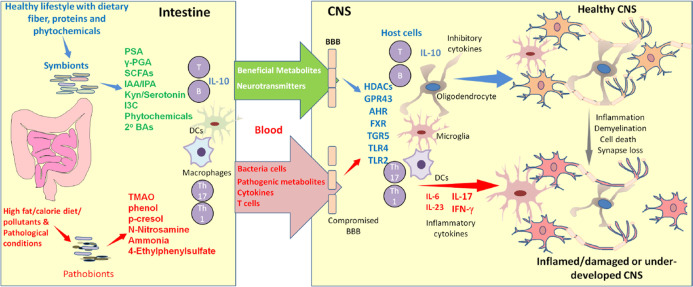
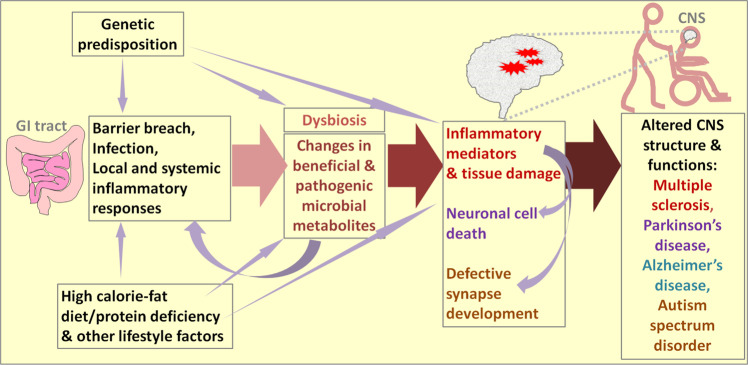
The gut is connected to the CNS by immunological mediators, lymphocytes, neurotransmitters, microbes and microbial metabolites. A mounting body of evidence indicates that the microbiome exerts significant effects on immune cells and CNS cells. These effects frequently result in the suppression or exacerbation of inflammatory responses, the latter of which can lead to severe tissue damage, altered synapse formation and disrupted maintenance of the CNS. Herein, we review recent progress in research on the microbial regulation of CNS diseases with a focus on major gut microbial metabolites, such as short-chain fatty acids, tryptophan metabolites, and secondary bile acids. Pathological changes in the CNS are associated with dysbiosis and altered levels of microbial metabolites, which can further exacerbate various neurological disorders. The cellular and molecular mechanisms by which these gut microbial metabolites regulate inflammatory diseases in the CNS are discussed. We highlight the similarities and differences in the impact on four major CNS diseases, i.e., multiple sclerosis, Parkinson's disease, Alzheimer's disease, and autism spectrum disorder, to identify common cellular and molecular networks governing the regulation of cellular constituents and pathogenesis in the CNS by microbial metabolites.
肠道通过免疫介质、淋巴细胞、神经递质、微生物和微生物代谢物与中枢神经系统相连。越来越多的证据表明,微生物组对免疫细胞和中枢神经系统细胞有显著影响。这些影响通常导致炎症反应的抑制或加剧,后者可导致严重的组织损伤、突触形成改变和中枢神经系统维持紊乱。本文重点综述了近年来关于微生物调节中枢神经系统疾病的研究进展,包括主要的肠道微生物代谢物,如短链脂肪酸、色氨酸代谢物和次级胆汁酸。中枢神经系统的病理变化与微生物失调和微生物代谢物水平改变有关,这可能进一步加重各种神经疾病。本文讨论了这些肠道微生物代谢物调节中枢神经系统炎症性疾病的细胞和分子机制。我们强调了四大中枢神经系统疾病(多发性硬化症、帕金森病、阿尔茨海默病和自闭症谱系障碍)的影响的异同,以确定微生物代谢物调控中枢神经系统细胞成分和发病机制的常见细胞和分子网络。