Tague Jessica G, Regmi Abish, Gregory Gwendolyn J, Boyd E Fidelma
Department of Biological Sciences, University of Delaware, Newark, DE, United States.
Front Microbiol. 2021 Oct 25;12:669447. doi: 10.3389/fmicb.2021.669447. eCollection 2021.
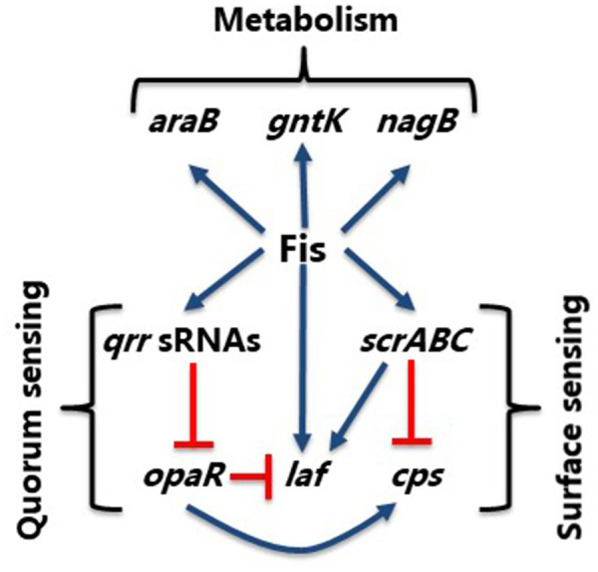
Factor for inversion stimulation (Fis) is a global regulator that is highly expressed during exponential phase growth and undetectable in stationary phase growth. Quorum sensing (QS) is a global regulatory mechanism that controls gene expression in response to changes in cell density and growth phase. In , a marine species and a significant human pathogen, the QS regulatory sRNAs, Qrr1 to Qrr5, are expressed during exponential growth and negatively regulate the high cell density QS master regulator OpaR. OpaR is a positive regulator of capsule polysaccharide (CPS) formation, which is required for biofilm formation, and is a repressor of lateral flagella required for swarming motility. In , we show that Fis is a positive regulator of the sRNAs expression. In an in-frame deletion mutant, expression was repressed and expression was induced. The Δ mutant produced CPS and biofilm, but swarming motility was abolished. Also, the deletion mutant was more sensitive to polymyxin B. Swarming motility requires expression of both the surface sensing operon and lateral flagella operon. Our data showed that in the Δ mutant both and genes were repressed. Fis controlled swarming motility indirectly through the QS pathway and directly through the surface sensing pathway. To determine the effects of Fis on cellular metabolism, we performed growth competition assays, and found that Δ was outcompeted by wild type in minimal media supplemented with intestinal mucus as a sole nutrient source. The data showed that Fis positively modulated mucus components L-arabinose, D-gluconate and N-acetyl-D-glucosamine catabolism gene expression. In an colonization competition assay, Δ was outcompeted by wild type, indicating Fis is required for fitness. Overall, these data demonstrate a global regulatory role for Fis in that includes QS, motility, and metabolism.
反向刺激因子(Fis)是一种全局调节因子,在指数生长期高表达,而在稳定期不可检测。群体感应(QS)是一种全局调节机制,可根据细胞密度和生长阶段的变化控制基因表达。在一种海洋物种及重要的人类病原体(文中未提及具体物种名称)中,群体感应调节性小RNA(sRNA)Qrr1至Qrr5在指数生长期表达,并对高细胞密度群体感应主调节因子OpaR起负调节作用。OpaR是荚膜多糖(CPS)形成的正调节因子,CPS形成是生物膜形成所必需的,且OpaR是群体游动所需的侧生鞭毛的阻遏物。在(文中未提及具体物种名称)中,我们表明Fis是sRNA表达的正调节因子。在一个框内缺失突变体中,(文中未提及具体基因名称)表达受到抑制,(文中未提及具体基因名称)表达被诱导。Δ突变体产生CPS和生物膜,但群体游动能力丧失。此外,缺失突变体对多粘菌素B更敏感。群体游动需要表面感应(文中未提及具体操纵子名称)操纵子和侧生鞭毛(文中未提及具体操纵子名称)操纵子的表达。我们的数据表明,在Δ突变体中,(文中未提及具体基因名称)和(文中未提及具体基因名称)基因均受到抑制。Fis通过群体感应途径间接控制群体游动能力,并通过表面感应途径直接控制。为了确定Fis对细胞代谢的影响,我们进行了生长竞争试验,发现在以肠黏液作为唯一营养源补充的基本培养基中,Δ被野生型淘汰。数据表明,Fis正向调节黏液成分L-阿拉伯糖、D-葡萄糖酸盐和N-乙酰-D-葡萄糖胺分解代谢基因的表达。在(文中未提及具体物种名称)定殖竞争试验中,Δ被野生型淘汰,表明Fis是适应性所必需的。总体而言,这些数据证明了Fis在(文中未提及具体物种名称)中的全局调节作用,包括群体感应(QS)、运动性和代谢。