Schueler Katja, Fritz Jessica, Dorfschmidt Lena, van Harmelen Anne-Laura, Stroemer Eike, Wessa Michèle
Department of Clinical Psychology and Neuropsychology, Institute of Psychology, Johannes Gutenberg-University of Mainz, Mainz, Germany.
Medical Informatics Group, University Hospital of Frankfurt, Frankfurt, Germany.
Front Psychiatry. 2021 Nov 17;12:736147. doi: 10.3389/fpsyt.2021.736147. eCollection 2021.
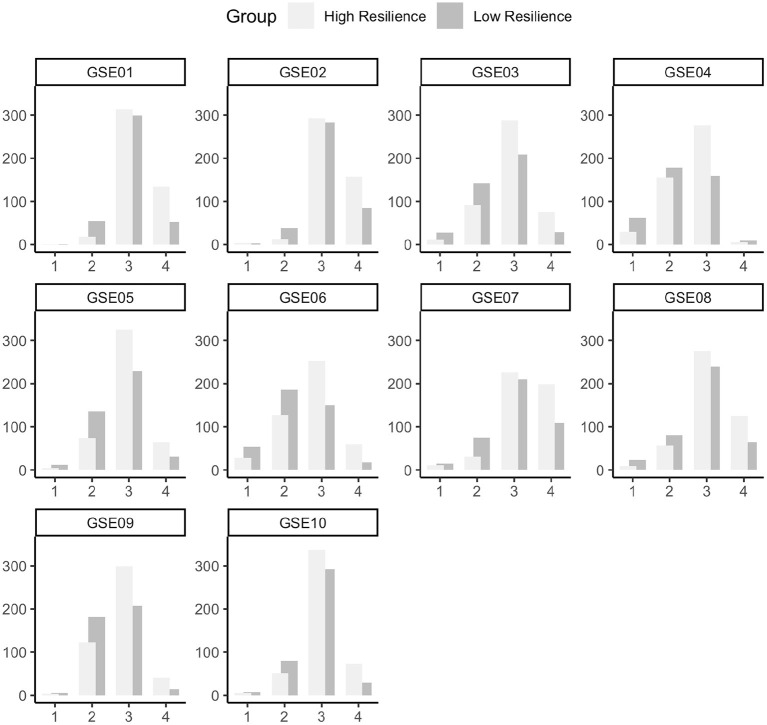
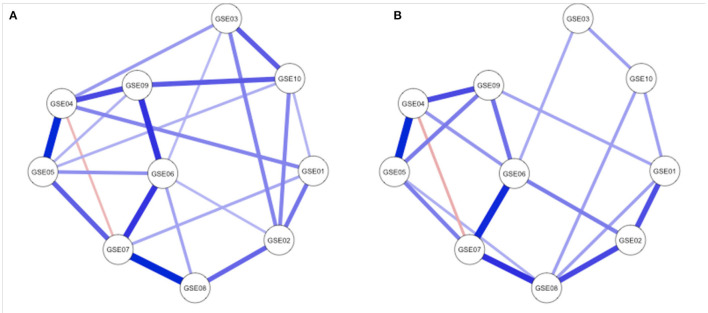
Resilience to stress has gained increasing interest by researchers from the field of mental health and illness and some recent studies have investigated resilience from a network perspective. General self-efficacy constitutes an important resilience factor. High levels of self-efficacy have shown to promote resilience by serving as a stress buffer. However, little is known about the role of network connectivity of self-efficacy in the context of stress resilience. The present study aims at filling this gap by using psychological network analysis to study self-efficacy and resilience. Based on individual resilient functioning scores, we divided a sample of 875 mentally healthy adults into a high and low resilient functioning group. To compute these scores, we applied a novel approach based on Partial Least Squares Regression on self-reported stress and mental health measures. Separately for both groups, we then estimated regularized partial correlation networks of a ten-item self-efficacy questionnaire. We compared three different global connectivity measures-strength, expected influence, and shortest path length-as well as absolute levels of self-efficacy between the groups. Our results supported our hypothesis that stronger network connectivity of self-efficacy would be present in the highly resilient functioning group compared to the low resilient functioning group. In addition, the former showed higher absolute levels of general self-efficacy. Future research could consider using partial least squares regression to quantify resilient functioning to stress and to study the association between network connectivity and resilient functioning in other resilience factors.
心理韧性在心理健康与疾病领域越来越受到研究者的关注,近期一些研究从网络视角对心理韧性进行了探究。一般自我效能感是心理韧性的一个重要因素。高水平的自我效能感已被证明可作为压力缓冲器来促进心理韧性。然而,在压力韧性的背景下,自我效能感的网络连通性所起的作用却鲜为人知。本研究旨在通过运用心理网络分析来研究自我效能感和心理韧性,以填补这一空白。基于个体的韧性功能得分,我们将875名心理健康的成年人样本分为高韧性功能组和低韧性功能组。为计算这些得分,我们应用了一种基于偏最小二乘回归的新方法,该方法用于自我报告的压力和心理健康测量。然后,我们分别为两组估计了一份十项自我效能感问卷的正则化偏相关网络。我们比较了三种不同的全局连通性指标——强度、预期影响力和最短路径长度——以及两组之间自我效能感的绝对水平。我们的结果支持了我们的假设,即与低韧性功能组相比,高韧性功能组中自我效能感的网络连通性更强。此外,前者的一般自我效能感绝对水平更高。未来的研究可以考虑使用偏最小二乘回归来量化对压力的韧性功能,并研究网络连通性与其他韧性因素中韧性功能之间的关联。