Department of Dermatology, Beijing Chaoyang Hospital, Capital Medical University, Beijing, China.
China CDC Key Laboratory of Radiological Protection and Nuclear Emergency, National Institute for Radiological Protection, China Centers for Disease Control, Beijing, China.
Front Immunol. 2021 Nov 18;12:790125. doi: 10.3389/fimmu.2021.790125. eCollection 2021.
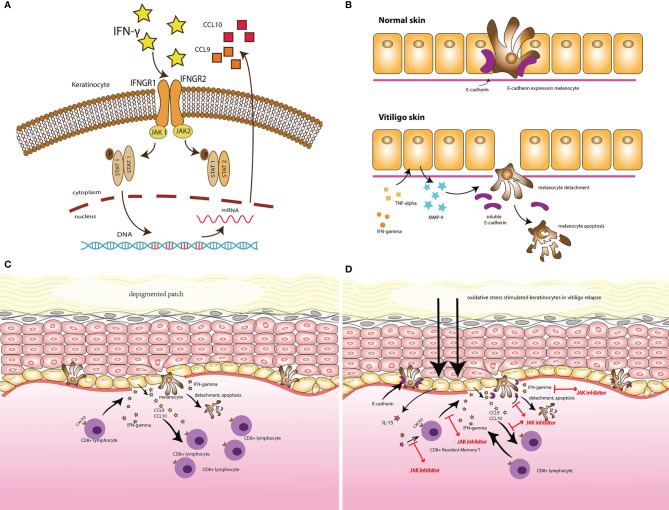
Vitiligo is a multifactorial reversible skin disorder characterized by distinct white patches that result from melanocyte destruction. Activated CXCR3 CD8 T cells promote melanocyte detachment and apoptosis through interferon-gamma (IFN-γ secretion and chemokines secreted by keratinocytes through the Janus kinase (JAK)/signal transducer and activator of transcription (STAT)-1 signaling pathway results in further recruitment of CXCR3 CD8 T cells and the formation of a positive-feedback loop. JAK inhibitors target the JAK/STAT pathway and are now approved to treat many immune-related diseases. In the treatment of vitiligo, JAK inhibitors, including ruxolitinib, baricitinib, and tofacitinib, are effective, supporting the implication of the IFN-γ-chemokine signaling axis in the pathogenesis of vitiligo. However, more studies are required to determine the ideal dosage of JAK inhibitors for the treatment of vitiligo, and to identify other inflammatory pathways that may be implicated in the pathogenesis of this condition.
白癜风是一种多因素可逆性皮肤疾病,其特征是明显的白色斑块,由黑素细胞破坏引起。激活的 CXCR3 CD8 T 细胞通过干扰素-γ(IFN-γ)分泌和角质形成细胞通过 Janus 激酶(JAK)/信号转导和转录激活物(STAT)-1 信号通路分泌的趋化因子促进黑素细胞脱离和凋亡,导致更多的 CXCR3 CD8 T 细胞募集和正反馈环的形成。JAK 抑制剂靶向 JAK/STAT 通路,现已批准用于治疗许多免疫相关疾病。在白癜风的治疗中,JAK 抑制剂,包括鲁索利替尼、巴瑞替尼和托法替尼,是有效的,支持 IFN-γ-趋化因子信号轴在白癜风发病机制中的作用。然而,还需要更多的研究来确定 JAK 抑制剂治疗白癜风的理想剂量,并确定其他可能参与该疾病发病机制的炎症途径。