Migayron Laure, Boniface Katia, Seneschal Julien
University of Bordeaux, INSERM, BMGIC, U1035, 33000, Bordeaux, France.
R&D Department, SILAB, Brive-la-Gaillarde, France.
Dermatol Ther (Heidelb). 2020 Dec;10(6):1185-1198. doi: 10.1007/s13555-020-00447-y. Epub 2020 Sep 19.
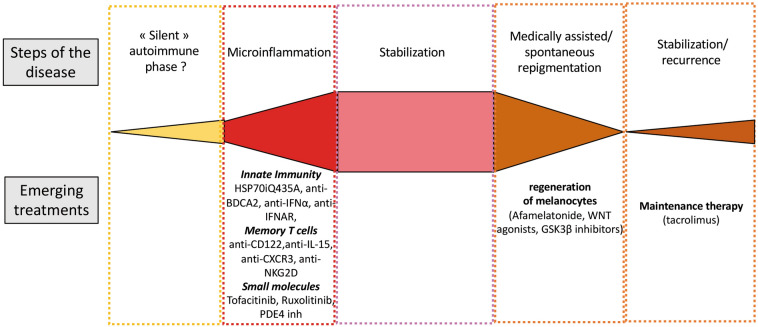
Vitiligo is a chronic inflammatory skin disease leading to the loss of epidermal melanocytes. To date, treatment options for vitiligo patients are limited, lack sustained efficacy, and are mainly based on off-label use of immunosuppressive agents, such as systemic or topical steroids or topical calcineurin inhibitors, in association with the use of ultraviolet light. However, recent insights into the understanding of the immune pathogenesis of the disease have led to the identification of several therapeutic targets and the development of targeted therapies that are now being tested in clinical trials. In this review, based on the physiopathology of the disease, we summarize emerging targets that could be developed for the treatment of vitiligo and discuss recent and ongoing developments of drugs for the management of the disease.
白癜风是一种导致表皮黑素细胞丧失的慢性炎症性皮肤病。迄今为止,白癜风患者的治疗选择有限,缺乏持续疗效,且主要基于免疫抑制剂的非标签使用,如全身性或局部性类固醇或局部钙调神经磷酸酶抑制剂,并联合使用紫外线。然而,最近对该疾病免疫发病机制的深入了解已导致确定了几个治疗靶点,并开发了目前正在临床试验中进行测试的靶向疗法。在本综述中,基于该疾病的生理病理学,我们总结了可用于治疗白癜风的新兴靶点,并讨论了该疾病治疗药物的最新及正在进行的进展。