Jeong Minjin, Ocwieja Karen E, Han Dongjun, Wackym P Ashley, Zhang Yichen, Brown Alyssa, Moncada Cynthia, Vambutas Andrea, Kanne Theodore, Crain Rachel, Siegel Noah, Leger Valerie, Santos Felipe, Welling D Bradley, Gehrke Lee, Stankovic Konstantina M
Department of Otolaryngology-Head and Neck Surgery, Harvard Medical School, Boston, MA USA.
Eaton Peabody Laboratories and Department of Otolaryngology-Head and Neck Surgery, Massachusetts Eye and Ear, Boston, MA USA.
Commun Med (Lond). 2021;1(1):44. doi: 10.1038/s43856-021-00044-w. Epub 2021 Oct 29.
COVID-19 is a pandemic respiratory and vascular disease caused by SARS-CoV-2 virus. There is a growing number of sensory deficits associated with COVID-19 and molecular mechanisms underlying these deficits are incompletely understood.
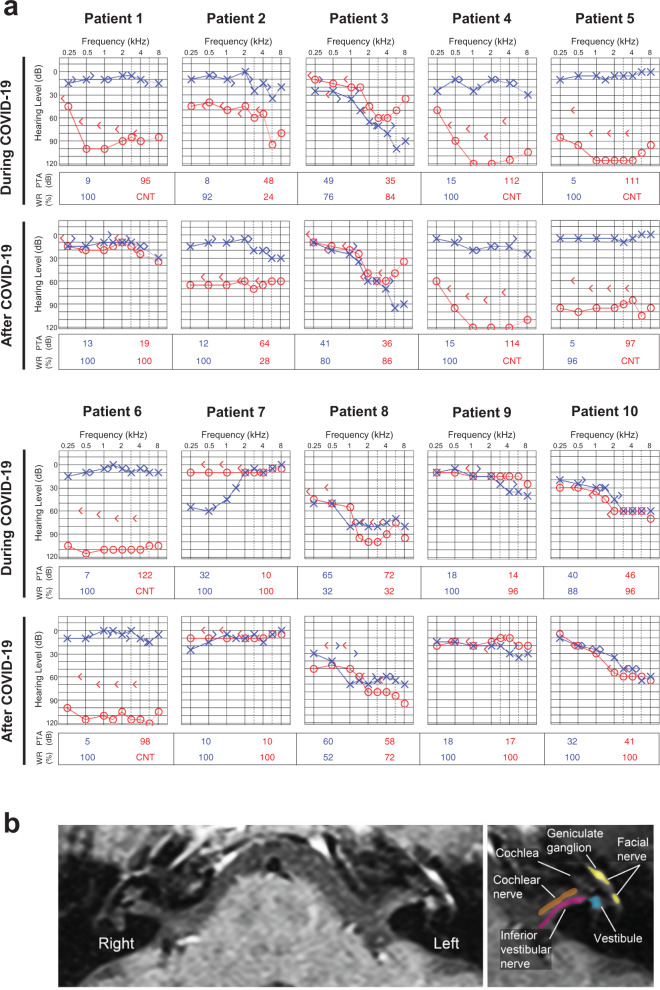
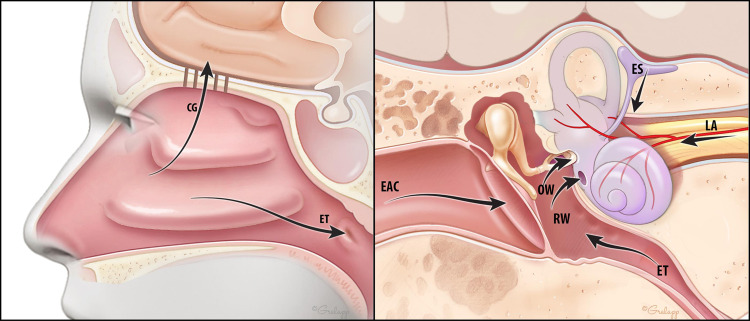
We report a series of ten COVID-19 patients with audiovestibular symptoms such as hearing loss, vestibular dysfunction and tinnitus. To investigate the causal relationship between SARS-CoV-2 and audiovestibular dysfunction, we examine human inner ear tissue, human inner ear in vitro cellular models, and mouse inner ear tissue.
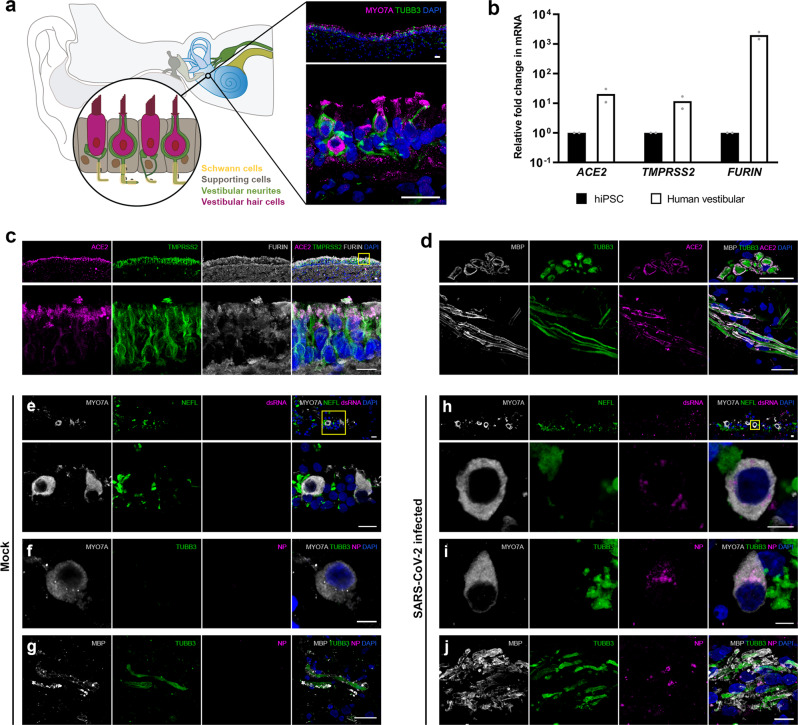
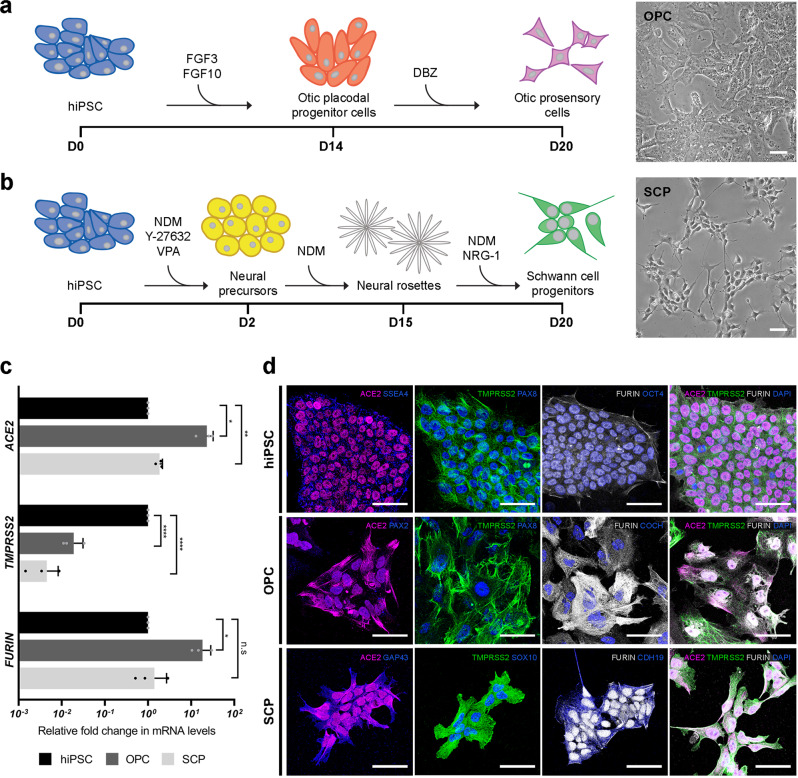
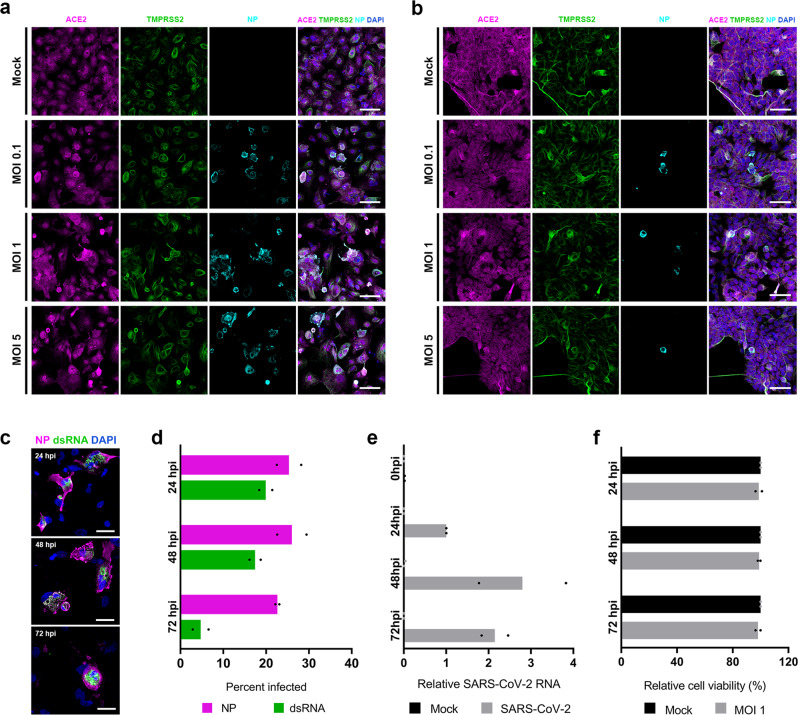
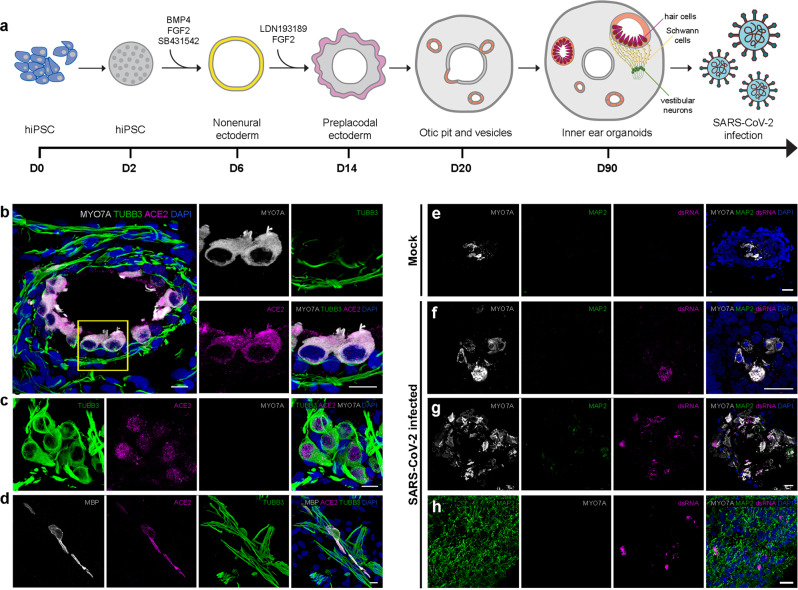
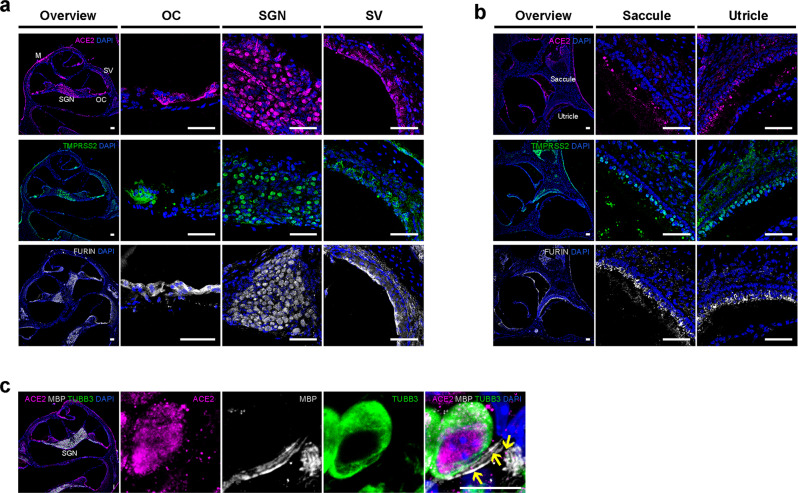
We demonstrate that adult human inner ear tissue co-expresses the angiotensin-converting enzyme 2 (ACE2) receptor for SARS-CoV-2 virus, and the transmembrane protease serine 2 (TMPRSS2) and FURIN cofactors required for virus entry. Furthermore, hair cells and Schwann cells in explanted human vestibular tissue can be infected by SARS-CoV-2, as demonstrated by confocal microscopy. We establish three human induced pluripotent stem cell (hiPSC)-derived in vitro models of the inner ear for infection: two-dimensional otic prosensory cells (OPCs) and Schwann cell precursors (SCPs), and three-dimensional inner ear organoids. Both OPCs and SCPs express ACE2, TMPRSS2, and FURIN, with lower ACE2 and FURIN expression in SCPs. OPCs are permissive to SARS-CoV-2 infection; lower infection rates exist in isogenic SCPs. The inner ear organoids show that hair cells express ACE2 and are targets for SARS-CoV-2.
Our results provide mechanistic explanations of audiovestibular dysfunction in COVID-19 patients and introduce hiPSC-derived systems for studying infectious human otologic disease.
新型冠状病毒肺炎(COVID-19)是由严重急性呼吸综合征冠状病毒2(SARS-CoV-2)引起的一种大流行性呼吸道和血管疾病。与COVID-19相关的感觉缺陷越来越多,而这些缺陷背后的分子机制尚未完全明确。
我们报告了一系列10例有听觉前庭症状(如听力损失、前庭功能障碍和耳鸣)的COVID-19患者。为了研究SARS-CoV-2与听觉前庭功能障碍之间的因果关系,我们检查了人类内耳组织、人类内耳体外细胞模型和小鼠内耳组织。
我们证明,成人人类内耳组织共表达SARS-CoV-2病毒的血管紧张素转换酶2(ACE2)受体,以及病毒进入所需的跨膜蛋白酶丝氨酸2(TMPRSS2)和弗林蛋白酶(FURIN)辅助因子。此外,共聚焦显微镜显示,移植的人类前庭组织中的毛细胞和施万细胞可被SARS-CoV-2感染。我们建立了三种用于感染的人类诱导多能干细胞(hiPSC)来源的内耳体外模型:二维耳前体细胞(OPC)和施万细胞前体(SCP),以及三维内耳类器官。OPC和SCP均表达ACE2、TMPRSS2和FURIN,SCP中ACE2和FURIN的表达较低。OPC对SARS-CoV-2感染敏感;同基因SCP中的感染率较低。内耳类器官显示毛细胞表达ACE2,是SARS-CoV-2的靶标。
我们的结果为COVID-19患者听觉前庭功能障碍提供了机制解释,并引入了用于研究人类感染性耳科疾病的hiPSC衍生系统。