Department of Civil & Environmental Engineering, University of Washington, Seattle, Washington, USA.
Department of Epidemiology, University of Washington, Seattle, Washington, USA.
Environ Health Perspect. 2021 Dec;129(12):127005. doi: 10.1289/EHP8584. Epub 2021 Dec 15.
Few studies have investigated air pollution exposure disparities by race/ethnicity and income across criteria air pollutants, locations, or time.
The objective of this study was to quantify exposure disparities by race/ethnicity and income throughout the contiguous United States for six criteria air pollutants, during the period 1990 to 2010.
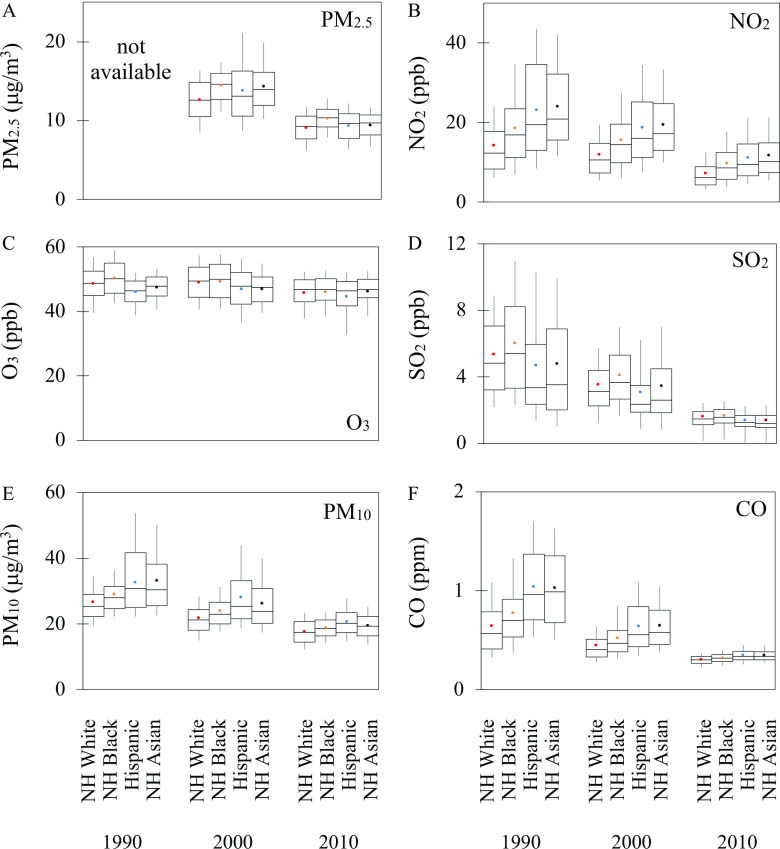
We quantified exposure disparities among racial/ethnic groups (non-Hispanic White, non-Hispanic Black, Hispanic (any race), non-Hispanic Asian) and by income for multiple spatial units (contiguous United States, states, urban vs. rural areas) and years (1990, 2000, 2010) for carbon monoxide (CO), nitrogen dioxide (), ozone (), particulate matter with aerodynamic diameter (; excluding year-1990), particulate matter with aerodynamic diameter (), and sulfur dioxide (). We used census data for demographic information and a national empirical model for ambient air pollution levels.
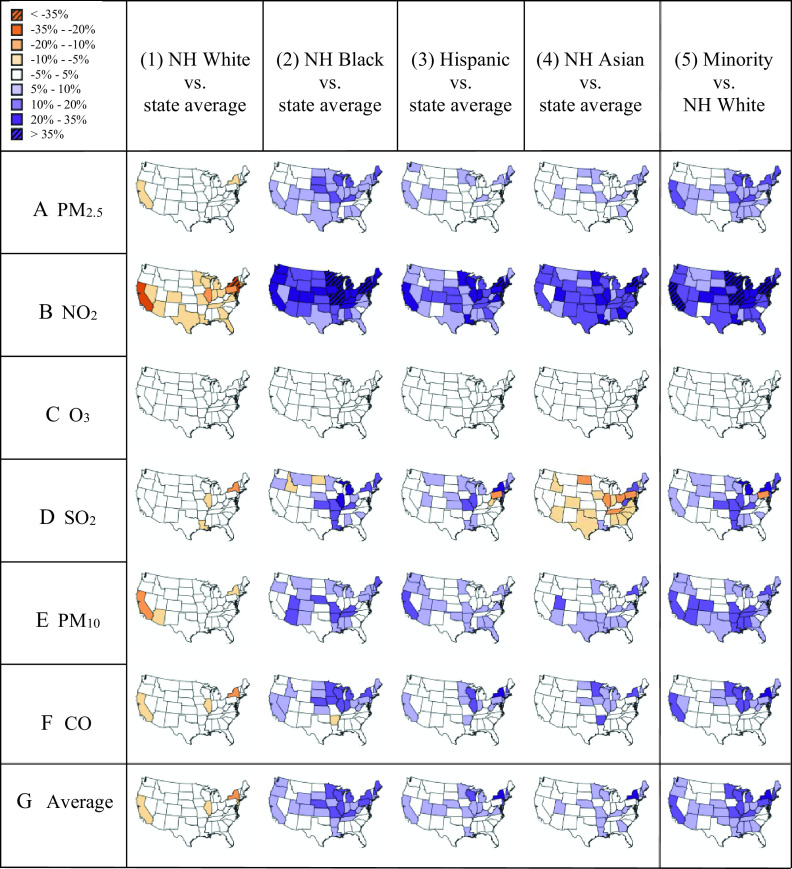
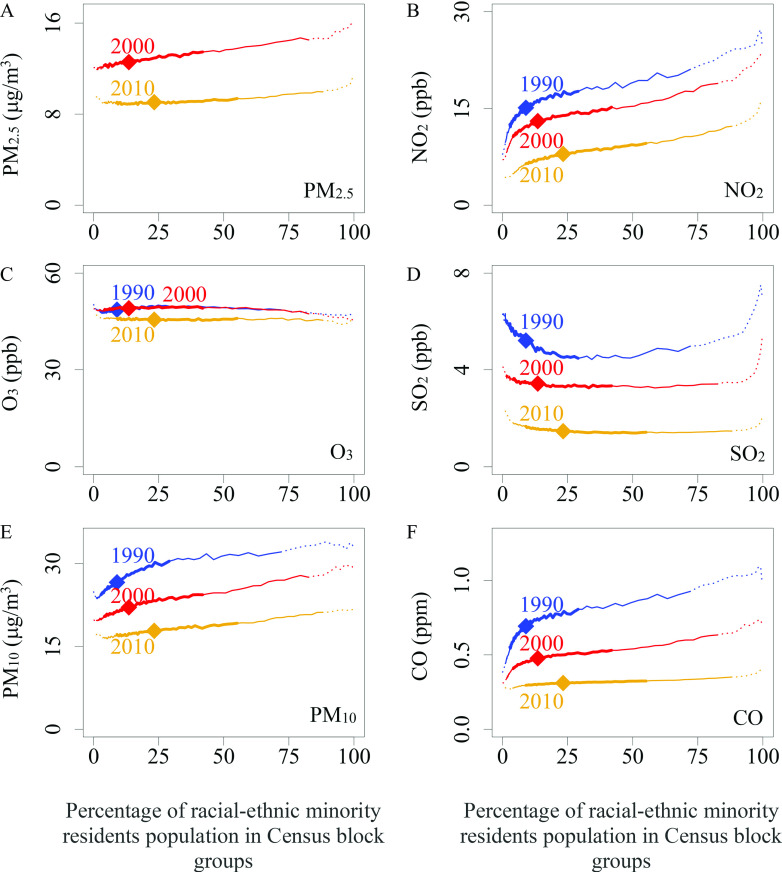
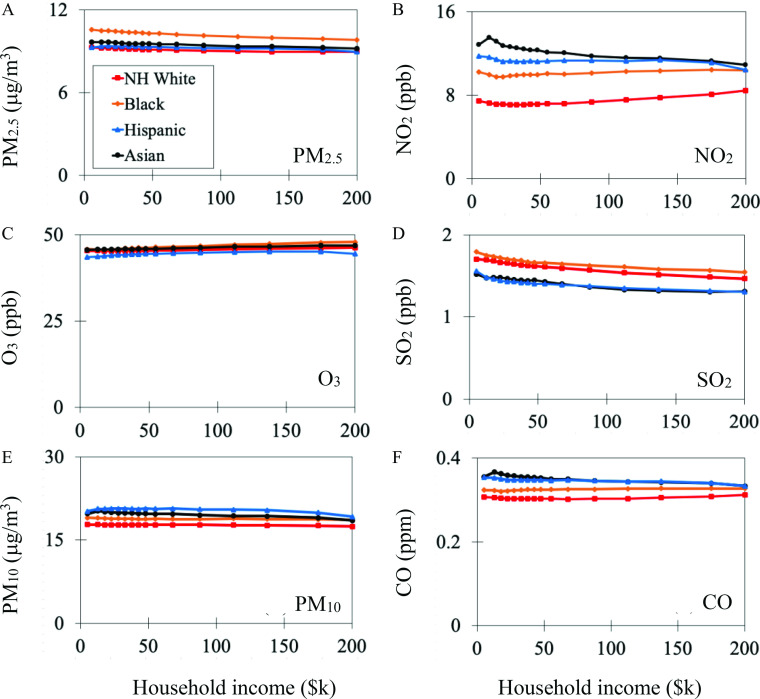
For all years and pollutants, the racial/ethnic group with the highest national average exposure was a racial/ethnic minority group. In 2010, the disparity between the racial/ethnic group with the highest vs. lowest national-average exposure was largest for [54% ()], smallest for [3.6% ()], and intermediate for the remaining pollutants (13%-19%). The disparities varied by U.S. state; for example, for in 2010, exposures were at least 5% higher than average in 63% of states for non-Hispanic Black populations; in 33% and 26% of states for Hispanic and for non-Hispanic Asian populations, respectively; and in no states for non-Hispanic White populations. Absolute exposure disparities were larger among racial/ethnic groups than among income categories (range among pollutants: between 1.1 and 21 times larger). Over the period studied, national absolute racialethnic exposure disparities declined by between 35% (; ) and 88% (; CO); relative disparities declined to between (; i.e., nearly zero change) and (CO; i.e., a reduction).
As air pollution concentrations declined during the period 1990 to 2010, absolute (and to a lesser extent, relative) racial/ethnic exposure disparities also declined. However, in 2010, racial/ethnic exposure disparities remained across income levels, in urban and rural areas, and in all states, for multiple pollutants. https://doi.org/10.1289/EHP8584.
很少有研究调查过按种族/族裔和收入划分的各种标准空气污染物、地点或时间的空气污染暴露差异。
本研究的目的是量化 1990 年至 2010 年间美国各地六个标准空气污染物的种族/族裔和收入的暴露差异。
我们根据多种空间单位(美国大陆、州、城市与农村地区)和年份(1990 年、2000 年、2010 年),对非西班牙裔白人、非西班牙裔黑人、西班牙裔(任何种族)、非西班牙裔亚裔等种族/族裔群体和收入水平的一氧化碳(CO)、二氧化氮()、臭氧()、空气动力学直径 (不包括 1990 年)的颗粒物()、空气动力学直径 的颗粒物()和二氧化硫()的暴露差异进行了量化。我们使用人口普查数据获取人口统计信息,并使用国家大气污染水平经验模型。
在所有年份和污染物中,全国平均暴露水平最高的种族/族裔群体是少数民族群体。2010 年,种族/族裔群体之间的暴露差异最大,最高组与最低组的差异最大,为 54%(),最小的为 3.6%(),其余污染物(13%-19%)介于两者之间。差异因美国各州而异;例如,2010 年,在非西班牙裔黑人人口中,有 63%的州的 暴露水平至少比平均水平高出 5%;在西班牙裔和非西班牙裔亚裔人口中,分别有 33%和 26%的州的暴露水平比平均水平高出 5%;而在非西班牙裔白人人口中,没有一个州的暴露水平比平均水平高出 5%。与收入类别相比,种族/族裔群体之间的绝对暴露差异更大(污染物范围:1.1 到 21 倍)。在研究期间,全国绝对种族/族裔暴露差异下降了 35%()至 88%(CO);相对差异下降到 (即几乎没有变化)至 (CO;即减少了 )。
1990 年至 2010 年间,随着空气污染浓度的下降,绝对(相对)种族/族裔暴露差异也有所下降。然而,2010 年,多种污染物在所有州的城市和农村地区,在不同收入水平上,种族/族裔的暴露差异仍然存在。https://doi.org/10.1289/EHP8584.