de Waard Sheryl, van der Vis Jacqueline, Venema Pascale A H T, Sierevelt Inger N, Kerkhoffs Gino M M J, Haverkamp Daniël
Specialized Centre of Othopedic Research & Education (SCORE) and Xpert Orthopedie, Amsterdam, Netherlands.
Academic Medical Centre (AMC), Amsterdam, Netherlands.
EFORT Open Rev. 2021 Nov 19;6(11):1040-1051. doi: 10.1302/2058-5241.6.210030. eCollection 2021 Nov.
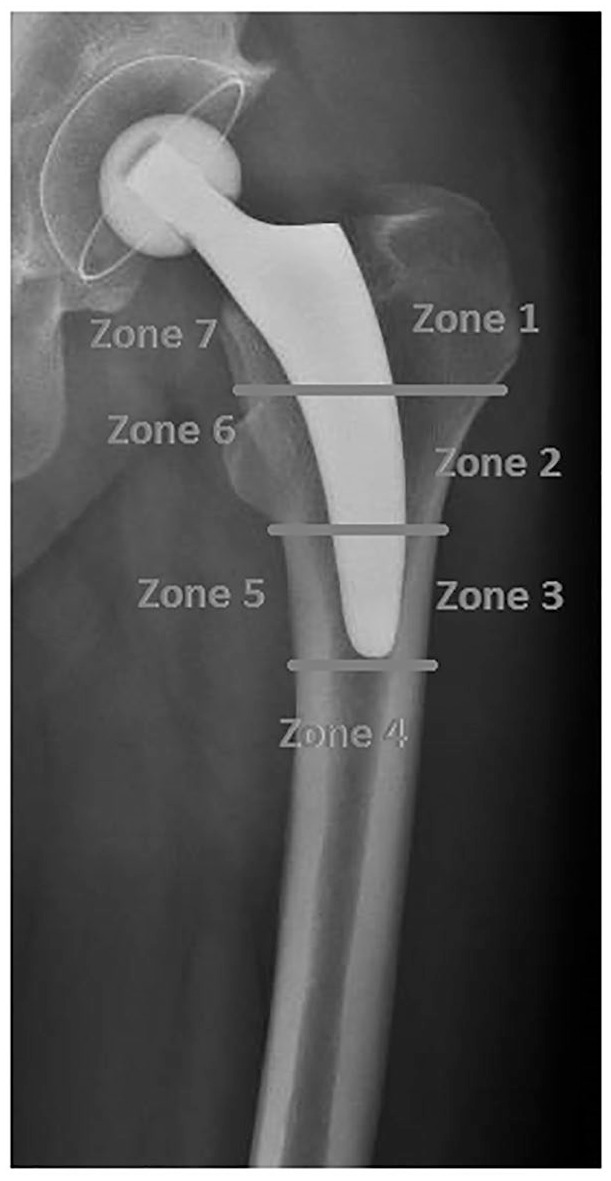
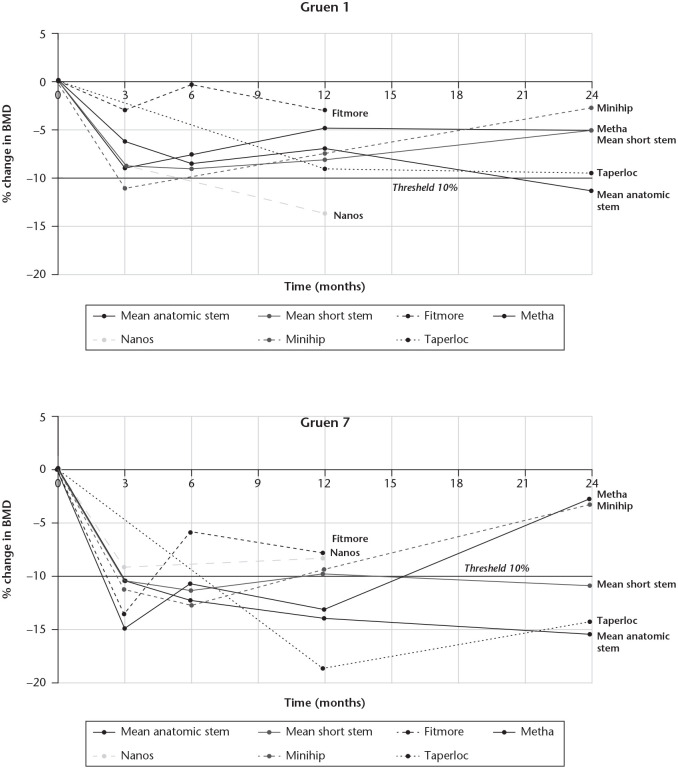
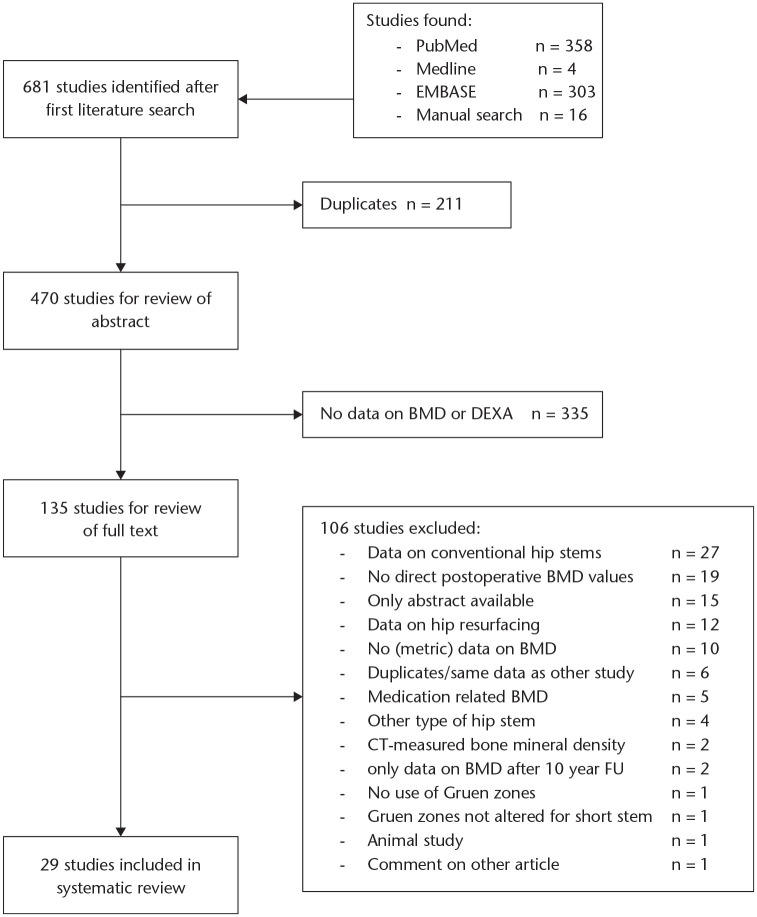
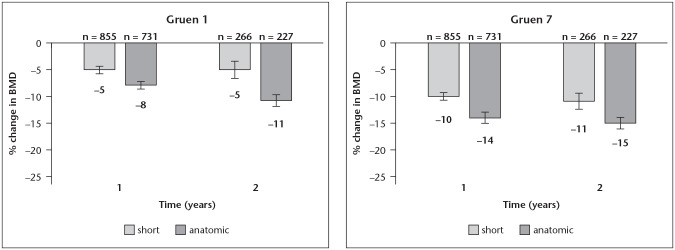
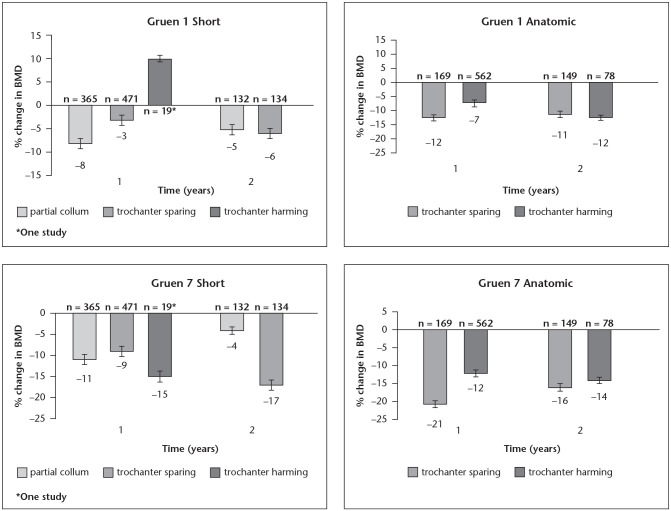
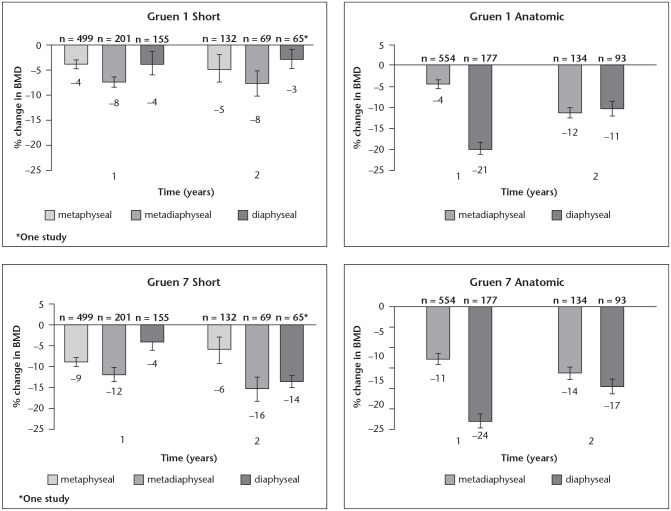
Total hip arthroplasty is performed more frequently in younger patients nowadays, making long-term bone stock preservation an important topic. A mechanism for late implant failure is periprosthetic bone loss, caused by stress shielding around the hip stem due to different load distribution. Short stems are designed to keep the physical loading in the proximal part of the femur to reduce stress shielding. The aim of this review is to give more insight into how short and anatomic stems behave and whether they succeed in preservation of proximal bone stock.A systematic literature search was performed to find all published studies on bone mineral density in short and anatomic hip stems. Results on periprosthetic femoral bone mineral density, measured with dual-energy X-ray absorptiometry (DEXA), were compiled and analysed per Gruen zone in percentual change.A total of 29 studies were included. In short stems, Gruen 1 showed bone loss of 5% after one year ( = 855) and 5% after two years ( = 266). Gruen 7 showed bone loss of 10% after one year and -11% after two years. In anatomic stems, Gruen 1 showed bone loss of 8% after one year ( = 731) and 11% after two years ( = 227). Gruen 7 showed bone loss of 14% after one year and 15% after two years.Short stems are capable of preserving proximal bone stock and have slightly less proximal bone loss in the first years, compared to anatomic stems. Cite this article: 2021;6:1040-1051. DOI: 10.1302/2058-5241.6.210030.
如今,全髋关节置换术在年轻患者中更为常见,这使得长期保留骨量成为一个重要课题。假体周围骨丢失是假体晚期失败的一种机制,其由髋关节柄周围因负荷分布不同导致的应力遮挡引起。短柄假体旨在保持股骨近端的物理负荷,以减少应力遮挡。本综述的目的是更深入了解短柄和解剖型柄的表现,以及它们是否成功保留近端骨量。进行了系统的文献检索,以查找所有已发表的关于短柄和解剖型髋关节柄骨密度的研究。采用双能X线吸收法(DEXA)测量假体周围股骨骨密度的结果,按Gruen分区以百分比变化进行汇总和分析。共纳入29项研究。在短柄假体中,Gruen 1区在1年后骨丢失5%(n = 855),2年后骨丢失5%(n = 266)。Gruen 7区在1年后骨丢失10%,2年后骨丢失 -11%。在解剖型柄中,Gruen 1区在1年后骨丢失8%(n = 731),2年后骨丢失11%(n = 227)。Gruen 7区在1年后骨丢失14%,2年后骨丢失15%。与解剖型柄相比,短柄假体能够保留近端骨量,且在最初几年近端骨丢失略少。引用本文:2021;6:1040 - 1051。DOI:10.1302/2058 - 5241.6.210030。